Sunday, 30 August 2015

Snooping around the Old Forde House

In the market town of Newton Abbot, a stone's throw from the A380 and the Penn Inn roundabout, sits a grand old jewel of a house. Everybody in town knows of it, and each day thousands watch it pass by their car windows, probably with nonchalance.  Separated from the roadside by a generous green, upon which local dog walkers and ramblers will stroll gently under its shadow, with a stately air and granite-grey facade, lies arguably the town's most well-known landmark, our beloved Forde House.

Forde House's wood-paneled entrance hall 

Many years ago, as a little eight-year-old, I paid a visit here on a school trip examining the Tudors and Stuarts.  Today, for the first time in 22 years, I passed through its front door once again, Teignbridge District Council (owners and occupiers since 1978) having begun, last year, a series of summer open days.  The history of the house can be dated back to the 13th century, although in its present form, the house is around 400 years old, remodelled in 1610 into its familiar Jacobean appearance.  Built in the shape of an E, as were several manor houses of the age, it is said to have been a tribute to Queen Elizabeth I, although Her Majesty died in 1603, seven years before the completion of the building.


The parlour

To me, this is the most historically important building in town (apologies St Leonard's clock tower, Bradley Manor, and our lovely railways station,) for in terms of a building keeping beat to the pulse of history, this house saw it all.  Perhaps most famously, King Charles I stayed here in 1625, en route to Plymouth to review the fleet, before it set off for the Cadiz Expedition, and returned some days later, staying a further two nights. In 1643, having captured Exeter from the forces of Parliament during the Civil War, a band of the King's cavaliers stayed here before travelling on to take the port of Dartmouth.  Three short years later, it was Parliament who were put up at the house, when Oliver Cromwell and Colonel Fairfax, more heavyweight names of English history, were hosted on their way to retake Exeter, and march towards eventual success in that bloody conflict.  

Engraving by J Henshall, around 1835 after a painting by R Brown (source: Wikipedia)

Fast forward 45 years and, now in the hands of the Courtenay family of Powderham Castle (see also: Courtenay Park in the town,) Forde House again played host to royalty.  After a brilliant landing at Brixham, William, Prince of Orange, stopped by at the onset of the Glorious Revolution.  William of Orange would march on to London for his coronation, but his first declaration on English soil was made at the foot of St Leonard's tower in the town.  Today, a plaque there reads:

"The first declaration of William, Prince of Orange, the glorious defender of the Protestant Religion and the liberties of England, was read on this pedestal by the Rev John Reynall, Rector of this parish, on November 5th 1688."

Thus began one of Britain's most important events, one that eventually led to the Bill of Rights, a cornerstone of British democracy.  Forde House played a role in this story.

Lizzie at the Old Forde House

We were treated to a very well-informed tour courtesy of a local historian with terrific knowledge and passion for his subject, reeling off the life history of the building and its historical context, without even the briefest of glances at his notes.  It certainly shed new light on a house that I pass nearly every day, and one that I hold now in higher regard still.  Forde House, like so many familiar, forgotten gems across the country, is a witness to the amazing story of English history.  You won't find it in many history books, save for a footnote or perhaps a mention in an index, but I really believe that places like this are where our history was made, ideas formed, and inspiration gained by the icons of our past.  This makes them invaluable, and is exactly why I jumped at the chance to explore it once again.  A far more detailed potted history of the house can be found on the Teignbridge District Council webpages, and is worth a read.

Sunday, 23 August 2015

Glorious Gulls - An underdog story

It's tough following a small football team.  There are more lows than highs, there is more pain than joy, and there are more miserable Saturday afternoons than you would find in the average Manchester United or Chelsea household.  Following Torquay United, as I have done for the last twenty years (longer, if you include my six-year-old self's trip to Wembley's famous twin towers in the 1991 play-off final)  I think it's fair to say that I, along with many others in south Devon, have lived a never-ending rollar coaster cheering on the Gulls; and what better way to re-live all the delight and agony, than with a visit to Torquay Museum's latest exhibition, Glorious Gulls - An Underdog Story.


Of course, there's far too much in this packed-out little exhibition to mention here, for within is documented the life of the football club, from humble beginnings to the... erm... humble modern age.  The journey begins at the club's 1899 formation, carries the visitor through those faltering first few years, its election into the Football League in 1927, and its many achievements since that time, including promotions, Wembley visits, and cup ties against footballing royalty such as Tottenham Hotspur.


Torquay United in 1927.  Note the black-and-white stripes, which earned United their first nickname - The Magpies
FA Cup third round programme, 1965.  Torquay secured an amazing 3-3 draw in this match thanks to goals from Atkinson and Stubbs.  The replay at White Hart Lane was captured by the newsreels - you can see highlights by clicking here

One of my favourite aspects of the exhibition was the old photographs, blown up large for the information boards.  Prolific goalscorer Sammy Collins, signed from Bristol City in 1948, scored 219 goals in 379 games for the Gulls, and set a goal scoring record in the 1955-56 season with 40 League and two cup goals.  There's also a shot of Jim McNichol and police dog Bryn, famous to all Torquay fans.  On 9 May 1987, Torquay United hosted Crewe Alexander in the final league fixture of the season.  Finding themselves 2-1 down with moments remaining, United were heading out of the Football League.  Jim McNichol paced down the wing and whipped in a cross, in the process confusing Bryn the police dog, who promptly ran onto the field and bit McNichol on the leg.  Medical treatment led to several minutes of stoppage time, from which Torquay defender Paul Dobson somehow found the net, saving Torquay's position in the Football League at the very death, and propelling the German Shepherd to local stardom.  Quite simply, it could only happen that way at Plainmoor.


Sammy Collins scores again
Jim McNichol shakes the paw of Bryn

There is also plenty of memorabilia from within my memory of supporting the Gulls, starting with the shirt worn by Kevin Hill in the 2008 FA Trophy final, which marked the midfielder's record-breaking 474th appearance in yellow.  Hill was a bit of a cult hero when I was a teenager, an ever-present throughout the years and held in high regard by the Torquay faithful.  There's also a nod, in caricature form, to one of my favourite players, St Vincent international, Rodney Jack.  Jack was banging in the goals at around the time I started regularly attending Torquay matches, and largely through his goals, United reached the Division 3 play-off final in 1998.  After defeat to Colchester, Crewe signed him for £650,000, but fans like me never forgot those lightning performances in yellow-and-blue.


Kevin Hill's FA Trophy final shirt
Rodney Jack
There's so much more to see and remember; automatic promotion under Leroy Rosenior in 2004; ultimate relegation into non-league football, twice; all the ups and downs in one well-thought-out and colourfully put-together exhibition, which will thrill Torquay United supporters and anybody else interested in the history of local football.  Of course, our visit coincided with a match day, and what better way to round off a trip down football's memory lane than by taking a seat in the familiar old ground, the usual crowd, the colours, sights, sounds and smells of your home football team, and with a 1-0 win to boot!  Real Madrid it ain't, but it's just as historic, and just as important to its fans.  This visit reminded me just how much I love my football - now come on you Yellows!


You can see all the photos from my visit to the Glorious Gulls exhibition by clicking here.

Sunday, 16 August 2015

High Rippon Tor

I tramp o'er the moors in the fresh morning air,
The breeze in my face, so bracing and rare.
Deep golden gorse amidst heather I saw,
Whilst climbing "up over" high Rippon Tor.


The track through the bracken on velvety turf,
Grey rocks, lichen-cover'd, and red-brown earth,
Wild shaggy ponies that graze on the moor
Watch me climb "up over" high Rippon Tor.


Whortle berries brushed with purple-hued bloom,
Their leaves vivid scarlet, and all attune
With ling and trefoil bespangling the moor
Like a patchwork carpet o'er Rippon Tor.


The views from the crest are a joy to behold,
Peak'd hills and far distant tors they enfold,
The sun-touched sea shines all bright like ore,
As I stand right atop of Rippon Tor.
Violet Francis

Wednesday, 29 July 2015

Stunning Streatham

Being in the employ of the University of Exeter means I'm lucky enough to work in a very beautiful part of the city.  We frequently enjoy the grounds of a sunny lunchtime, but for a more in-depth look, we took a weekend stroll - with Mum and Terry - to sample some of the many delights on this most extraordinary campus.

What I like most about this campus are the many little pockets, easily missed if you're in a hurry or don't stop to look, that teem with all manner of life.  First stop, Reed Pond, is a lovely setting, really just a stone's throw from the main road into the city centre, but somehow of another world.  I adore the arboreal backdrop, the duckweed sitting softly on the water's surface, and the stunning dragonflies that skim across the surface, a sure sign that wildlife is alive and well here.

Reed Pond

Through the trees and up the hill sits Reed Hall, an Italianate mansion donated to the (then) Exeter Technical and University Extension College by former Exeter Mayor, Alderman W H Reed, in 1922.  Back then, this was Streatham Hall, but in recognition of the Mayor's generosity, the hall was renamed in his honour.  Surrounding the hall, some of the grounds team's finest work goes into the stately gardens, so that they are always kept up-to-date, in colour, and ready to impress.  On display last weekend, white alyssum and blue ageratum, apparently designed to represent the colours of the University (although on a recent tour, the Scottish head of grounds told us he liked to consider it the Saltire.)

Reed Hall gardens
Reed Hall

Onto my personal favourite part of the gardens, to the plantation running roughly parallel to Stocker Road, but with views and an atmosphere that leave you believing you're in the density of a rainforest.  You'd be hard-pushed to know that the watercourse here is actually man-made, so delightful and natural is the landscaping, the slow trickle of the stream competing only with birdsong on an otherwise silent campus.  Where the plantation yields, so views are afforded across another pond, in an almost-exotic aspect, and just lovely in the hot summer sun.  I have walked down this footpath so many times, in every season and in every weather, and every time it offers a slightly different experience.  Today it's a red admiral butterfly, resting easily on a leaf (although, to my misfortune, it takes wing as soon as my camera lens comes close.)

Pond on North Park Road

Moving on, we take a moment to enjoy the colourful planting around the Library and the Stocker Road entrance, before visiting the wildflower meadow, which sits in the centre of Streatham Court.  If the number of bees is a good indicator of wildlife value, then this square is terrific - it simply buzzes with life.  We've been cultivating our own wild patch at home, so this makes an excellent reference point for us.

Planting outside the Library
Wildflowers at Streatham Court

We end our little tour by wandering up Taddiforde Valley.  Known to be full of colour when the magnolias blossom in spring, on our visit it's a more subdued, welcome pocket of shade.  The birdsong once again flutters through the air, and there's a definite feeling that not only are we on the edge of the campus, but also on the very borders of the city itself - for beyond, the fields roll away into mid Devon.  And this was always the joy of Streatham Campus for me - it's a short walk into the city centre, and an equally short walk into the countryside.  How many other top universities can boast that?

Taddiforde Valley
Taddiforde Valley

A lovely little tour around a stunning campus, which makes me feel very lucky to have at my fingertips, every day of the week.  For gardens that the public can visit and wander around for free, I simply don't think it can be beaten.  You can see the latest updates from the grounds team on their Budding News blog.

Sunday, 19 July 2015

Summer garden update

So here we are in midsummer, the halfway point of the year passed, and the garden growing more-and-more into its own.  I’ve spent a lot of time recently planning out a grander, more attractive and productive level for growing fruit and vegetables, much of which will not come good until next year – such is the gardener’s need to plan ahead.  This has involved the removal of concrete, cement, and ugly old paving slabs, the digging over of the ground underneath, removing along the way huge stones and other rubble, all of which is now mounted up at the very back of the plot (and, I hope, a perfect home for insects.)  In their place I have planted two young blackberry canes, and a couple of blackcurrant plants – none of which will bear fruit this year, but will hopefully give a small crop in a year’s time.  I’ve dabbled for the first time in soft fruits this year, and have so far found it an enjoyable experience.  My summer raspberry canes, currently in a pot (but hopefully, by next year, in the ground) have fruited admirably – the key, I have read, is to continuously pick in order to prolong the season, so the early pickings are freezer-bound until I can make up a decent size crop.  That said, one-or-two haven’t made it to the house, and I can testify, they are juicy, sweet and delicious!

Home grown raspberries

I’ve also started off two blueberry bushes this summer, again without expectation for this year.  One of the bushes – a cultivar Bluecrop – has produced a small handful of berries, so I’m trying to bring these on for ripening – anything, this year, is a bonus.  Blueberries are a fussy plant, requiring acidic soil and rainwater to grow well.  Because of this, they’re both living in pots of ericaceous compost, whilst I make daily trips to the water butt with the can.  Rainwater has been in relatively shot supply so far this summer, so I’m hoping I can just bring them through to the autumn unscathed.

Home grown blueberries

Flowers and ornamental plants is an area where I’m learning a lot this year – Lizzie has much better knowledge than I do – but both of us, this summer, have fallen in love with sweet peas.  Grown from seeds on the windowsill back in the cold months, these little troopers have gone from strength-to-strength, and with a bit of advice from gardening books and parents, we’ve brought them up their canes and into full, prolific, flower.  The key, like with raspberries, is to keep picking in order to encourage more, and their blooming is so constant, that we currently have a vase of sweet peas in almost every room in the house.

Sweet peas

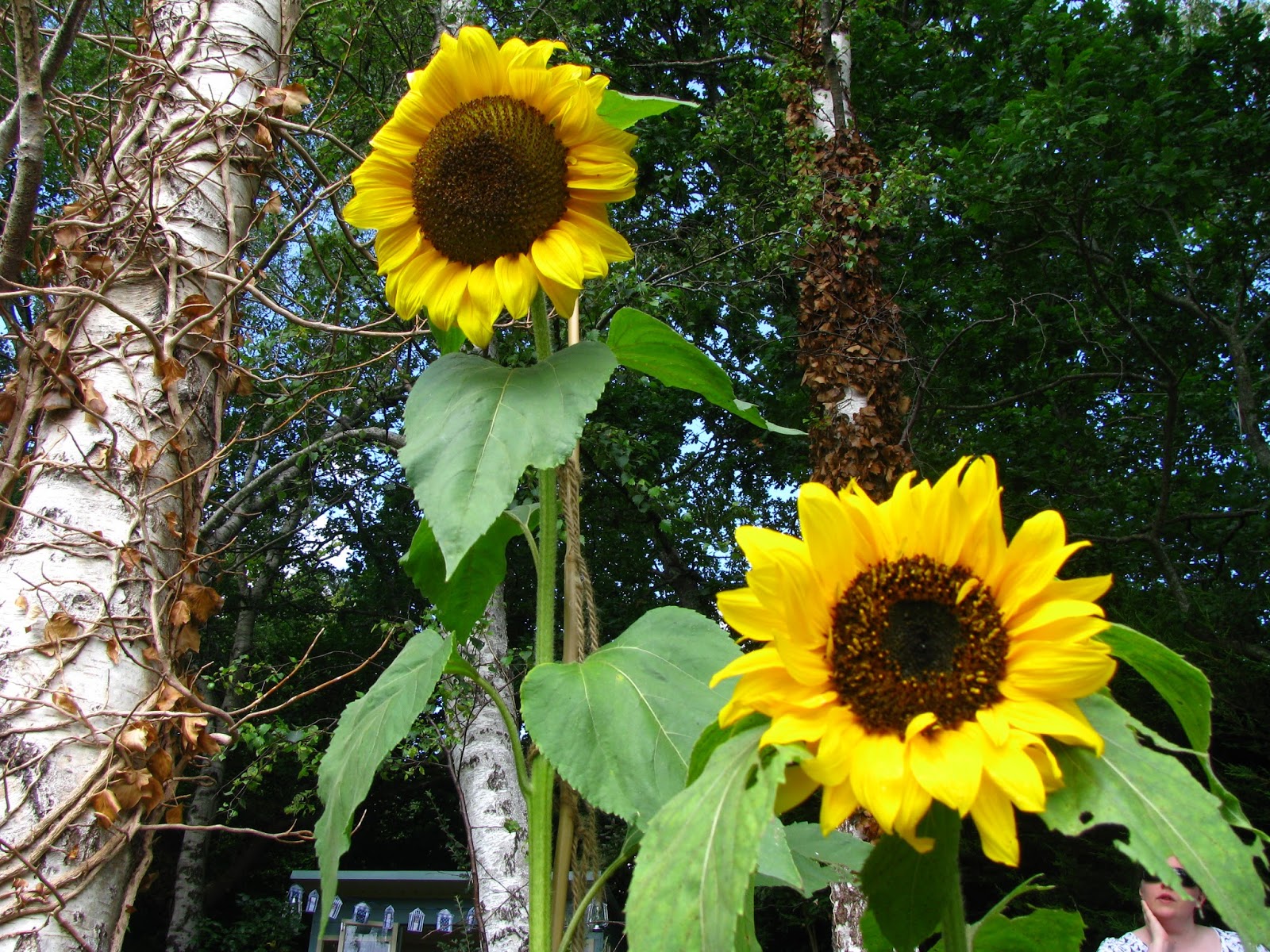
There are some plants that are just so enjoyable to grow in the course of the season, and this year, it has been the giant sunflowers.  Again grown from seed, I have watched these amazing stems grow up to my knees, then my chest, then my head, and now they stand proudly above me, surveying the garden far below, visible from our front drive.  The tallest one is around eight-foot, and has been in bloom for at least two weeks.  I love sunflowers – they’re unfussy, simple, yet stunning and impressive to look at.  I’ll definitely look at growing more next year, and am also very interested in some of the dwarf varieties, like those seen at that lovely kitchen garden in the Hampton Court Flower Show.

Sunflowers

On our recent visit to RHS Rosemoor, Lizzie spied a rose called English Miss, to which she took a particular liking.  She didn’t know it at the time, but Mum ordered this rose for her as a birthday present, and a few weeks ago, we planted it out in one of the garden’s many gaps, in the hope that it would thrive.  Just a few weeks on, and the plant is covered in buds, with an early bloom really offsetting its delicate pale pink against the dark green foliage.  With a little bit of luck and attention, it’ll grow to fill the space, and reward us with lovely scented flowers for years to come.

Lizzie's new rose, English Miss

This first summer in the garden has been a delight, and also a challenge.  Many plants have cropped up that we can’t identify, and we’ve also had ups-and-downs with a few of our own that we’ve added – our lupin, for example, was utterly decimated by slugs and snails within a few short weeks of planting.  One plant that has quietly got on with it (so quietly, in fact, that until it bloomed, we thought it was dying) is our passion flower.  Now, this unique plant has intrigued me for years – it simply screams tropical, and getting one to grow in our climate feels like something of a horticultural victory.  In truth, however, we’ve planted, fed and watered, and allowed it to do its thing whilst loosely training it up some old trellis.  We’re now seeing a succession of beautiful flowers, none of which last more than a day or two, but which catch the eye every time, and are a real delight.

Passion flower

Our other main garden project for the year, aside from horticulture, has been to renovate the summerhouse.  This old wooden shack was not in a great way when we moved in – bits were rotten, the roof was leaking, old electrical wires had been laughably trailed up from the house by way of a hose pipe…  Over the last couple of months, we’ve knocked it into shape, laying new roofing felt, filling gaps left by rot, and generally making it fit for habitation once again.  The priming and painting of the structure took hours of tedious after-work effort, but we’ve finally finished, and are now enjoying the beach-themed hut as much as possible (in fact, it’s where I’m writing this blog today.)  With a bit of maintenance, we’re looking forward to using this space for years to come, and I for one can’t wait to kick back with a cool beer in this shady little corner of the garden – where else could I possibly want to be?

Our summerhouse last autumn
Our summerhouse this summer