
Showing posts with label Cartoons. Show all posts
Showing posts with label Cartoons. Show all posts
Tuesday, 24 March 2020
Friday, 15 July 2016
One for all...
...and all for one! Some of the finest children's cartoons came out of my 80s childhood, but in an era defined by Danger Mouse and Duckula, Thundercats and Transformers, there is one series that stands alone, towering head-and-shoulders above its rivals - Dogtanian and the Three Muskehounds.
One of Dogtanian's biggest appeals - and surprises - is just how far it flew under the radar of generation Y. It is largely ignored by its former viewers, forgotten, overlooked and left as a footnote on the annals of their formative years. Why it has been eclipsed is a mystery to me, for Dogtanian and the Three Muskehounds has it all - wonderful artistry and real attention to detail for its time; a fantastic, fast-paced adventure story; bundles of history; oodles of Paris; a vibrant, clever cast of characters; and the abundant wit that seems in such short supply in modern kids' programming. At the heart of the plot, in which the country bumpkin son of a national hero is sent to Paris to become a Musketeer, is a classic battle between good and evil, played out in the palaces and streets of the French capital, where Dogtanian must prove himself, win his love, and thwart the numerous machinations of the evil Cardinal Richelieu, aided in his dastardly deeds by the cunning Milady, bumbling Captain Widimer, and likeable Count Rochefort, the 'Black Moustache'. Does Dogtanian rise to become a Musketeer? Will Richelieu's ambition to singularly control the country ever be realised? I'll leave you to crack open your own DVD box set to find out these answers.
The purpose of this blog was not just to look back on such a ground-breaking series, but also to look forward - for a smattering of online reports suggest that the Dogtanian brand has not been confined to the 1980s. Indeed, if you believe Animation magazine or Variety.com, the swashbuckling adventure may soon be delighting kids and adults once more, by way of a new 3D animated film. In my opinion, the first signs are pretty promising - the images thus far released look great, and BRB International's 2016 reel gives a further snapshot of the excitement that awaits (move this video onto 3.52 and let yourself be swept away.) In all, a new Dogtanian, rooted in the heritage of the original cartoon, and looking every bit like a 21st century production. Well played BRB.
Now if I'm being honest, I've never actually read Alexander Dumas' acclaimed classic, despite housing it on my bookshelf for more than 15 years. Maybe, in light of this film release, I'll give it a go (not that it'll be possible to imagine the characters as anything other than a host of colourful animals.) In the meantime, I think a re-watch of the original cartoon series is in order. All together now: "One for all and all for one, muskehounds are always ready..."
 |
| Dogtanian and the Three Muskehounds |
One of Dogtanian's biggest appeals - and surprises - is just how far it flew under the radar of generation Y. It is largely ignored by its former viewers, forgotten, overlooked and left as a footnote on the annals of their formative years. Why it has been eclipsed is a mystery to me, for Dogtanian and the Three Muskehounds has it all - wonderful artistry and real attention to detail for its time; a fantastic, fast-paced adventure story; bundles of history; oodles of Paris; a vibrant, clever cast of characters; and the abundant wit that seems in such short supply in modern kids' programming. At the heart of the plot, in which the country bumpkin son of a national hero is sent to Paris to become a Musketeer, is a classic battle between good and evil, played out in the palaces and streets of the French capital, where Dogtanian must prove himself, win his love, and thwart the numerous machinations of the evil Cardinal Richelieu, aided in his dastardly deeds by the cunning Milady, bumbling Captain Widimer, and likeable Count Rochefort, the 'Black Moustache'. Does Dogtanian rise to become a Musketeer? Will Richelieu's ambition to singularly control the country ever be realised? I'll leave you to crack open your own DVD box set to find out these answers.
 |
| Dogtanian meets the Black Moustache |
 |
| The evil Cardinal Richelieu |
The purpose of this blog was not just to look back on such a ground-breaking series, but also to look forward - for a smattering of online reports suggest that the Dogtanian brand has not been confined to the 1980s. Indeed, if you believe Animation magazine or Variety.com, the swashbuckling adventure may soon be delighting kids and adults once more, by way of a new 3D animated film. In my opinion, the first signs are pretty promising - the images thus far released look great, and BRB International's 2016 reel gives a further snapshot of the excitement that awaits (move this video onto 3.52 and let yourself be swept away.) In all, a new Dogtanian, rooted in the heritage of the original cartoon, and looking every bit like a 21st century production. Well played BRB.
 |
| Dogtaninan in 3D (source: variety.com) |
Now if I'm being honest, I've never actually read Alexander Dumas' acclaimed classic, despite housing it on my bookshelf for more than 15 years. Maybe, in light of this film release, I'll give it a go (not that it'll be possible to imagine the characters as anything other than a host of colourful animals.) In the meantime, I think a re-watch of the original cartoon series is in order. All together now: "One for all and all for one, muskehounds are always ready..."
Sunday, 8 May 2016
Herge, Tintin, the Nazis, and the Seven Crystal Balls
I've been working my way through the Tintin canon recently, aided
by Micahel Farr's Tintin The Complete Companion, the definitive guide that takes you behind the scenes
of Herge's mind and back in time to really get to grips with where his boy
reporter's adventures originate. Recently I read the Seven Crystal Balls, dipping
in-and-out of Farr's book for added detail and context about this most
interesting story.
The Seven Crystal Balls was
first serialised in December 1943, in Le Soir, a French-language daily
newspaper. Its opening scenes, as Tintin fans around the world will know,
see our hero taking a train out to Marlinspike Hall to visit his
friend, Captain Haddock. It's an innocuous, unmemorable scene that very
few readers would give more than a cursory glance. I, too, would have
glossed completely over it, had I not discovered the remarkable story behind
these most unremarkable little frames.
For the explanation, you
need to fast forward to page 50 of the same story. Following a visit to a
hospital, in which seven brave explorers are fighting for their lives following
a haunting curse set upon them by the Incan mummy Rasar Capac, Tintin again
makes this journey, in almost identical artistry, to the front door of
Marlinspike. Why is this scene repeated in such similar manner? Had
Herge slipped up, and popped in the same frames twice? Perhaps he forgot
that this scene had already occurred? Fortunately, with a bit of
historical context, you'll get the answer.
 |
| Above: Tintin arriving at Marlinspike Hall on page two. Below: Tintin's near-identical return on page 50 |
The year was 1943, and Belgium was three-years-deep in the grip of Nazi occupation. The Nazi authorities shut down Le XXe Siècle, the paper in which Herge's adventures had been serialised, but the artist soon found work on a French-language publication, Le Soir, who invited him to continue his Tintin adventures with them. Within weeks of Herge's appointment, this paper too fell into Nazi hands, where it began publishing stories of Wehrmacht successes and other propaganda. Herge continued producing Tintin adventures against this backdrop, taking his readers on more outlandish adventures (such as the 1942 science-fiction tale The Shooting Star , and the swashbuckling legend of Red Rackham's Treasure in 1943), and avoiding the political themes and current events that had been so prevalent in his earlier works (for example, his criticism of Japanese imperialism in the Blue Lotus in 1934-35; the veiled pop at fascism in King Ottokar's Sceptre in 1939.) This eventually led to the beginning of The Seven Crystal Balls, a story about the curse of an Incan mummy - a tale sufficiently distanced from war-torn Europe.
 |
| Science fiction ruled in the Shooting Star (left); King Ottokar's Sceptre took on a more anti-fascist tone (right) |
Roll on 1944 and, midway through drawing The
Seven Crystal Balls, the Allied Liberation. In amongst the new
rules laid down by the liberating powers, a ban on work was enforced for
everybody associated with the Nazi press. It was an indignity that must have caused deep
grief to Herge - rather like the author P.G. Wodehouse, Herge had been, at
worst, naive about his involvement with the Nazi-controlled newspaper,
considering his work as bringing a little joy and escapism to its readers
during those turbulent years. Not so in the eyes of the authorities - nor
in the minds of a proportion of his compatriots - who considered his
involvement in Le Soir an act of collaboration, and his work a marketing force
behind Nazi propaganda. Blacklisted, barred from work, and under
official investigation, Herge faced arrest four times in 1944, spending one
night in a cell. Each time he was released without charge.
How did it work out for Herge? The artist spent his enforced down time re-drawing and colouring older adventures of Tintin, for the publisher Casterman. He also begun producing comics under the pseudonym Olav, alongside friend Edgar P Jacobs, and by the Autumn of 1945, he had been approached by Raymond Leblanc, a former member of Belgium's wartime Resistance, to help launch a weekly children's magazine. Leblanc's prominence in the Resistance smoothed Herge's pathway back to work (the Head of Censorship and Certificates of Good Citizenship concluded he was "a blunderer rather than a traitor") and the case against him was finally closed on 22 December 1945, when it was declared that "in regard to the particularly inoffensive character of the drawings published by Remi, bringing him before a war tribunal would be inappropriate and risky." In a sense, Herge was lucky - several other Belgians working on Nazi-controlled literature were sentenced to life imprisonment and even death.
 |
| Herge during the war (source: Daily Express) |
Receiving his Certificate of Good Citizenship in May 1946, Herge was at last
able to work again. He set about producing the Tintin Magazine, and
turned his attention back to his unfinished adventure - The Severn Crystal Balls - which was eventually concluded in
1948. It is this that makes Tintin's second return to Marlinspike Hall
such a fascinating piece of illustration. In Tintin's deliberate steps up
to the main doors for the second time, we glimpse Herge's re-beginning, both of
this particular story, and also of his career as an illustrator. The
following scene, in which Tintin is led into the Captain's chamber, also delves
deep into Herge's frame of mind during this tumultuous period. Haddock
sits, grim-faced, angry and frustrated. His butler, Nestor, explains
"He's aged ten years since this trouble began..." It is here, in
this otherwise inconspicuous scene, that Herge found a vent for the experiences
of the last five years. It is a scene fraught with the artist's pain.

Herge went on to cement his place amongst the world's very best cartoonists,
illustrators, artists and story tellers. A visionary, he would put his
character on the Moon 15 years before Armstrong, dally in real-time global
affairs, and even hint at the existence of aliens. They say that Herge
never forgave Belgian society for the way he was treated in the aftermath of
Liberation. Nonetheless, he has gone on to become one of that country's most
celebrated sons.
Monday, 13 July 2015
Live in peace and plant potatoes and dream
It's easy, in this 24/7, energetic, busy and hassled world, to get a bit wrapped up in your own life. Those small work decisions that are just so important; the commute home each day in the fraught and choc-a-bloc traffic; bills; politics; technology... Maybe I'm undergoing a personal revolution, or perhaps I'm simply getting old before my time, but the modern-day bustle of life is fast losing its appeal in my eyes - I don't want the latest iphone, I don't need to stream my movies from "the cloud," and I really couldn't care less about the latest social media craze; the "ice bucket challenge," and "selfies," it has all just blissfully passed me by, and I have to say, I'm the happiest I've ever been.

This current outlook on life meant I really connected with the film I took Lizzie to see for her birthday recently, where a trip to Dartington's Barn Cinema saw us enjoy an hour-and-a-half in the company of the Moomins, in their new feature film, The Moomins on the Riviera. Now, I have a deep fondness for these loveable, big-nosed creatures stretching back into childhood, and was amazed when I first met Lizzie, to find that she was an even bigger fan. And what's not to love? The Moomins live a peaceful life, in a tranquil valley, where an understanding of the world and a one-ness with nature prevails. As a kid I was enthralled by their adventures, and Tove Jansson's brilliant creations have long been my inspiration for travelling to Scandinavia - an ambition as yet unfulfilled.
The Moomins on the Riviera was released on 10 October 2014 to celebrate the 100th anniversary of Tove Jansson's birth, but only made it onto UK screens at the end of May this year. There's plenty to get excited by in this new film; for a start, it does something that no other film producer wants to do these days (sit up and take note, Disney) - it has stuck to its traditional, iconic, winning formula of good, old-fashioned, hand-drawn, two-dimensional animation, which for me beats your high-tech CGI computer animation every time. But beyond the method of production lies the heart of the matter - the Moomins, virtually unchanged from their first animated debut in 1990, holding true to their culture and their values in a world where so many others have taken the money and sold out. The very presence of this film demonstrates this point, but it is also woven deep into the fabric of the film's plot, in which the Moomins set sail for the Riviera. During their time living the jet-set lifestyle, Moomin Papa falls in with a rich aristocrat and Snorkmaiden falls for the local playboy, leaving Moomintroll consumed with jealousy, and Moomin Mama to hold the family together, and get them all back on track to their traditional, life-affirming ways. It's a powerful shot at a weary world, a challenge to a society fuelled by greed and always on the pursuit of financial wealth and riches.
The timing of the film's screening fell, by some chance, on Lizzie's birthday weekend, which tied in (quite accidentally) with her present from me - volumes one to four of the Moomins TV series on DVD. I actually worked quite hard to find these, but have already seen how, with the release of the feature film, they are slowly beginning to appear in the shops. We've started to work our way through the episodes, and there's a definite humour to them that I certainly didn't perceive as a child. What is the same, though, is that lovely, clean, idyllic Moomin way, and its message is as strong today - maybe even stronger, and perhaps more necessary - as it was when it first hit our TV screens 25 years ago. The series in their book form, of course, goes back much further, to 1945 - but that's a story for another blog.
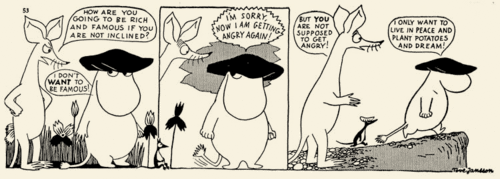
Sometimes, when I'm pottering in the garden, watching bumble bees buzz around the lavender, or just admiring the view from our summer house, I feel a little bit like Moomintroll. I feel like we're both content with what we have, both in touch with the world, both happy to while away the summer evenings with our loved ones, watching the flowers bloom and the vegetables grow. And I'm happy with that, to have a sort-of kindred spirit in the animated world, and one whose vision of a happy life I really share - that is, to live in peace, and plant potatoes, and dream.
 |
| Moomin Mama, Moomin papa and precocious Little My |
The Moomins on the Riviera was released on 10 October 2014 to celebrate the 100th anniversary of Tove Jansson's birth, but only made it onto UK screens at the end of May this year. There's plenty to get excited by in this new film; for a start, it does something that no other film producer wants to do these days (sit up and take note, Disney) - it has stuck to its traditional, iconic, winning formula of good, old-fashioned, hand-drawn, two-dimensional animation, which for me beats your high-tech CGI computer animation every time. But beyond the method of production lies the heart of the matter - the Moomins, virtually unchanged from their first animated debut in 1990, holding true to their culture and their values in a world where so many others have taken the money and sold out. The very presence of this film demonstrates this point, but it is also woven deep into the fabric of the film's plot, in which the Moomins set sail for the Riviera. During their time living the jet-set lifestyle, Moomin Papa falls in with a rich aristocrat and Snorkmaiden falls for the local playboy, leaving Moomintroll consumed with jealousy, and Moomin Mama to hold the family together, and get them all back on track to their traditional, life-affirming ways. It's a powerful shot at a weary world, a challenge to a society fuelled by greed and always on the pursuit of financial wealth and riches.
 |
| The Moomins on the Riviera (source: official film website) |
The timing of the film's screening fell, by some chance, on Lizzie's birthday weekend, which tied in (quite accidentally) with her present from me - volumes one to four of the Moomins TV series on DVD. I actually worked quite hard to find these, but have already seen how, with the release of the feature film, they are slowly beginning to appear in the shops. We've started to work our way through the episodes, and there's a definite humour to them that I certainly didn't perceive as a child. What is the same, though, is that lovely, clean, idyllic Moomin way, and its message is as strong today - maybe even stronger, and perhaps more necessary - as it was when it first hit our TV screens 25 years ago. The series in their book form, of course, goes back much further, to 1945 - but that's a story for another blog.
 |
| Moomin DVDs |
Sometimes, when I'm pottering in the garden, watching bumble bees buzz around the lavender, or just admiring the view from our summer house, I feel a little bit like Moomintroll. I feel like we're both content with what we have, both in touch with the world, both happy to while away the summer evenings with our loved ones, watching the flowers bloom and the vegetables grow. And I'm happy with that, to have a sort-of kindred spirit in the animated world, and one whose vision of a happy life I really share - that is, to live in peace, and plant potatoes, and dream.
 |
| Snufkin |
Monday, 11 May 2015
Mommy, are the characters real?
We've seen the shows, been thrilled on the rides, been enticed in the shops, and eaten our own body weight in all the wrong kinds of food. What's left at Disneyland for a childless couple to possibly enjoy? Umm, that'll be the parades then.

Disney's most famous characters are all here, waving, blowing kisses, beaming out those ubiquitos Disney smiles that are obviously part of the job description. Alan Whicker, in his exploration of Disney World in 1971, was told about pixie dust, that sprinkle of magic in which every employee of the Disney Corporation is expected to immerse themselves, during every second of their work. It comes out everywhere - the shop assistants, the grounds keepers, the waitresses and the ride attendants - but nowhere is it more pronounced, more obvious, more explicit, than during the iconic Disney Parade.
The spectators gather all the way down Main Street, ushered into neat rows by stewards who seem to part the crowds like Moses at the Red Sea. The pitter-patter of the rain, and the wind blowing up the cobbles, betray the warmth of feeling running through the crowds. From the distance comes the sweet sound of jovial music, and over heads can be seen a mob of colour, slowly making its way along the road, a stark contrast to the dismal grey drizzle. We pick a spot behind two of the smallest children, a tactic that ensures an excellent view, and as the first float approaches, a little girl turns to her mother and asks, enchanted: "Mommy, are the characters real?"


There follows a cacophony of sight and sound, as all those heroes and heroines - plus a few villains thrown in for good measure - file past. They're playful, involved, interactive, and choreographed to perfection. The kids love it, the adults admire it, and despite the cheesiest soundtrack that ever was written, it goes down a storm. New faces to the Disney repertoire mingle with old favourites like King Louie, Merlin the Wizard and Mary Poppins, and it's pretty hard not to get swept along in the fun and good nature of the afternoon.


After sunset, Disneyland takes on an altogether different character. The shops and eateries, lit up like Christmas trees, become all-the-more inviting, whilst Sleeping Beauty's castle seems bigger, and much more sinister. Disneyland after dark, where the rides shut down one-by-one, and where spaces filled with laughter only hours before, become the dim home of shadows and echoes. By 8pm, everyone has made their way to the foot of the castle, where they wait in hushed anticipation. If the afternoon's Disney parade is good, then what happens later in the evening is world-class. A mind-blowing display of waterworks, fireworks, and animation is played out for twenty minutes, to ooos, aaaahs, cheers, claps, gasps and the odd sing-along. It's a new high, the very pinnacle of all the entertainment on offer, and leaves a lasting impression on the audience that makes you realise, these guys really know what they're doing.

It's a fine way to leave Disneyland, basking in its own fantastic display of lights and lasers, and there is a certain awestruck feeling in the air as the spectators stream for the exit. For us, it's a magnificent farewell to Walt, and tomorrow a train back home, where life will once again pick up its rhythm and routine. We know Disneyland isn't the most authentic location for a holiday, and it doesn't exactly score highly for a cultural experience. But dig a little deeper under the surface, as I've tried to do with this series of blogs, and you'll find a world of history, literature, and music, all of which are bound deep within the Disney story. It's not so much the park itself that sticks in the mind, but the homage to heritage that it represents, and that has been so proudly and brilliantly presented at almost every turn, by people who really know how to put on a show worthy of the world's greatest animator.

Disney's most famous characters are all here, waving, blowing kisses, beaming out those ubiquitos Disney smiles that are obviously part of the job description. Alan Whicker, in his exploration of Disney World in 1971, was told about pixie dust, that sprinkle of magic in which every employee of the Disney Corporation is expected to immerse themselves, during every second of their work. It comes out everywhere - the shop assistants, the grounds keepers, the waitresses and the ride attendants - but nowhere is it more pronounced, more obvious, more explicit, than during the iconic Disney Parade.
The spectators gather all the way down Main Street, ushered into neat rows by stewards who seem to part the crowds like Moses at the Red Sea. The pitter-patter of the rain, and the wind blowing up the cobbles, betray the warmth of feeling running through the crowds. From the distance comes the sweet sound of jovial music, and over heads can be seen a mob of colour, slowly making its way along the road, a stark contrast to the dismal grey drizzle. We pick a spot behind two of the smallest children, a tactic that ensures an excellent view, and as the first float approaches, a little girl turns to her mother and asks, enchanted: "Mommy, are the characters real?"


There follows a cacophony of sight and sound, as all those heroes and heroines - plus a few villains thrown in for good measure - file past. They're playful, involved, interactive, and choreographed to perfection. The kids love it, the adults admire it, and despite the cheesiest soundtrack that ever was written, it goes down a storm. New faces to the Disney repertoire mingle with old favourites like King Louie, Merlin the Wizard and Mary Poppins, and it's pretty hard not to get swept along in the fun and good nature of the afternoon.


After sunset, Disneyland takes on an altogether different character. The shops and eateries, lit up like Christmas trees, become all-the-more inviting, whilst Sleeping Beauty's castle seems bigger, and much more sinister. Disneyland after dark, where the rides shut down one-by-one, and where spaces filled with laughter only hours before, become the dim home of shadows and echoes. By 8pm, everyone has made their way to the foot of the castle, where they wait in hushed anticipation. If the afternoon's Disney parade is good, then what happens later in the evening is world-class. A mind-blowing display of waterworks, fireworks, and animation is played out for twenty minutes, to ooos, aaaahs, cheers, claps, gasps and the odd sing-along. It's a new high, the very pinnacle of all the entertainment on offer, and leaves a lasting impression on the audience that makes you realise, these guys really know what they're doing.

It's a fine way to leave Disneyland, basking in its own fantastic display of lights and lasers, and there is a certain awestruck feeling in the air as the spectators stream for the exit. For us, it's a magnificent farewell to Walt, and tomorrow a train back home, where life will once again pick up its rhythm and routine. We know Disneyland isn't the most authentic location for a holiday, and it doesn't exactly score highly for a cultural experience. But dig a little deeper under the surface, as I've tried to do with this series of blogs, and you'll find a world of history, literature, and music, all of which are bound deep within the Disney story. It's not so much the park itself that sticks in the mind, but the homage to heritage that it represents, and that has been so proudly and brilliantly presented at almost every turn, by people who really know how to put on a show worthy of the world's greatest animator.

Thursday, 30 April 2015
A day in the studios
Following the release of his first few cartoons, which left audiences around America delighted, Disney began to explore other ways of animating that would push the boundaries of his craft into a whole new dimension. In 1937, this inevitably led him to the multiplane camera, which
was first used in a Silly Symphony called
The Old Mill. The multiplane camera essentially
allowed layered scenes to give a three-dimensional effect. Parts of the artwork of one layer are left
blank, to allow other layers to be seen behind them. These layers could then be moved independent
of each other, and in varying distance from the camera, creating the illusion
of motion and depth. It was a break-through
moment in animation, famously used in Snow
White and the Seven Dwarfs, and employed subsequently for the next fifty
years in Disney classics, all the way up until the 1989 film, The Little Mermaid, after which time computer
systems began to take over. Nowadays, only
three Disney multiplane cameras survive – one of these is housed at Walt Disney
Studios, at Disneyland, Paris. It’s a great artefact to start a day in Walt Disney Studio
park, and a real piece of history so pertinent to all of this, for without it there
really would have been no Toy Story, no Monsters Inc, and no Frozen.
Walt Disney studios is a celebration of modern Disney, and all the techniques that have brought its bulging back-catalogue into the 21st century. The computer may have superseded the pencil, but there’s still a decent nod to the past around this place – a statue of Walt sharing a joke with Mickey Mouse stands centre stage, whilst family favourites such as Jiminy Cricket are scattered around the site, intermingled with the modern-day heroes like Buzz Lightyear. The whole mixup sort of works; where else would 1928's Steamboat Willy so easily and seamlessly encounter 2014's Frozen heroine, Elsa?
 |
| The Disney multiplane camera (Source: WaltDisney.org) |
Walt Disney studios is a celebration of modern Disney, and all the techniques that have brought its bulging back-catalogue into the 21st century. The computer may have superseded the pencil, but there’s still a decent nod to the past around this place – a statue of Walt sharing a joke with Mickey Mouse stands centre stage, whilst family favourites such as Jiminy Cricket are scattered around the site, intermingled with the modern-day heroes like Buzz Lightyear. The whole mixup sort of works; where else would 1928's Steamboat Willy so easily and seamlessly encounter 2014's Frozen heroine, Elsa?


So what is Walt Disney Studio Parks all about? There are studios devoted to Disney animation history, stage shows, stomach-churning rides, and special effects left, right and centre. My favourite spot on our chilly visit is inside Studio One, packed full of Americana, where the restaurants and cafes sit on a fake boulevard, a vintage car is serviced at a redundant gas station, all under the watchful eye of a slowly setting Beverly Hills sun. The gaping doors of the studio open to reveal the bright lights of Hollywood, sky scrapers giving way to that famous hilltop sign. It's fake, but at the same time it feels like an utterly romanticised reality - which is, I suppose, the genius of film-makers.
 |
| Studio One |
 |
| Hollywood at Walt Disney Studios, Paris |
Once we've sat through the obligatory Art of Disney Animation presentation, the Animagique spectacular stage show (in which Donald Duck steals Mickey Mouse's key to the animation vault and unleashes the fun onto everyone in an all-singing, all-dancing, mad, magical adventure - yes, it's exactly as it sounds) and the flying carpets of Agrabah (talk about disappointing - our carpet never got off the ground) you can still take a tour around earthquake-stricken London, be first on the scene at a mining disaster, and take a turn around a hidden Parisian square. And if that's not enough to float your boat, you can join virtually every other visitor in watching one of the park's famous stunt shows, which plays out live-action car acrobatics, guns, explosions, and people being set on fire. It does offer something of a wow factor, and the slick one-minute film produced at the end of the show - using actual footage from the performance - makes for gripping viewing.
 |
| Quake-stricken London |
 |
| A gripping stunt show |
Our day at the studios complete, we head for the exit and make for the Disney Village, a complex of shops and restaurants sitting outside the park bounds, and open late into the night. Its the usual energetic mix of bright lights and good times, as hotel residents and day trippers unwind from their hectic days with a burger, beer or cocktail. For us, it's some light browsing at the World of Disney flagship store, followed by dinner at Billy Bob's Wild West Tex Mex, and then a gentle stroll through the village, out past the lake, slowly meandering home amongst exhausted parents, and children with big Minnie Mouse balloons. The skyline of the Disney Village itself appears like a film set from across the water and the peace, after such a loud and bustling day, is a as magnificent as any movie score.

 |
| Evening scenes in the Disney Village |
Tuesday, 21 April 2015
An American in Paris - Walt's magical world
Disneyland Paris sits in the new town of Marne-la-Vallée, about 20 miles to the east of the French capital. Not that you'd know it, for in many ways, it's worlds away from the boulevard cafes and artistic backstreets. This is a small piece of America, which just happens to sit in France, and you'd be totally forgiven for thinking you're spending dollars, and not euros. For the short-haul visitor, it's a unique kind of culture shock; should I try speaking French to the shop assistant? Is it a betrayal if I order a burger and fries? Lizzie tries a bit with the French, but gets a decidedly English response, and so the matter is settled.
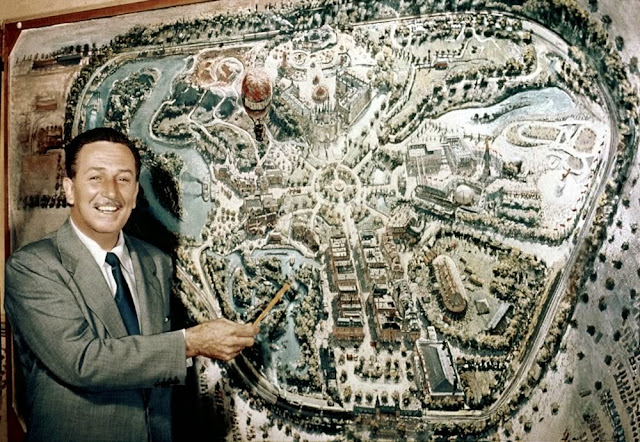
Disneyland was invented on July 17 1955 when Walt himself, having personally supervised its construction, opened Disneyland Resort in Anaheim, California. On that morning, Disney spoke to the crowds, saying: "To all who come to this happy place: Welcome. Disneyland is your land. Here age relives fond memories of the past, and here youth may savour the challenge and promise of the future. Disneyland is dedicated to the ideals, the dreams, and the hard facts that have created America, with the hope that it will be a source of joy and inspiration to all the world." Over the next 60 years, that inspiration has seen parks spring up in Florida, Tokyo, Hong Kong, Shanghai, and of course Paris. There's a four-ship strong Disney cruise line, a points-based Disney vacation club, and a Disney resort and spa in Hawaii. Disneyland Paris arrived in 1992, to a mixed response from the locals, many of whom worried that the park would introduce American consumerism to France. I can't imagine why.
A wander down Main Street USA, as discussed previously, is an assault on the senses, and by the time you make it to the end of the street, you've been transported to a whole other world. The centrepiece of the park, known the world over, is of course the Disneyland Castle. Wannabe princes and princesses run around with boundless energy, enchanted at the prospect of seeing Sleeping Beauty awake from her timeless sleep. For me, there's something even better to discover here - the sword in the stone, from one of my favourite films. Unlike Arthur in the depths of Dark Age London, I'm unable to pull it from its anvil, but it does make for a good photo op, and is surely one to tick off the childhood dreams list.
Disney, rightly so, is unashamed of its identity, and through the park it pays homage to the many famous moments and characters brought to life by animation. The cats from the Aristocats; the Mad Hatter's tea party; Aladdin's magic carpet ride; round every corner is another reminder, a further celebration. With this in mind, the major attractions sort of play second-fiddle to the act of simply being in Disneyland, and our favourite rides are not the fast or the furious ones. A cute little buggy takes you through the story of Pinocchio; a hanging pirate ship flies you over the rooftops of London with Peter Pan; a spiralled hedge maze brings you face-to-face with the Cheshire Cat. This is what Disneyland means to us - it's the reconnection of the famous old stories from childhood, and in that respect it renders many of the scary rides somewhat out-of-place.
The landscaping around the Disneyland park is superb. One moment we're in the deepest Wild West, the next we're in the thick of an Arabian street market. The good people in the props department really do a number on Disneyland, leaving no patch of ground vacant in their attempt to give you the real deal. There are four 'lands' within the park, with piratical Adventure Land conjuring up a Peter Pan world, landscaped to perfection, and our favourite place to linger. Adventure Land is also the home of the ride, Pirates of the Caribbean, the famous inspiration behind the international film series starring Johnny Depp. Total fantasy and good old romantic imagery ensue, as our little water boat is bumped along a dusky island coast, past an 18th century Spanish fortress, and into the lives of rum-drinking, sword-wielding pirates, all to the memorable tune of yo-ho, yo-ho, a pirate's life for me.
If there's one thing besides rides and attractions that every single person seems to do in Disneyland, it's shop. There are shops everywhere, hawking every conceivable thing that will fit a mouse motif. Cuddly toys, crockery, clothes, porcelain figures, badges, baseball caps, sweets, biscuits... the list, truly, is endless. My impression of the shopping in Disneyland is that they simply saturate you until you buy something, for most of the emporiums sell identical wares. However, this doesn't stop each and every premises from maintaining presentable, inviting properties, in keeping with the usual Disney image. In an evening where the night closed in, the wind blew up and the rain poured, flitting from shop-to-shop became our lifeline against the elements, and we enjoyed each-and-every carefully-designed window display. Created with care, delivered to perfection - the Disney way.


Disneyland was invented on July 17 1955 when Walt himself, having personally supervised its construction, opened Disneyland Resort in Anaheim, California. On that morning, Disney spoke to the crowds, saying: "To all who come to this happy place: Welcome. Disneyland is your land. Here age relives fond memories of the past, and here youth may savour the challenge and promise of the future. Disneyland is dedicated to the ideals, the dreams, and the hard facts that have created America, with the hope that it will be a source of joy and inspiration to all the world." Over the next 60 years, that inspiration has seen parks spring up in Florida, Tokyo, Hong Kong, Shanghai, and of course Paris. There's a four-ship strong Disney cruise line, a points-based Disney vacation club, and a Disney resort and spa in Hawaii. Disneyland Paris arrived in 1992, to a mixed response from the locals, many of whom worried that the park would introduce American consumerism to France. I can't imagine why.
 |
| Walt presents his dream (source: Remembering Disney) |
A wander down Main Street USA, as discussed previously, is an assault on the senses, and by the time you make it to the end of the street, you've been transported to a whole other world. The centrepiece of the park, known the world over, is of course the Disneyland Castle. Wannabe princes and princesses run around with boundless energy, enchanted at the prospect of seeing Sleeping Beauty awake from her timeless sleep. For me, there's something even better to discover here - the sword in the stone, from one of my favourite films. Unlike Arthur in the depths of Dark Age London, I'm unable to pull it from its anvil, but it does make for a good photo op, and is surely one to tick off the childhood dreams list.
 |
| "Whoso pulleth out this sword of this stone and anvil, is rightwise king born of all England..." |
 |
| The iconic Disney castle |
Disney, rightly so, is unashamed of its identity, and through the park it pays homage to the many famous moments and characters brought to life by animation. The cats from the Aristocats; the Mad Hatter's tea party; Aladdin's magic carpet ride; round every corner is another reminder, a further celebration. With this in mind, the major attractions sort of play second-fiddle to the act of simply being in Disneyland, and our favourite rides are not the fast or the furious ones. A cute little buggy takes you through the story of Pinocchio; a hanging pirate ship flies you over the rooftops of London with Peter Pan; a spiralled hedge maze brings you face-to-face with the Cheshire Cat. This is what Disneyland means to us - it's the reconnection of the famous old stories from childhood, and in that respect it renders many of the scary rides somewhat out-of-place.
 |
| The Aristocats in making merry music |
 |
| This way or that? Lost in a hedge maze |
The landscaping around the Disneyland park is superb. One moment we're in the deepest Wild West, the next we're in the thick of an Arabian street market. The good people in the props department really do a number on Disneyland, leaving no patch of ground vacant in their attempt to give you the real deal. There are four 'lands' within the park, with piratical Adventure Land conjuring up a Peter Pan world, landscaped to perfection, and our favourite place to linger. Adventure Land is also the home of the ride, Pirates of the Caribbean, the famous inspiration behind the international film series starring Johnny Depp. Total fantasy and good old romantic imagery ensue, as our little water boat is bumped along a dusky island coast, past an 18th century Spanish fortress, and into the lives of rum-drinking, sword-wielding pirates, all to the memorable tune of yo-ho, yo-ho, a pirate's life for me.
 |
| Adventureland, home of pirates |
If there's one thing besides rides and attractions that every single person seems to do in Disneyland, it's shop. There are shops everywhere, hawking every conceivable thing that will fit a mouse motif. Cuddly toys, crockery, clothes, porcelain figures, badges, baseball caps, sweets, biscuits... the list, truly, is endless. My impression of the shopping in Disneyland is that they simply saturate you until you buy something, for most of the emporiums sell identical wares. However, this doesn't stop each and every premises from maintaining presentable, inviting properties, in keeping with the usual Disney image. In an evening where the night closed in, the wind blew up and the rain poured, flitting from shop-to-shop became our lifeline against the elements, and we enjoyed each-and-every carefully-designed window display. Created with care, delivered to perfection - the Disney way.
 |
| Shop windows along Main Street USA |
Sunday, 12 April 2015
The Disney imagination
"On a site bigger
than Manchester, a spread of swamp and woodland eighty times the size of Hyde
Park, they’re building a fantasy for £125 million. This is the house the Mouse built. The two million pound centerpiece of the Walt
Disney World, the biggest thing to hit Florida since Sunshine. Cinderella’s
castle, a fiberglass inspiration that looks real from any distance, should this
be your idea of reality. On October 1
Mickey Mouse, aged 43, opens his billion dollar business here, an improbable
dream of Disney imagineers, to cater for 10,000 visitors an hour, fifty thousand
a day, ten million a year, and so solve many Americans’ worries about expanding
leisure time, and surplus cash."
Alan Whicker, Pixie Dust on Goody-Goody Land, 1971
Alan Whicker, Pixie Dust on Goody-Goody Land, 1971
It’s amazing, the impact that that three little circles can make on the world. From one humble little sketch of a mouse, Walt Disney and his legacy have charmed and delighted people for eight decades. Surely some of the twentieth century's most enduring creations, Walt's animated heroes have seen him go down in history as the man who brought magic, wonder and laughter to so many children. I was one of the millions who was brought up with Disney, and remember fondly the hours of joy given to me by those famous cartoons. Now at 30-years-old, the innocence may have faded, but a definite place still remains for the myriad characters of all shapes and sizes that comprise the Disney repertoire. Recently, a long-held childhood dream was realised as, 20 years late, we finally took a trip to Disneyland. The Paris version, obviously.
 |
| Walt Disney and his creations on the cover of Life Magazine |
Mickey Mouse (The Mouse) was born
in 1928, Walt Disney’s replacement for Oswald the Lucky Rabbit, a character
Disney lost in a 1927 dispute with film producer and distributor Charles
Mintz. Legend goes that, whilst drawing
up new character ideas that included a cow, a horse, and even a frog, Walt Disney
observed a tame mouse at his desk. What
followed was Mortimer Mouse, soon re-Christened Mickey Mouse. Mickey was first piloted in the test
screening of Plane Crazy on 15 May 1928; this was followed by The Gallopin’
Gaucho, but neither film was released due to low interest and a lack of a
distributor. Disney remained persistent
and, on 18 November 1928, a third film was released - Steamboat Willie. Disney’s use of sound in animation was a new
technique, stealing a lead on other animators, to the delight of
audiences. Plane Crazy and The Gallopin’
Gaucho were both re-released in sound, and by the end of the 1920s, Mickey had
become a household name.
 |
| Mickey Mouse in Steamboat Willie |
The Mouse continued in his refinement into the 1930s,
becoming a role model for children. This
Cinderella status made it difficult to write material for Mickey, as the jokes
and situations he could be involved in were limited. Thus, in 1933, an angry little duck entered
the fray. A tempestuous powder-keg,
Donald Duck blew open the confines of Mickey’s idyllic little world. It has been said that Walt Disney based the
character on all the people he didn’t like, and Donald definitely offers a truer
representation of humanity than his mouse companion. Disney would
get mileage out of Donald’s wild mood swings; a classic storyline would see
Donald start off in a jovial mood, before something – anything – would spoil
his day. The weather. Some chipmunks. A dripping tap. To Donald, Disney dealt the blows of life
that somehow always passed over the head of ever-optimistic Mickey. You find yourself naturally sympathising with
Donald – you share in his plight, you understand his frustrations, and you
admire his often-spiteful actions. He is
a genius creation by a genius animator.
 |
| Donald Duck |
There’s obviously a lot more to the Disney franchise than
Mickey Mouse and Donald Duck, but were it not for these two characters, there
would almost certainly be no Disneyland to speak of today. Off the back of the Mouse
and Duck combo, and having won an exclusive contract with Technicolor to
produce cartoons in colour, Walt Disney
Productions Limited broke even more new ground, with a feature film,
three-years-in-the-making, called Snow White and the Seven Dwarfs (1937). By 1939 it was the highest-grossing film of
all time, and the profits generated paid for a new 51-acre studio complex in
Burbank, California. Countless classics
followed through the decades – Pinocchio (1940,) Cinderella (1950,) Peter Pan
(1953,) Sleeping Beauty (1959,) The Sword in the Stone (1963,) The Jungle Book
(1967,) Robin Hood (1973,) The Little Mermaid (1989,) Beauty and the Beast
(1992,) to name but a few of the many feature films produced in the next 76
years. Not a bad legacy for a paper boy
son of a farmer, and not a bad return for drawing those three little circles.
 |
| Most of Disney's films put a new spin on classic works of literature, such as Rudyard Kipling's The Jungle Book |
All of which brings us to the outskirts of Paris in 2015, where a wander down Main Street USA infects you with the charm and innocence of that earlier age. Main Street is billed in the visitor leaflet as a typical American street at the turn of the 20th century. I don't think anybody actually believes that, but nonetheless it has been brilliantly done, with well-maintained topiary, pastel-washed shop fronts, and a charming, old-fashioned, wholesome, idealised façade that is just Disney through-and-through. The clean-cut image is superbly preserved here - everything is in the appropriate place, and there's not a hint of litter in sight. Then there's the music, vintage family favourites wafting through the air from well-disguised speakers. It's an experience that fills the visitor with a sense of childlike joy, for if you can genuinely believe that this artificial construct, built in 1994, is for real, then you'll get a lot more out of your visit. And why not indulge yourself in this little piece of imagination? Guests of all nationalities, and all ages, lap it up, and judging by the number of Minnie Mouse ears being worn by folk in their 30s, it certainly seems like an appropriate place to submerse yourself in fantasy.
 |
| Main Street USA, Disneyland Paris |
 |
| "A typical American street at the turn of the 20th century" |
The reason for all of this is clear; Walt Disney, through his cartoons and feature films, strikes a chord with people across the globe. As a child you are lassoed into his world, and what is fostered is a fondness that, for many people, continues into adulthood. It may be the world's best marketing strategy, but cynicism doesn't seem to count within the bounds of Disneyland, and why should it? Where else in this day-and-age can you really forget the world and all its problems? To me, this is key to Disney's success, be it in a park or on the screen - it is escapism at its best, and that's appealing whether you're aged five or one hundred and five. As the great animator himself penned: "Laughter is timeless, imagination has no age, and dreams are forever."
Sunday, 4 January 2015
Blistering Barnacles and Thundering Typhoons! - The Tintin Factor
Those who know me will be aware that I've always held a place in my heart for the adventures of the boy reporter, Tintin. The intrepid investigator first burst into my life when I was a kid, that iconic and dramatic "dun-dun-dun" theme tune booming out of the television, drawing you in to whatever international plot awaited. The stories were always sophisticated, involved and utterly enthralling, and this enjoyment has never left me although, as I grew older, I started to find an equal, if not greater pleasure, through the Tintin books. A few years ago I started collecting these and, this New Year, I added the final few of books to my collection, forming a complete library of the Belgian reporter's finest investigations.
I absolutely love this series of books. The artwork is second-to-none, phenomenal given its time, with a detail given to each and every frame that today's comic book artists could certainly learn from. Equally important in this respect, I've collected the series in hardback, which really shows off the quality and genius of the cover art. Now, we all know that you shouldn't judge a book by its cover, but these covers are simply beautiful, proper works of art in their own right, front pages that whet the appetite and invite you to delve a little deeper.


Perhaps what stands out best for me is the depth to which Hergé produced every single one of the characters, across 24 books. And there are a lot of characters - beyond Tintin, Captain Haddock, Professor Calculus and Snowy lie a whole host of supporting personalities, many regulars throughout the series. There's Interpol's finest detectives, Thomson and Thompson, criminal mastermind Rastapopoulos, Milanese opera singer Bianca Castafiore, evil dictator General Tapioca, colourful (if not drunkard) military officer General Alcazar... In fact, the list extends to nearly one hundred individuals playing out their lives in both real and fictional parts of the globe, an amazing feat of imagination on the part of the author, created to fit Tintin's adventures into a more realistic world. Indeed, of all the series' characters, it is Tintin himself that is perhaps the most beige. As Harry Thompson, radio and TV producer, novelist, and author of Hergé and His Creation said:
The result of this undeniably genius casting makes for brilliant viewing or, as I'm now finding out, brilliant reading, for children and adults alike. And what better what to escape the drab, cold January evenings than to slip into a world of exotic adventure and intrigue?
So that's my collection complete and, as with so many of my interests, it's a collection that has a free history lesson thrown in for good measure! Now I'm sure I know all the stories off by heart already, but there's no harm in revisiting some classics, so if anybody wants me, I'll be in the reading chair...


 |
| Captain Haddock and Tintin in The Secret of the Unicorn |
 |
| Thomson and Thompson in Land of Black Gold |
I absolutely love this series of books. The artwork is second-to-none, phenomenal given its time, with a detail given to each and every frame that today's comic book artists could certainly learn from. Equally important in this respect, I've collected the series in hardback, which really shows off the quality and genius of the cover art. Now, we all know that you shouldn't judge a book by its cover, but these covers are simply beautiful, proper works of art in their own right, front pages that whet the appetite and invite you to delve a little deeper.
Perhaps what stands out best for me is the depth to which Hergé produced every single one of the characters, across 24 books. And there are a lot of characters - beyond Tintin, Captain Haddock, Professor Calculus and Snowy lie a whole host of supporting personalities, many regulars throughout the series. There's Interpol's finest detectives, Thomson and Thompson, criminal mastermind Rastapopoulos, Milanese opera singer Bianca Castafiore, evil dictator General Tapioca, colourful (if not drunkard) military officer General Alcazar... In fact, the list extends to nearly one hundred individuals playing out their lives in both real and fictional parts of the globe, an amazing feat of imagination on the part of the author, created to fit Tintin's adventures into a more realistic world. Indeed, of all the series' characters, it is Tintin himself that is perhaps the most beige. As Harry Thompson, radio and TV producer, novelist, and author of Hergé and His Creation said:
"Tintin is almost featureless, ageless, sexless, and did not appear to be burdened with a personality. Yet this very anonymity remains the key to Tintin's gigantic international success. With so little to mark him out, anybody from Curaçao to Coventry can identify with him and live out his adventures..."
The result of this undeniably genius casting makes for brilliant viewing or, as I'm now finding out, brilliant reading, for children and adults alike. And what better what to escape the drab, cold January evenings than to slip into a world of exotic adventure and intrigue?
 |
| A hero's parade in Tintin in America |
 |
| A plane crash and a missing friend takes Tintin to Tibet |
So, what are the origins of this wonderful adventure series? Well the reporter's creator, Georges Remi - Hergé - was employed as an illustrator at Le Vingtieme Siecle, a Belgian newspaper based not far from Brussels. Hergé rose to be appointed editor of the Thursday youth supplement, but soon became dissatisfied with his role, and started his own cartoon strip instead, adapting the new innovation of speech balloons to depict words coming out of the characters' mouths. Hergé already had experience with creating comic strips, having written Les Adventures de Totor, about a boy scout with a strong resemblance to Tintin. Tintin as we know him first came to print in 1929, when Tintin in the Land of the Soviets was serialised. Hergé had wanted to send his new hero to America, but was ordered by newspaper boss, Abbe Norbert Wallez, to send Tintin to the Soviet Union, to provide anti-socialist propaganda for the right-wing newspaper. The cartoon proved popular, and so more stories followed - Tintin in the Congo, Tintin in America, Tintin and the Cigars of the Pharaoh, The Blue Lotus, The Broken Ear, The Black Island, then King Ottokar's Sceptre were all serialised and released in black-and-white before the outbreak of a Second World War that would change the direction of Tintin forever. What happened then, and what happened afterwards, will be the subject of a future blog.
 |
| Totor, sometimes referred to as "Tintin's younger brother" |
 |
| Tintin meets a lifelong friend in The Crab with the Golden Claws |
So that's my collection complete and, as with so many of my interests, it's a collection that has a free history lesson thrown in for good measure! Now I'm sure I know all the stories off by heart already, but there's no harm in revisiting some classics, so if anybody wants me, I'll be in the reading chair...
Subscribe to:
Posts (Atom)