Monday, 20 July 2020

Hestercombe Gardens

We popped across the county border over the weekend to visit the gardens of Hestercombe House, near Taunton.  The gardens had recently been featured on Gardeners' World, and looked so enticing that we immediately made a plan to visit.  Since the easing of lock-down restrictions, we've seen all around us how hard people have been working to get their attractions up-to-scratch for the summer season.  At Hestercombe, the gardens are usually maintained by a team of eight, with up to 30 volunteers, but since lock-down, that number has had to be reduced to two gardeners, taking care of some 50 acres.  I can only imagine how hard they've had to work (there's two of us to work on our back garden, and there are times when that doesn't feel enough!),  but for what it's worth, they've done an unbelievable job.  On a day when even the sun was drunk on summer, it was a pleasure to amble around the woods, meadows, and formal gardens of the estate.  And all sown up with a cream tea too (as I informed Lizzie, in Somerset it's neutral territory for the cream-jam debate, although obviously we stuck to the correct, Devonian way.)  Garden enthusiasts should get themselves here as soon as possible - just don't forget to book online.  Here's just a snippet of what we found...


Friday, 10 July 2020

Challenging times

I guess I fell off the blogging wagon again recently.  It’s not that I don’t enjoy keeping this page going, but I guess there’s a combination of factors that have just diverted my attention elsewhere, and like with every aspect of life, you really can only fit so much into your day.

These have been dark, stressful and frantic times for many of us, me included.  Work has hit a pace that I don’t think I’ve ever seen before, and now that working from home has become the new normal, it sometimes feels like there’s very little escape from the office.  As one colleague told me recently, “instead of working from home, they should just call it ‘living at work.’”  My trouble is that we seem to have hit a perfect storm this year.  The pandemic is a worry.  Work is a stress.  And having a seemingly endless building project going on at home is the proverbial final straw.  Aligned to that, my usual avenues of enjoyment and stress-relief have largely (if temporarily) been restricted – I’ve had to abandon the garden, because the scaffolding on the side and back of our house has made it so hard to get in there; live football has gone out the window, and I really miss my visits to Plainmoor; I’m less motivated to do exercise because the treadmill’s in temporary storage; and I’m not settled enough to concentrate on reading ,because things have been constantly buzzing around my head.  As for blogging?  Forget it.

I think adaptability is key right now, along with a philosophical approach to the fact that 2020 just hasn’t worked out as planned.  There were a lot of archaeological sites I wanted to visit this year.  We had a great holiday booked in Scandinavia.  I had planned to see more of my friends.  Hell, we even thought that July would see a new addition to our family.  Alas these things have not come to pass, and even dwelling on them is futile, but boy does it all just chip away at your ability to cope.

So here we are, and what I’ve learned from the last few months is how uncomfortable it feels to be overwhelmed.  I've unconsciously tripped into that hole a little bit, so now the fightback must begin – I’m going to learn how to be more resilient, how to say no, and how to make sure that we look after ourselves, whilst all the madness drifts past.  And I’m going to focus on the positives.  The scaffolding came down from our house this week, so I can begin to get going on the garden, including planning a new “tropical” corner (well, we are in the Westcountry!)  I’m going to try and have an hour dedicated to reading.  I’m going get back into doing some proper exercise.  And I’m also going to make sure that at home, we’re kind to ourselves and each other.  Because you know, in amongst this crap time, there’s still a lot to look forward to, and I’m sure that happier times are just around the corner.

Tuesday, 14 April 2020

Mrs Malone

Mrs Malone

Mrs Malone
Lived hard by a wood
All on her lonesome
As nobody should.
With her crust on a plate
And her pot on the coal
And none but herself
To converse with, poor soul.
In a shawl and a hood
She got sticks out-o'-door,
On a bit of old sacking
She slept on the floor,
And nobody, nobody
Asked how she fared
Or knew how she managed,
For nobody cared.
Why make a pother
About an old crone?
What for should they bother
With Mrs. Malone?

One Monday in winter
With snow on the ground
So thick that a footstep
Fell without sound,
She heard a faint frostbitten
Peck on the pane
And went to the window
To listen again.
There sat a cock-sparrow
Bedraggled and weak,
With half-open eyelid
And ice on his beak.
She threw up the sash
And she took the bird in,
And mumbled and fumbled it
Under her chin.
" Ye're all of a smother,
Ye're fair overblown!
I've room fer another,"
Said Mrs. Malone.

Come Tuesday while eating
Her dry morning slice
With the sparrow a-picking
( " Ain't company nice!")
She heard on her doorpost
A curious scratch,
And there was a cat
With its claw on the latch.
It was hungry and thirsty
And thin as a lath,
It mewed and it mowed
On the slithery path.
She threw the door open
And warmed up some pap,
And huddled and cuddled it
In her old lap.
" There, there, little brother,
Ye poor skin-an'-bone,
There's room fer another,"
Said Mrs. Malone.

Come Wednesday while all of them
Crouched on the mat
With a crumb for the sparrow,
A sip for the cat,
There was wailing and whining
Outside in the wood,
And there sat a vixen
With six of her brood.
She was haggard and ragged
And worn to a shred,
And her half-dozen babies
Were only half-fed,
But Mrs. Malone, crying
" My! ain't they sweet!"
Happed them and lapped them
And gave them to eat.
" You warm yerself, mother,
Ye're cold as a stone!
There's room fer another,"
Said Mrs. Malone.

Come Thursday a donkey
Stepped in off the road
With sores on his withers
From bearing a load.
Come Friday when icicles
Pierced the white air
Down from the mountainside
Lumbered a bear.
For each she had something,
If little, to give —
" Lord knows, the poor critters
Must all of 'em live."
She gave them her sacking,
Her hood and her shawl,
Her loaf and her teapot —
She gave them her all.
" What with one thing and t'other
Me family's grown,
And there's room fer another,"
Said Mrs. Malone.

Come Saturday evening
When time was to sup
Mrs. Malone
Had forgot to sit up.
The cat said meeow,
And the sparrow said peep,
The vixen, she's sleeping,
The bear, let her sleep.
On the back of the donkey
They bore her away,
Through trees and up mountains
Beyond night and day,
Till come Sunday morning
They brought her in state
Through the last cloudbank
As far as the Gate.
" Who is it," asked Peter,
" You have with you there?"
And donkey and sparrow,
Cat, vixen, and bear

Exclaimed, " Do you tell us
Up here she's unknown?
It's our mother, God bless us!
It's Mrs. Malone
Whose havings were few
And whose holding was small
And whose heart was so big
It had room for us all."
Then Mrs. Malone
Of a sudden awoke,
She rubbed her two eyeballs
And anxiously spoke:
" Where am I, to goodness,
And what do I see?
My dears, let's turn back,
This ain't no place fer me!"
But Peter said, " Mother
Go in to the Throne.
There's room for another one,
Mrs. Malone."

Eleanor Farjeon

Tuesday, 7 April 2020

The Archaeology Files - Knowlton Circles

Date of visit: 1 March 2020
Location: 7 miles north of Wimborne Minster, Dorset
Time period: Neolithic, 4,000 BC to 2,500 BC
Type of site: A series of Neolithic henge monuments, the best-preserved of which contains the remains of a Norman church in its centre

Description and observations:
I love Knowlton Circles.  I first came here on an undergraduate fieldtrip with a coachload of other students back in 2003.  We'd been on-the-go all day, and this was our last stop before the journey home.  It was autumn, and the dusk was falling fast upon us, the sun was down, and the sky was silvery-grey.  I looked upon the site in an earthy, reflective mood, and I could almost hear it speaking back to me, the voice of some force from the deep past.  That dusk at Knowlton I experienced an atmosphere that I've never felt before - or since.  I suppose it was there that I first fell in love with the subject of archaeology.


Knowlton Circles from the air, courtesy of English Heritage

Knowlton Circles is a series of four Neolithic (4,000-2,500 BC) henge monuments, sitting in the landscape at the village of Knowlton, midway between Blandford Forum, Dorset, and Ringwood, Hampshire.  Three of them are barely visible now, but the fourth one is beautifully preserved.  Henges are a bit of a mystery to archaeologists - essentially, they are characterised by having a ring-shaped bank and ditch, within which is a relatively flat area (generally considered as more than 20m in diameter - smaller than this and they are termed hengiform monuments; larger and they are known as henge enclosures, such as the enormous example at Avebury.)  Their purpose, like so much in prehistory, is a matter of debate - we've seen in a previous blog how the henge at Maumbury, Dorchester, made a perfect amphitheatre, and this seems like a natural conclusion for other henges too.  We should always be wary of ascribing modern thought processes to the ancient past, so this isn't and shouldn't be the only interpretation, and archaeologists have also suggested ritual use and astronomical observation.  What is agreed upon is that henges weren't occupied, and that they weren't used as defensive structures - not least because (notwithstanding the atypical example of the famous Stonehenge) the ditches of henges just about always occur on the inside of the bank.  It's yet another mystery of prehistory that we can fascinate ourselves with.

Back to Knowlton, where most people's sole interest lies in the fourth henge, also called Church Henge, on account of the fact that in the 12th century, the Normans stuck a church in its centre.  Some commentators believe that the church's location symbolises the transition from Paganism to Christianity, and I suppose it does in a way, although I've no idea if that was the exact intention of the Norman builders, given that England had been largely Christianised since Roman times.  Having said that, something is clearly significant or spiritual about the site, which made it the right spot for Christian worship, and this is supported by the discovery, in 1958, of 16 Anglo-Saxon burials just to the east of the henge.  The church itself was extensively remodelled in the centuries following the Norman Conquest, and despite the fact that the village was utterly devastated and left virtually deserted by the Black Death in the 14th century, the church continued to hold a congregation until the roof collapsed in the 18th century.


Knowlton Church within its henge

There's an irony to the idea that a church which was built to stamp on the identity of an ancient religion, now lies in ruins alongside it, and I don't think this should be overlooked when trying to describe the atmosphere of the site.  My recent visit was on a bright, crisp March morning and I felt the site in perfect tranquillity, and would have been happy to linger.  But some say that ancient melancholy hangs in the air here, and the site is reported to be one of the county's most haunted, with legends of phantom horsemen, a ghostly face that appears in the tower's top window, and the kneeling figure of a weeping woman, or nun, trying to purge herself of some unknown sin.  I think for some, the unique atmosphere of Knowlton is rationalised through ghost stories, whereas my personal belief is that the history and ancientness of a place naturally means it will absorb the energy of human activity over the millennia.  I'm pretty sure this is what I've felt on my visits here, to this wonderful, spiritual place.


The ruins of Knowlton Norman church

Sunday, 5 April 2020

Reasons to be cheerful III

Number one - cooking.  Well this peculiar time has given us the opportunity to spend more time in the (unfinished) kitchen, and the chance to cook up vibrant and tasty dishes.  This week it has been baked tomatoes in tortilla wraps; sloppy Joes; and homemade huevos rancheros.  Bellissimo!


Number two - camellias.  They're at their best right now, and they're providing a very welcome boost of colour to the early spring garden.  In fact, the garden as a whole has waltzed out of its winter shroud and has been basking in the April sunshine.  Bellissimo, bellissimo!


Number three - Lego pirates.  Lego's newest set is based on the narrative that the iconic "Black Seas Barracuda" pirate ship (released by Lego 30 years ago) has finally turned up shipwrecked, with the Lego pirates still on board.  Lego tapping into the absolute heart of their customer base, this is the best advert you'll see this year, and one that marketing students will study for years to come.  A real tear-jerker!  Watch it online.


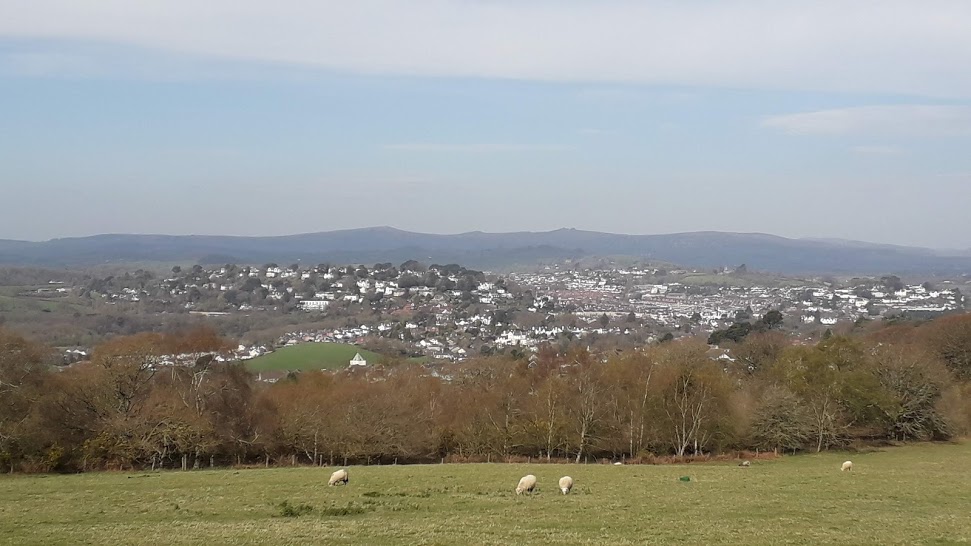
Number four - beautiful views.  This is my hometown from Milber Down hillfort, where we took our once-a-day walk today.  Bellissimo, bellissimo, bellissimo!