Sunday, 22 May 2016

A Bug's Life

What's creeping in the undergrowth this week at Oak Tree Drive?  Most probably it's slugs and snails, the bane of my life these last few weeks, for they destroy everything, from my tender argyranthemums to my aspiring sunflower plants.  Even my mint has been ravaged, which is a new one on me, so these last few nights, I've taken to the garden armed with torch and trowel, to try and remove a few of the hungry little beasts from my garden.  It wasn't all slugs, however, as last night saw the return of a powerful ally and lifelong friend of the gardener, the slow worm.  A prolific slug-eater - thank goodness, maybe some of my plants will be allowed to come into flower after all.

An adult slow worm

We've seen all manner of creepy-crawlies recently, many of which are a tell-tale sign of May.  Last week, a cockchafer - or May bug - flew through the bathroom window, the first I've seen for many years, instantly recognisable by the aggressive sound of its buzzing.  The May bug is, of course, a quite harmless, clumsy little thing.  The six leaves on its unique antennae showed that this one was a female (males have seven.)  We've also been visited by a couple of scarlet lily beetles, which are apparently attracted to fritillaries, a few of which I popped into the garden a couple of months ago.  The beetles squeak when feeling threatened, to shock and frighten a predator such as a bird, or unsuspecting gardener!


A May bug in the bathroom
Scarlet lily beetles on the stem of a fritillary

Last week, we took a walk over the hills of South Devon, to the village of Coffinswell (see my October 2015 blog for more on that village.)  It was a stunning blue-skied day, and butterflies were out in force, with orange tips, red admirals, and large-and-small whites fluttering over the fields and around the hedgerows, visiting the abundant stitchwort, red campion and bluebells.  Our enjoyment was complete on the return walk, when a damselfly drifted lazily across the air - a "beautiful demoiselle," one of only two species of damselfly to have coloured wings, which grow more metallic with age.  From what I have learned, this particular individual is an immature male - although what it was doing in our neck of the woods is less clear, for this is a species that favours fast-flowing streams and rivers.


Male orange-tip butterfly
A "Beautiful Demoiselle" damselfly

The diversity that can be found in the garden or just on the doorstep is amazing at this time of year, so much so that I haven't even got around to giving a garden update.  All of that - including the first appearances of greenfinches, bullfinches and woodpeckers on our plot - will have to wait until next time!

Tuesday, 17 May 2016

Cooking heaven!

My word, this one has been on our minds for a while!  I must admit, we've put redecoration of the kitchen off, then off again, because of the daunting amount of chaos it would generate.  Having the entire contents of our cupboards - pots, pans, plates, food, the microwave - piled up high on our dining table is not my idea of how to keep a tidy home, but three weeks ago we bit the bullet, poured out the paint, and got started.  Every evening since then - and every weekend - has felt like a thousand years of sanding, priming, painting (and repeat...) through four walls, three drawers, 13 cupboard doors, cabinet ends, skirting boards, door frames... if it was there, the chances are we painted it.  But in the end, we turned it from this:


Into this:


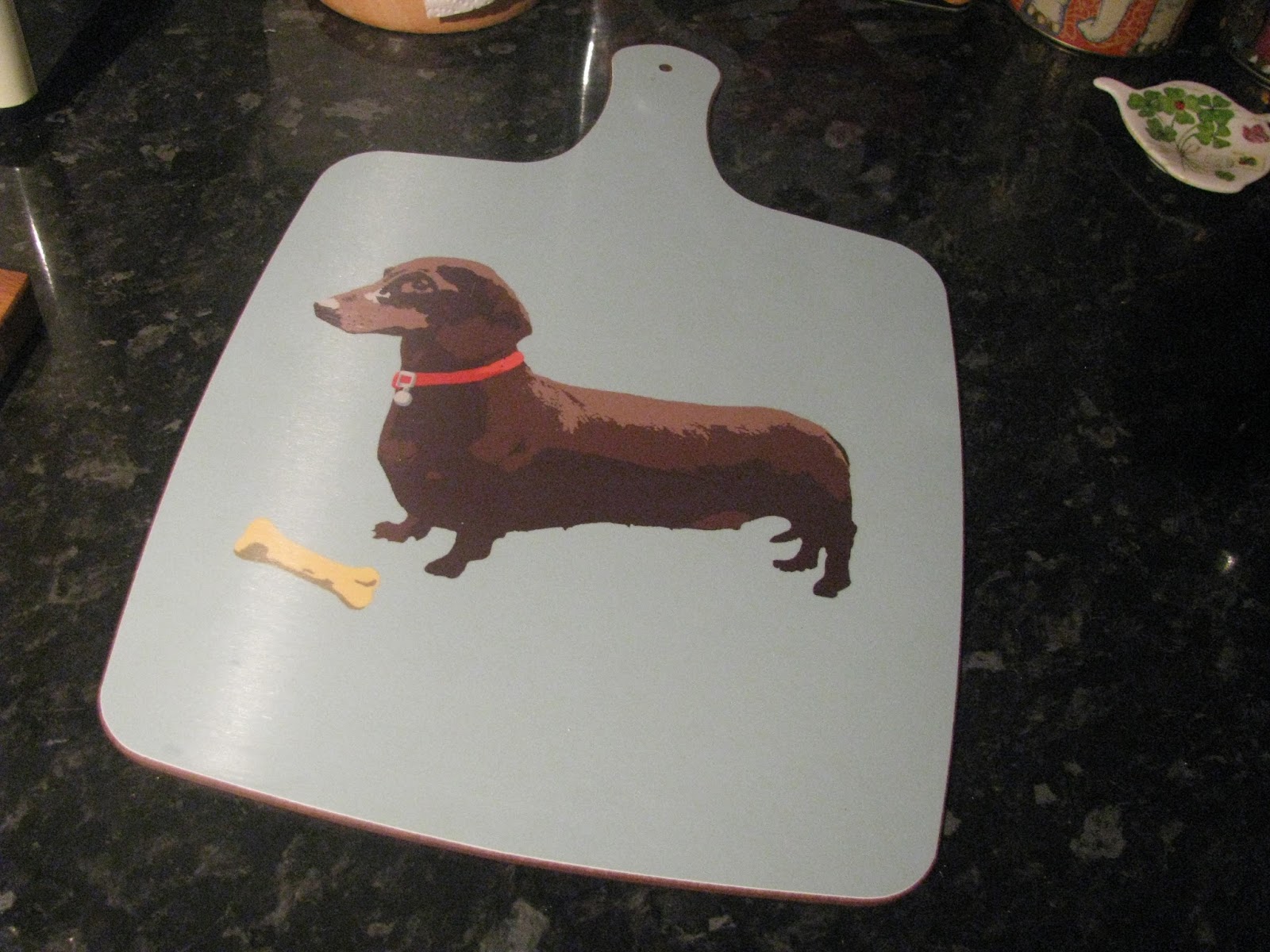
So, now that we've reached the end of this madcap project, what do we like best?  Well, there's a lovely new bread bin, toaster and kettle, tying in with the airy Mediterranean feel that we were looking for, which also fits perfectly with Lizzie's Dachshund serving board (a find from the amazing Pug & Puffin of Lyme Regis.)  We also got hold of a nice cast iron casserole dish which I've had my eye on for a while, along with a splendid wine crate, and some continental olive oils and vinegars.  This is, of course, first-and-foremost a working and cooking space, so we've added a swanky new fruit and veg crate, as well as an inoffensive little compost caddy, keeping every utility perfectly on-hand.  Finally, every kitchen should have its favourite herbs - on our windowsill it's basil, thyme and chives, complementing the rosemary, oregano and mint which grow happily in the garden.


To finish the space, we took a trip to Newton's Frames and Boxes for a browse at their selection of pictures and prints.  We ummed and arred amongst their excellent collection of wall art, before plumping for a Becky Bettesworth print entitled Ooh La La.  Mmmm I don't know about you, but with the Vespa, palm trees and easy-living, I can almost smell the warm seashore of Nice, Cannes, and the Côte d'Azur.


All-in-all, it's been three pretty hard weeks, but the result makes us both very happy - it's a thousand times better than previous, and will at least keep us going until we can afford that complete kitchen refit.  Now the only thing left to do is cook, cook, cook... Oh, and make sure we keep it nice and clean, of course!


Sunday, 8 May 2016

Herge, Tintin, the Nazis, and the Seven Crystal Balls

I've been working my way through the Tintin canon recently, aided by Micahel Farr's Tintin The Complete Companion, the definitive guide that takes you behind the scenes of Herge's mind and back in time to really get to grips with where his boy reporter's adventures originate.  Recently I read the Seven Crystal Balls, dipping in-and-out of Farr's book for added detail and context about this most interesting story.

The Seven Crystal Balls was first serialised in December 1943, in Le Soir, a French-language daily newspaper.  Its opening scenes, as Tintin fans around the world will know, see our hero taking a train out to Marlinspike Hall to visit his friend, Captain Haddock.  It's an innocuous, unmemorable scene that very few readers would give more than a cursory glance.  I, too, would have glossed completely over it, had I not discovered the remarkable story behind these most unremarkable little frames.

For the explanation, you need to fast forward to page 50 of the same story.  Following a visit to a hospital, in which seven brave explorers are fighting for their lives following a haunting curse set upon them by the Incan mummy Rasar Capac, Tintin again makes this journey, in almost identical artistry, to the front door of Marlinspike.  Why is this scene repeated in such similar manner?  Had Herge slipped up, and popped in the same frames twice?  Perhaps he forgot that this scene had already occurred?  Fortunately, with a bit of historical context, you'll get the answer.  

Above: Tintin arriving at Marlinspike Hall on page two.  Below: Tintin's near-identical return on page 50

The year was 1943, and Belgium was three-years-deep in the grip of Nazi occupation.  The Nazi authorities shut down Le XXe Sièclethe paper in which Herge's adventures had been serialised, but the artist soon found work on a French-language publication, Le Soir, who invited him to continue his Tintin adventures with them.  Within weeks of Herge's appointment, this paper too fell into Nazi hands, where it began publishing stories of Wehrmacht successes and other propaganda.  Herge continued producing Tintin adventures against this backdrop, taking his readers on more outlandish adventures (such as the 1942 science-fiction tale The Shooting Star , and the swashbuckling legend of Red Rackham's Treasure in 1943), and avoiding the political themes and current events that had been so prevalent in his earlier works (for example, his criticism of Japanese imperialism in the Blue Lotus in 1934-35; the veiled pop at fascism in King Ottokar's Sceptre in 1939.)  This eventually led to the beginning of The Seven Crystal Balls, a story about the curse of an Incan mummy - a tale sufficiently distanced from war-torn Europe.

Science fiction ruled in the Shooting Star (left); King Ottokar's Sceptre took on a more anti-fascist tone (right)

Roll on 1944 and, midway through drawing The Seven Crystal Balls, the Allied Liberation.  In amongst the new rules laid down by the liberating powers, a ban on work was enforced for everybody associated with the Nazi press.  It was an indignity that must have caused deep grief to Herge - rather like the author P.G. Wodehouse, Herge had been, at worst, naive about his involvement with the Nazi-controlled newspaper, considering his work as bringing a little joy and escapism to its readers during those turbulent years.  Not so in the eyes of the authorities - nor in the minds of a proportion of his compatriots - who considered his involvement in Le Soir an act of collaboration, and his work a marketing force behind Nazi propaganda.  Blacklisted, barred from work, and under official investigation, Herge faced arrest four times in 1944, spending one night in a cell.  Each time he was released without charge.

How did it work out for Herge?  The artist spent his enforced down time re-drawing and colouring older adventures of Tintin, for the publisher Casterman.  He also begun producing comics under the pseudonym Olav, alongside friend Edgar P Jacobs, and by the Autumn of 1945, he had been approached by Raymond Leblanc, a former member of Belgium's wartime Resistance, to help launch a weekly children's magazine.  Leblanc's prominence in the Resistance smoothed Herge's pathway back to work (the Head of Censorship and Certificates of Good Citizenship concluded he was "a blunderer rather than a traitor") and the case against him was finally closed on 22 December 1945, when it was declared that "in regard to the particularly inoffensive character of the drawings published by Remi, bringing him before a war tribunal would be inappropriate and risky."  In a sense, Herge was lucky - several other Belgians working on Nazi-controlled literature were sentenced to life i
mprisonment and even death.

Herge during the war (source: Daily Express)

Receiving his Certificate of Good Citizenship in May 1946, Herge was at last able to work again.  He set about producing the Tintin Magazine, and turned his attention back to his unfinished adventure - The Severn Crystal Balls - which was eventually concluded in 1948.  It is this that makes Tintin's second return to Marlinspike Hall such a fascinating piece of illustration.  In Tintin's deliberate steps up to the main doors for the second time, we glimpse Herge's re-beginning, both of this particular story, and also of his career as an illustrator.  The following scene, in which Tintin is led into the Captain's chamber, also delves deep into Herge's frame of mind during this tumultuous period.  Haddock sits, grim-faced, angry and frustrated.  His butler, Nestor, explains "He's aged ten years since this trouble began..."  It is here, in this otherwise inconspicuous scene, that Herge found a vent for the experiences of the last five years.  It is a scene fraught with the artist's pain.


Herge went on to cement his place amongst the world's very best cartoonists, illustrators, artists and story tellers.  A visionary, he would put his character on the Moon 15 years before Armstrong, dally in real-time global affairs, and even hint at the existence of aliens.  They say that Herge never forgave Belgian society for the way he was treated in the aftermath of Liberation.  Nonetheless, he has gone on to become one of that country's most celebrated sons.

Friday, 22 April 2016

Earth Day 2016

Today marks the 46th Earth Day, a day to celebrate our beautiful planet, inspire people, challenge how we perceive and use our Earth, and motivate people into action.

We are privileged to both live in an unbelievably stunning world, and have the mental capacity to recognise and enjoy it.  From darkest jungle to endless beaches, rugged moorland to arid deserts, there's more variety and diversity here than any of us could possibly comprehend.  Whether you're lucky enough to have trekked through the Amazon, paddled up the Nile, or simply taken a walk around your local nature reserve, you will have witnessed our wonderful world and everything that lives within.  For me, it's sitting back and watching a robin drink from our wildlife pond, seeing badgers on the University campus, or guessing the age of a huge and ancient oak tree.  It is the world that gives me pleasures right on my doorstep, completely free, yet priceless.

Stover lake near Newton Abbot

To promote the day, Google have produced a series of artworks that I think really capture the spirit of Earth in their own unique style.  We've come to expect great artwork from these people, but the latest banners are especially worth a look, and I hope they inspire everybody to think about our world, and ways of making a difference.


As for me and what I'm doing for Earth Day?  The value of wildlife in our garden is really important to us, and is at the forefront of our minds whenever we are working outside.  We're introducing myriad pollinator-friendly plants, maintaining the aforementioned wildlife pond, and providing extra homes, food and habitats for all manner of creatures.  It has been quite a slow start to spring, but some of my favourite residents and visitors to the garden so far include a blackcap (female,) peacock butterfly and comma, whilst out-and-about, we've seen plenty of tadpoles, newly-hatched ducklings, and that fantastic harbinger of summer, the swallow.  I hope everybody enjoys Earth Day!

Swallow (Source: RSPB)

Saturday, 9 April 2016

Garden planning and the curse of April

Oh the curse of April!  New hours of daylight, soft rays of spring sunshine that float down from the heavens to tease and tempt the gardener.  Blue skies, birdsong, emerging bumblebees, and hints of the warm summer season to come.

Followed by a hard frost.

This afternoon I've been busy gathering up all my plants, which have been basking in the good April weather, and turned our dining area into a makeshift greenhouse, in preparation for what the weatherman says will be a cold and frosty night.  It's a slightly frustrating reminder that we're not quite there yet, and that a lack of attention in this changeable month could sound the death knell for many of the more tender - or even not-quite-hardened-off - plants.  Frankly, I've given too much time, care and money to let that happen to my garden, so the whole lot has either come in for the night, or is tucked up in the pop-up mini greenhouse.

Frost protection - a full dining table

Number Three Oak Tree Drive currently resembles one big nursery.  Last year, gardening was all about setting the structure, renovating the space, gathering up the previous occupants' masses of rubbish (disgusting,) digging borders, removing concrete, and attempting to revitalise shrubs that had long since been left to ruin.  This year, it's all about the plants, and we barely go anywhere on a weekend, without coming back laden with various specimens from the local garden centres.  Our windowsills are groaning under the weight of seedlings, the gardening magazines are all well-thumbed, and there's a feverish anticipation with every wander up the garden path.  This is what makes April such a frustrating month.  I'm ready, the garden is ready, but the climate says wait.

The April garden

In my mind, you can divide our garden into three broad areas.  The first, nearest the house, is the grass, which we let grow wild and long, forming a fabulous habitat for moths, butterflies and, later in the summer, grasshoppers.  There's a few wildflowers that will be left to grow amongst the grasses - oxeye daisies are bound to come up, and I've put in some night-flowering catchfly.  

The grass patch is overlooked by our deck, beyond which lies our newly-created borders, formerly a concrete slab and a number of drab, grey, school-playground paving slabs.  This will be our central place for flowers and colour, informally designed in the cottage garden style, with an emphasis on pollinator-friendly plants.  If everything grows, I'm expecting rudbeckia, echinacea, sedum, cosmos, asters, poppies and scabious to grow happily alongside old-fashioned species such as delphiniums, aquilegia, polemonium, and everybody's favourite, foxgloves.  For bees and butterflies, the key is to provide a constant source of nectar and pollen from now until October; right now it's forget-me-nots and primroses, but when the borders really get going, there should be an abundance of flowers - and, hopefully, borders buzzing with life.  This part of the garden is also home to our container pond, which last year attracted frogs and dragonflies, and has this spring been frequented by a splash-happy blackbird.

Forget-me-nots

As you leave the cottage garden and continue up the path, you enter an altogether different space - a woodland bank.  Until 30 years ago, our house was woodland, and the garden has really retained the character of the woodland edge.  Here, wild garlic grows in abundance, periwinkle rambles through the undergrowth, and lesser celandine spreads its bright little flowers over any bare patch of earth.  Over the early spring, we've added some red campion, dug in several foxgloves, and popped in a couple of beautiful cowslips, which really look at home here, so this bank should retain its natural beauty over the next few months.  The woodland end of the garden is also home to our winter border, which has largely gone over now, but will grow anew in October and November, when cyclamen, hellebores, bergenia, and winter aconite will again emerge.

Lesser celandine
Woodland cowslip

What else has been happening in the garden?  Sadly, butterflies have so far been in short supply, limited to a cabbage white and a lovely comma, but I have seen the first bat I've ever seen in the garden, and we are being regularly visited by a lady goldcrest.  We're working really hard to attract and keep all manner of wildlife in the garden, and sights like this really make it worth the effort, so hopefully there'll be much more as the season progresses.

A beautiful goldcrest - a very welcome visitor to our garden

That's it from the garden for now, apart from giving a quick mention to these beautiful new heucheras I picked up today from Plant World, named Georgia Peach - I think their deep crimson colour will work beautifully at the front of the cottage garden border, contrasting perfectly with the blues and greens and cascading informally over the edges and onto the path.

Heuchera Georgia Peach