Showing posts with label Nature. Show all posts

Wednesday, 6 October 2021

A beautiful walk around the Bolderwood Deer Sanctuary

We recently had a few days away in the beautiful New Forest, which has become a favourite place of ours in the last few years.  I love the pace of the forest, which I find to be a capsule of peace and tranquillity in amongst the hubbub of fast-paced modernity.  Here, it feels like things change slowly, if at all, and when I'm in the forest, I get the sense that I'm living the same experience that people have enjoyed for hundreds of years.  There are many walks throughout the forest, of which we've done a few in previous visits.  On this occasion, following a brief stop in Ringwood, we took the slow lanes to the Bolderwood Deer Sanctuary where, on a drizzly day, the forest is exhibiting its first displays of Autumn.

Our walk begins with the Canadian Memorial, a wooden roadside cross set up to remember the Canadian forces who were present in the New Forest on the lead-up to D-Day. The site was chosen because it marks the spot where Canadians frequently gathered for church services.  It's a lonely place, and the juxtaposition of the peaceful forest and the recollection of the Normandy beaches is stark and reflective.  It feels a world away from the horror of war, and yet many Canadians who enjoyed the simple quietude of the forest in 1944, would very shortly lose their lives in the defence of liberty.  It's worth a moment to pause and consider this.

A gravel trackway takes us away from the memorial, across heathland and down into the depths of the treescape.  Sensing the downturn in the weather, the local ponies begin taking shelter in the bracken, and we pass a number of them nestled in the ferns.  Further down the track, signs indicate that we're entering the deer sanctuary, and it isn't long before we spot a couple in the nearby field.  As far as I can work out, the deer here are wild, but the herd is fed daily by the local New Forest keeper between April and September, meaning that they tend to remain fairly local at this time of year. The type of deer here are wild fallow deer, evidenced by their typical spotted coat, and were of course a joy to see.

Beyond the deer sanctuary, we have a good walk in the trees, eventually making our way to an enormous yew tree, which I just have to take a look at.  I'm fascinated by yew trees, mostly because their ancientness makes me marvel at what they have witnessed in the passage of time.  It's amazing to think that the tree I'm looking at could well have been standing when William the Conqueror evicted the peasants to create this forest, nearly 1,000 years ago.  In fact, it could be even older than that - I once read of a yew tree in the grounds of the churchyard at the Hampshire village of Lockerley, which was growing at the time of Christ.  I just love that thought.

Not too far from this tree lies the Radnor Stone, an ornately carved stone dedicated to the late Earl of Radnor, Forestry Commissioner from 1942-63, and Verderer of the New Forest from 1964-66.  One may instantly draw comparisons to the Rufus Stone, and I wonder whether that was the inspiration for this modern memorial.  I suppose if I was a Verderer and a life-long forest man, the location would be perfect for my memorial - untouched by the modern world, sitting quietly amongst the trees, no doubt visited more frequently by deer and ponies than by any human, a lovely place in which to be remembered.

Our walk from here takes us past the north side of the deer sanctuary, and back to the car.  The weather has further deteriorated, but it's been a lovely walk, punctuated by Schnitzel meeting a similar-sized sausage dog in the car park.  William is full of fresh air and fast asleep, so for us it's a slow and scenic drive back through the reaches of the forest to our hotel, where a comfy and cosy bar awaits.

Friday, 25 September 2020

The enduring nature of the New Forest

A much-needed week off for the both of us saw us pack up the car and head east, through lovely Dorset and into the wilds of the New Forest.  I've always loved the New Forest - the peace, the ponies, the important opportunity to reconnect with nature.  And nature is all around, as we found when we took a walk around the Hawkhill Inclosure, between Brockenhurst and Beaulieu.  The walk is a classic bit of New Forest, with strolls along pony paths cut through bracken, areas of dense forest, and sunlit clearings along the way.  An old Irish gent, an ex-military man and his dog Magoo started us on our way, by pointing out that it's hard to get lost - "just listen for the trains" he said, speaking of the nearby railway, " and you'll always be able to work out where you are."  Mr Magoo honed his skills on the northern slopes of Dartmoor, where the mist can descend at an alarming pace, but since retirement as walked the many thousand acres of the New Forest, even drawing up his own maps.


There's a fascinating history to the forest, beyond its creation as a hunting ground for William the Conqueror.  At one point on this first walk, we happened upon a long, straight stretch of asphalt.  This is RAF Beaulieu, a former RAF station.  The Royal Flying Corps used an aerodrome here in the First World War, but we were walking along the Second World War section, built on the opposite side of the main road, and used by both the British and American airforce, as both a bomber and fighter airfield.  The aerodrome closed in the 1950s, and the associated buildings demolished, but the airstrip lives on, fittingly used by flying aircraft model enthusiasts.


Of course, the New Forest's chief historic concern lies in its royal connection, and one of my favourite historic sites of all is the Rufus Stone.  Now, as a monument it's nothing remarkable, but as a sense of place it cannot be underestimated.  Here on 2 August 1100, King William II was killed when a hunting arrow, shot by Sir Walter Tirel / Tyrrell, when it entered his lung.  What has followed has been one of English history's most enduring mysteries - not so much a whodunnit, but more a question of tragic accident, or murder?  Some Chroniclers point out that Walter Tirel was a crack shot with a bow, and most unlikely to make such a fatal error.  Others, however, quickly surmised that the incident was an act of God, one which brought a swift end to a wicked king.  Walter Tirel fled to France after that incident, whilst William's brother Henry, who was in the hunting party that day, rode off to Winchester where he had a row over whether he should succeed the throne (for the older brother, Robert Curthose, was abroad on a Crusade) and eventually occupied Winchester Castle, seizing the royal treasury.  A hastily-arranged coronation followed.  Well, I think I know what I think.


I feel that in a way, the New Forest never really shook off this episode, and as we travelled around the forest, you could almost feel the ghost of Tyrrell lurking in the trees.  It's also got an interesting parallel in my own family history, as reported previously.  Perhaps it's because the forest feels so little changed from all those centuries ago - it's so easy to look out on a silent view and see William's hunting party galloping over the heath.  I felt it throughout our stay here, most notably at Kingston Great Common Nature Reserve, where after a short walk from the roadside we appeared to escape every form of human life and effectively step back in history.  This unchanging character is what I love most about the forest - I know it'll be this way next year, or in ten years, or in another fifty, and in our ever-changing, fast-paced world, this is a source of comfort to me.

Sunday, 6 May 2018

Suddenly Summer!

Well, it's certainly the case that nobody can complain about the bank holiday weather this time around, as we bask in blue skies and full sun, whilst enjoying the all ever-rewarding three-day weekend.  So far this weekend (for 'tis only Sunday evening) we've been quite predictable - a trip for lunch in Torquay, lots of quality time spent in the garden, and a long and rewarding walk in the countryside today.

It was actually one of the most enjoyable walks I've ever been on, as we left the front door and headed over the hill towards the Teign Estuary.  The footpaths and public right of ways here are quick to leave the suburbs, and we were soon strolling in delightfully Devonian lanes, high banks giving way every now-and-then to field gates, from which one leans to take in spectacular views.  The banks were thick with scented English bluebells, stitchwort and red campion, to the delight of all manner of butterflies - peacocks, orange tips, speckled woods the most abundant.  Even better, when we paused at one gate to admire the vista, we noticed a rustling going on at the foot of the gatepost, glancing just in time to see the back half of a grass snake disappear into the undergrowth.  No time for a photo, but certainly a great wildlife moment for me - it's the first wild snake I've ever actually seen.


The lane here eventually wends its way to the village of Netherton, which looks like a lovely place to live, contains many a thatched cottage, and is home to the Mare and Foal Sanctuary at their idyllically-named Honeysuckle Farm.  We soon found ourselves walking through fields of rescued horses and, true to form, Lizzie was soon saying hello to one friendly equine.


Netherton behind us, we eventually came across the estuary, and Coombe Cellars pub, which was in its element in the midday sun.  Sail boats drifted by, people were paddling away in canoes, whilst others looked on from the shore sipping their drinks and watching the world go by.  We found a spot in the shade, and as we listened to the waters lapping the shore, I had the distinct feeling that I was on holiday.  Could you possibly want to be in any other part of the world on such a day?  I couldn't imagine it.


Moving on again, our walk turned from the lovely countryside, and we followed the Teign estuary - still tidal at this point - back towards Newton Abbot.  The walk here follows the historic Templar Way, although they're being a bit liberal when they call it a footpath, for here were slippery rocks and big trees blocking our path.  Nonetheless, it's a very lovely aspect - looking across the water we watched trains come-and-go, whilst up the estuary was the very familiar shapes of Hay Tor and Saddle Tor, and the hills of eastern Dartmoor.  Eventually we reached the A380 road bridge, under which we passed before picking up the Aller Brook, which guided our way home.  A six mile, four-hour adventure that we would both do again in a heartbeat, and no better way to spend a sunny Sunday in our wonderful part of Devon.

Saturday, 31 March 2018

Easter garden

It's fair to say that the garden has hardly sprung into life, during what must have been one of the coldest - and wettest - Marchs for years.  Pretty much nobody in the UK needs a reminder of the weather, which brought heavy snow (twice) and an array of precipitation, from sleet and hail to good old rain.  Hardly a month for getting out and being enveloped by the unfurling spring weather, but we've nonetheless made the best of it here, and have been very busy prepping for the coming seasons of warmth.

Looking around the plot, it's easy to think that winter is still in charge, with plants sensibly deciding to keep their heads down until all is clear.  However, look a little closer and there's more than meets the eye.  There's erysimum Bowles Mauve that never really stopped flowering, providing lovely light purple spikes that are so important for those early-flying pollinators.  Emerging on the woodland bank are snake's head fritillaries, a firm favourite and a flower that seems to relish being in our garden, along with grape hyacinth and cowslips, those lovely English wildflowers that remind me of childhood.  In the shade, pulmonaria - lungwort - has poked its flowers up again (and I have added some more.)  Our camellia, having established itself last year in our ericaceous soil, has also popped out numerous buds, and although they're not long-lasting flowers, they do have a certain regal charm.


On to the main project this month, which is largely spurred by the really tragic news that Sudan, the last male white rhino, died two weeks ago, probably spelling the end of this subspecies (notwithstanding IVF treatment, which we all hope is a success.)  As human beings, we're all responsible for our environment and for ensuring that the diversity of life on Earth continues and flourishes.  When a species becomes extinct, every single one of us, and the whole world, is poorer for it.  When I was a kid in school, we learned about the dodo with fascination, and by the age of 10 understood extinction, along with what we as humans could do to stop it.  Now, short of writing to my MP to urge greater pressure on global environmental issues, I feel powerless to save entire species around the world.  But what I can do is provide suitable habitats in my own sphere of influence, in which local wildlife - which is all under pressure from human activities - can live and thrive.  I get frogs, slow worms, butterflies, moths, bats, birds, and all manner of insects, which make my life a richer and more rewarding place to be.  So whilst there is breath in my body, whilst I have strength to pick up a trowel, or am able to make a wood pile or water a plant, I will not allow that wildlife to starve, be homeless, or to needlessly die.  Life without it would be no life at all, and in my garden, I will do everything in my power to preserve them and give them a home.

Jumping off my soapbox, practically this has meant building a pond, both to draw more wildlife in and to keep what already resides within my fences.  It's not massive, but it's enough to make a difference, and as it establishes, and as the aquatic plants grow and flower, it'll be a new haven for pollinators, along with all the creatures associated with water.  Growing out of the water are natives such as marsh marigold, spearwort, water iris, and golden stripe rush.  Filling the cracks in the slabs, meanwhile, I've added aubretia and erigeron, the "Devon Daisy."  Here's the before and after shots:

Recently, on a trip to the local Oxfam bookshop, I picked up a lovely book called A Selborne Year, publishing pages from Gilbert White's journal of 1784, in which he records his observations in the garden.  It has spurred me, perhaps a little late, to start keeping my own garden journal, a place to record improvements, experiments, and observations about wildlife.  One of my major points of celebration this month has been the visit of a bullfinch to the bird feeder, the first time I've seen them in the garden - it's now in the journal, and will be a great point of reference as the years pass by.


And so we come to the Easter weekend, a time to reflect, a time to be grateful for what we have, and celebrate the rebirth which takes place both in the Christian faith, and also in nature, through the coming of spring.  To me, it's a time for everyone - religious or not - to share in the glories of new life, with all the hope and promise that this represents, and is all the more poignant given the dreadful weather of late.  Now as I write, I realise it's all coming back again - the first bumble bee of spring, the new buds, that wonderful spring birdsong - the first page of the next chapter being written as each day passes, and we once more jump aboard for the journey.  Happy Easter everybody!

Tuesday, 31 October 2017

The rhythm of Autumn

Autumn is in full swing again, bringing with it the usual blaze of colour, chilly skies, and earthy emotions.  The garden is preparing to shut down for another winter - or at least, it is moving into a new phase in its life - as late summer's passionate and exotic hues give way to the season's mellow tones.  For me, autumn is the greatest time of year, offering an opportunity to reflect, to bring in the last of the garden's harvest, and to be thankful for the season of plenty - as well as the festive time to come.  The focus of life, so firmly rooted in the garden over the June, July, August and September, shifts dramatically to indoors now, and leisurely sunshine barbecues and evening al-fresco beers are replaced with hot chocolates, and warming homemade crumbles on the sofa.  Talking of crumbles, Lizzie's first effort of the season is another stunner, made all-the-more pleasing by the fact that all the fruit (and there are apples, blackberries, raspberries, blueberries and blackcurrants) come from our own plot.  They're ingredients that make each-and-every mouthful that much more delicious.


Out on the plot itself, the party has finished amongst all but the hardiest of plants, and the world is bedding down for the cold weather ahead.  There's an urge amongst gardeners to clear and tidy their gardens at this time of year, but I take an entirely different approach, and will largely allow mine to die down naturally.  Fallen leaves and spent stems may not look all that attractive, but they're a God-send to all manner of insects and mammals seeking shelter in the cold nights, and seed heads will provide that extra bit of food to the birds that live in our neighbourhood.  Seed heads also add a wonderfully architectural element to the garden - they can definitely stay for winter.


The season is a very interesting one for those with a naturally inquiring mind, and around the garden at the moment I'm seeing plenty of fungi (including this superb toadstool, below) and a number of oak galls.  Oak galls are formed when an oak tree becomes host to a tiny type of parasitic wasp (Andricus kollari,) which lay eggs on oak buds.  The larvae inject chemicals into the buds to induce abnormal growths which enclose the larvae, giving them a safe space in which to develop.  Oak galls will frequently be seen with a small hole in the bottom - these are emergence holes, which gives you an understanding of just how small these creature are.  As usual, nature is amazing!


November arrives with the first frosts, and by the time I get home from work in the evening, it's already pitch-black.  Over the coming months, I will get but a glimpse of life in the garden, but whilst I leave it to its own devices, I have a strong sense that we're still living on the same rhythm, sharing the beat of the winter as it continues its inexorable march to the spring, when life will once more begin anew, and we will again greet old friends with excitement and vigour.


Friday, 17 March 2017

Early spring in the woodland garden

On an afternoon where spring certainly felt like it had replaced winter, I took a stroll up to the back of the garden, to the woodland bank.  Often overshadowed by numerous trees during the heart of the summer, right now it's an airy and interesting spot, the perfect place to while away some garden time, and a wonderful escape from hubbub of life.

The woodland bank, indeed the whole woodland garden, feels as though it has taken on an air of natural establishment.  The planting here is part-natural, part-manmade, but I really feel - for the first time - like the balance between my work and nature's in settling into rhythm up here.  Nestled into the many ferns that form the backrdop to the main woodland border sit some stunning hellebores, in full bloom at the moment, robust and uncompromising, but a reliable choice for years of uninterrupted pleasure.  It seems to be a very common phenomenon for gardeners to remove the leaves during the flowering hellebores in order to highlight the blooms, but I like to keep mine in the way nature intended - and if this means stooping to get a better view of the flower, then so be it - seeking these things out is one of the joys of gardening to me.


Complementing the hellebores is the rich and dainty purple of the latest addition, pulmonaria - also known as common lungwort or, as I like to call them, lady's cowslips - a perfect woodland plant that I can already tell will become a firm favourite.  I really like these unassuming plants, not just for their flowers (which do strike a remarkable similarity to another favourite, the cowslip) but also for their mottled silver-green foliage.  They've only recently gone into the ground, but they look as though they've always been there, and more importantly, they look like they belong.


I was delighted and surprised to notice that snakes head fritillaries - both last year's, and new bulbs I planted in the Autumn, have come up.  I almost missed the new bulbs, until Lizzie pointed them out, their delicate little heads drooping solemnly and bobbing the the breeze.  Even more of a surprise was last year's plants, for these have returned, only with a white flower instead of the usual mauve.  I'n not really sure why this is, but I'll live with it nonetheless - the colour almost adds to the delicacy.


Dotted patches of daffodils rise high above the new green of the wild garlic to give a timeless, native atmosphere - I feel like the Romans may have seen a similar scene when they clambered around these slopes, two thousand years ago.  Periwinkle rambles through the undergrowth here, and in a few short months, for the promise of summer is a sure one - the bank will be littered with the pinks and whites of myriad foxgloves. The woodland garden will grow, flourish, nurture and delight for months to come - but it all starts here, in early spring.

Sunday, 12 February 2017

February flowers

On a weekend where snowflakes swirled wildly in the air, and hail stones smashed to the ground under thick green-grey clouds, it really has felt like we're in the grip of a long, hostile winter.  From the outside, the garden too takes on this facade of the season, but in a rare half hour of sunshine, where the bitter winds seemed to briefly drop, the onset of spring - even in its most embryonic state - was almost tangible.  This winter has been endless, and the dark, cold months have had a much greater effect on me than usual.  Maybe it's the lack of sunlight, the soullessly damp evenings, or the unfulfilled need to care for, grow and nurture, but I'm impatient to once more spend warm mornings and sunny evenings planting, pruning, and communing with nature.

Last year, our patch of early daffodils were brutally shredded by winter storms, and never really showed their beautiful flowers.  Fast forward to now, and a lovely surprise on my ascent up the steps, which almost saw my heart skip a beat.  They're a particularly early variety, and a very welcome sight, basking in the glory of their own fineness.  I think I get Wordsworth now - perhaps his host of golden daffodils was the first sign of life he saw at the end of a long winter.  


Bulbs are the kings of the early gardening season.  As well as the daffs, croci and tulips are beginning to poke their heads up, with a promise of things to come.  Meanwhile, up in the shady corner of the winter border, another bulb, winter aconite, has began to bring its unabashedly yellow heads above the soil.  Winter aconite has become a favourite of mine, and suits this spot perfectly, where it will flower and die back before the towering trees come back to life and cast their thicker shade.  They share their border with the hellebores - which are also now showing their buds - and the cyclamen which, having flowered all through the darkest part of the year, are now on the wane.  


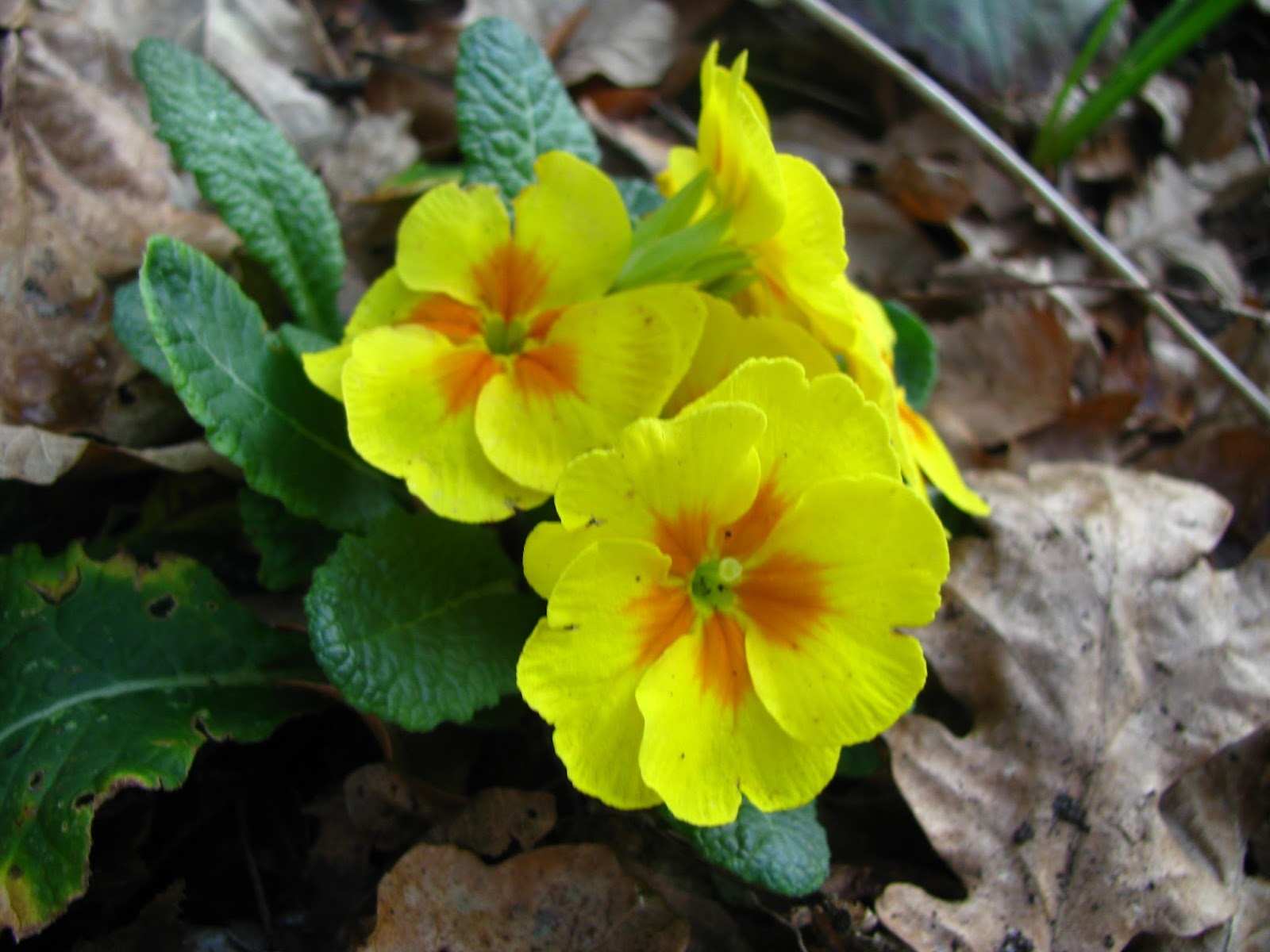
The other stalwarts of the season are, of course, primroses.  Trays of these have been popping up in garden centres across the country over the last few weeks, but there's something especially satisfying about seeing last year's plants coming back into growth, and dotted all around the garden like little paint specks on a canvas.  Primroses are a good choice for any early pollinators and we will, in the next few weeks, be moving into a critical time for all manner of insects, from bees to early butterflies.


Beyond the early flowers, my other source of delight is the somewhat mystical, old-worldly, mysterious witch hazel, whose bare winter branches make for a fascinating visual exploration, and whose catkin-like flowers are a sure sign of February.  To me, witch hazels seem come from another time, from deep forests filled with mythical beasts and wizards' huts, through which only the bravest of knights would dare to pass.  This may not be accurate, but its presence in our garden brings a sense of ancientness and history to the whole garden.


The birds are singing, there's flowers coming up everywhere, the days are getting longer, and the sun - when it does show its head - is a lifter of spirits and moods, and a sure sign that spring, the greatest and most affirming of seasons, has finally gathered its courage and is on the march towards our liberation.  I can't wait.

Saturday, 13 August 2016

Great Big Rhinos!

Three years ago, I blogged about a fabulous series of gorillas that had made its way to South Devon, as part of the Paignton Zoo and Wild in Art initiative to raise awareness around conservation.  It was - and it remains - one of the greatest art trails I've ever seen, taking us from the streets of Exeter to the coast of Torbay, with all manner of places dotted in between.  Following the trail, the gorillas were auctioned in aid of Paignton Zoo's conservation projects around the world - if you're lucky and look hard enough, you can still see one-or-two of them on display in public places.

The memory of the fantastic gorilla trail may have faded, but now we've been invaded again - this time by rhinos - as Paignton embarks on another awareness campaign that has kids and adults alike rushing, camera in hand, to get a glimpse of one of these life-size masterpieces.  Forty-two of them, to be precise.  Our own trail, which is still far-from-complete, began in Exeter, with an immediate favourite, Cath, which makes a thought-provoking statement on conservation.  Beautifully designed, the rhino carries with it the heart of Exeter's stunning Cathedral.  The foundations of Exeter Cathedral were laid nearly 1000 years ago - will we ensure the Javan and Sumatran rhinos have the same time ahead of them?


Another personal favourite is Dino Rhino, a take on the extinction of other once-prevalent species.  The evocative portrayal of prehistoric scenes, mingled with close-ups of long-lost sabre-tooth cats and woolly mammoths, really bring impact to the artist's question, do we really want the rhino to be just another distant memory?


Aquamarhino stands proud in Exeter's Princesshay shopping centre, perhaps a comment on our own consumption of the earth's natural resources.  A net of fish flounder - one brilliantly incorporated into this rhino's eye - suggesting that if our current trends continue, even more biodiversity will be wiped out of existence.


Down in Torbay, the rhino madness continues with Sun's Out, Horns Out, Lizzie's favourite on the trail, and certainly a fun design that is best suited to Torquay's sea front.  You certainly have to admire the attention to detail - from the splattered ice cream and bright armbands, down to the dainty sandals.


Up on Babbacombe Downs, meanwhile, the rhino Tranquillity surveys what must be the best view on the trail.  This one speaks of a world at peace, of perfect nature cooling down under the watercolour of an African sunset.  Perhaps the artist is giving us a glimpse of what we should enjoy, value and connect with in this world, as well as a reminder that the best things in life really are free.


There are, of course, many more rhinos that we haven't got to yet - Be sure to check out my Flickr page, which I'll be updating as we go around ticking these off the map.  You can - and probably should - also see the Great Big Rhinos webpage, for more about the art trail and conservation of these beautiful, iconic creatures.