We've gone a bit tropical here at Oak Tree. Perhaps it's a throwback to honeymoon, or maybe just a lock-down induced desire to get away, but as I sink back into the armchair, I can almost hear the steel drums being carried on a warm breeze, the palms swaying gently (next door genuinely has a tall one, you know!) and the melodic crashing of the ocean on the far-off reef's edge. Alright, maybe that's not all within earshot, but the weather outside is certainly tropical at the moment, so I'll do my best to match it with the first iteration of my brand new bar cart. It certainly puts me in the mood for a nice rum - what do you think?
Showing posts with label Summer. Show all posts
Tuesday, 18 August 2020
Sunday, 6 May 2018
Suddenly Summer!
Well, it's certainly the case that nobody can complain about the bank holiday weather this time around, as we bask in blue skies and full sun, whilst enjoying the all ever-rewarding three-day weekend. So far this weekend (for 'tis only Sunday evening) we've been quite predictable - a trip for lunch in Torquay, lots of quality time spent in the garden, and a long and rewarding walk in the countryside today.
It was actually one of the most enjoyable walks I've ever been on, as we left the front door and headed over the hill towards the Teign Estuary. The footpaths and public right of ways here are quick to leave the suburbs, and we were soon strolling in delightfully Devonian lanes, high banks giving way every now-and-then to field gates, from which one leans to take in spectacular views. The banks were thick with scented English bluebells, stitchwort and red campion, to the delight of all manner of butterflies - peacocks, orange tips, speckled woods the most abundant. Even better, when we paused at one gate to admire the vista, we noticed a rustling going on at the foot of the gatepost, glancing just in time to see the back half of a grass snake disappear into the undergrowth. No time for a photo, but certainly a great wildlife moment for me - it's the first wild snake I've ever actually seen.
The lane here eventually wends its way to the village of Netherton, which looks like a lovely place to live, contains many a thatched cottage, and is home to the Mare and Foal Sanctuary at their idyllically-named Honeysuckle Farm. We soon found ourselves walking through fields of rescued horses and, true to form, Lizzie was soon saying hello to one friendly equine.
Netherton behind us, we eventually came across the estuary, and Coombe Cellars pub, which was in its element in the midday sun. Sail boats drifted by, people were paddling away in canoes, whilst others looked on from the shore sipping their drinks and watching the world go by. We found a spot in the shade, and as we listened to the waters lapping the shore, I had the distinct feeling that I was on holiday. Could you possibly want to be in any other part of the world on such a day? I couldn't imagine it.
Moving on again, our walk turned from the lovely countryside, and we followed the Teign estuary - still tidal at this point - back towards Newton Abbot. The walk here follows the historic Templar Way, although they're being a bit liberal when they call it a footpath, for here were slippery rocks and big trees blocking our path. Nonetheless, it's a very lovely aspect - looking across the water we watched trains come-and-go, whilst up the estuary was the very familiar shapes of Hay Tor and Saddle Tor, and the hills of eastern Dartmoor. Eventually we reached the A380 road bridge, under which we passed before picking up the Aller Brook, which guided our way home. A six mile, four-hour adventure that we would both do again in a heartbeat, and no better way to spend a sunny Sunday in our wonderful part of Devon.
Location:
Newton Abbot TQ12, UK
Thursday, 24 August 2017
Late summer theatre
We've reached this point in the year. The garden, mature, wise, and brimming with confidence is reaching its crescendo, the long-awaited final explosion of colour, the finale of the season, which brings its hottest, most intense and evocative assault on the senses. No room here for the subtlety of spring past, nor yet for the mellowness of Autumn to come - it's here and now, it's fire-bright, and it's sizzling away in the late summer sun.
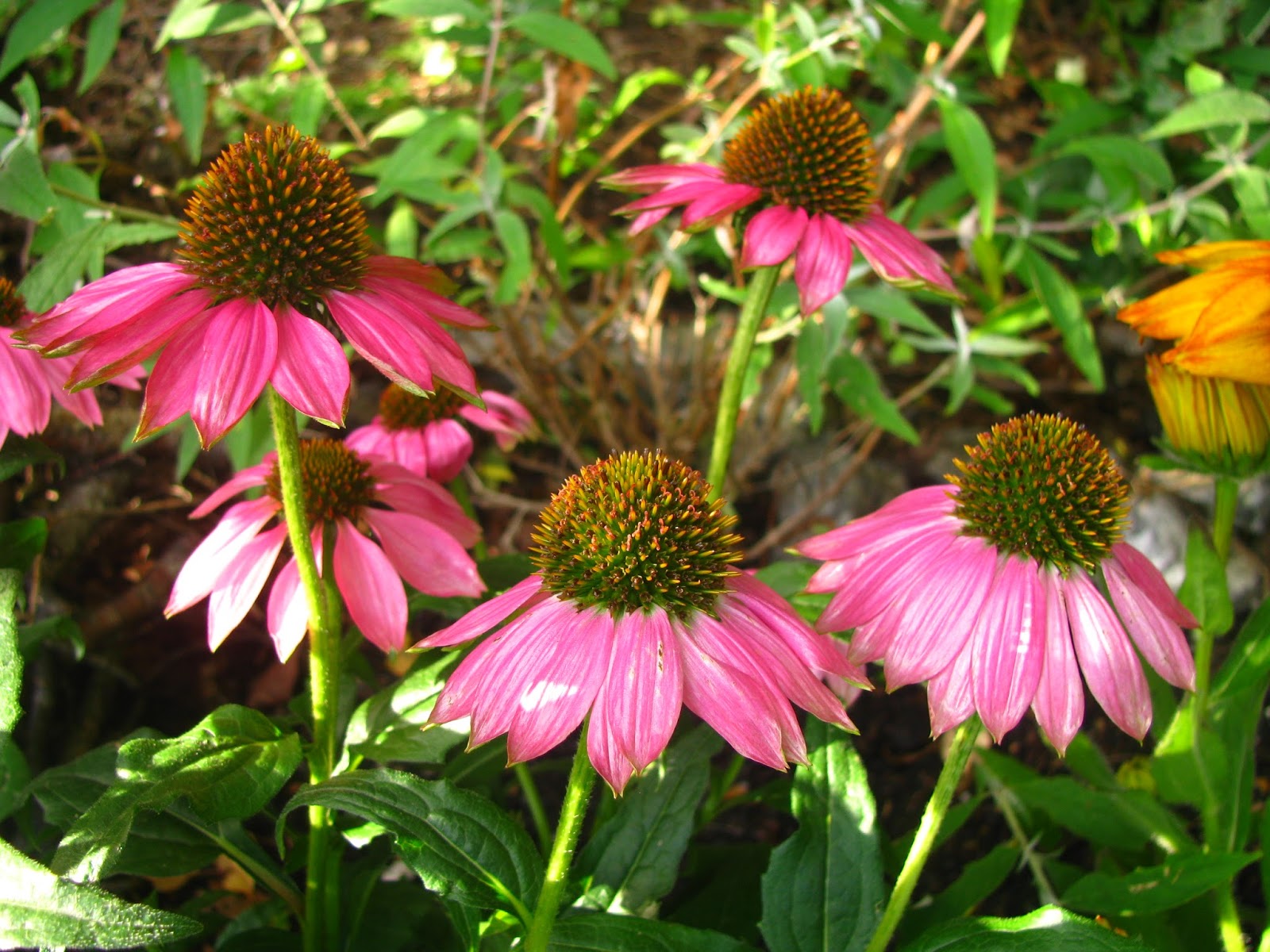
Many of my favourite flowers are coming into season right now. First off, echinacea, a well-known summer staple these days, but one of my most-loved because of its enduring flowers, which should continue uninterrupted to the first frosts. I can't get enough of their lovely flowers, whose seed heads grow more pronounced with age, and attract a plentiful supply of pollinators, including our resident population of gatekeeper butterflies. Secondly, echinacea's native American cousins, rudbeckia, which comes in a whole range of varieties, some of which seem particularly tasty to the local slug population. The standard is Rudbeckia goldsturm, whose cheery yellow flowers please the soul, but there are many others, including prairie sunset, summerina, and toto. My experience this year tells me that slugs and snails are much more drawn towards these fancy varieties - and not just towards the leaves - flower heads are grazed bare, and new buds chomped down before ever having the chance to open. Nonetheless, there are some things you just have to accept when gardening, and at least by focussing on these plants, the pests are ignoring several others.
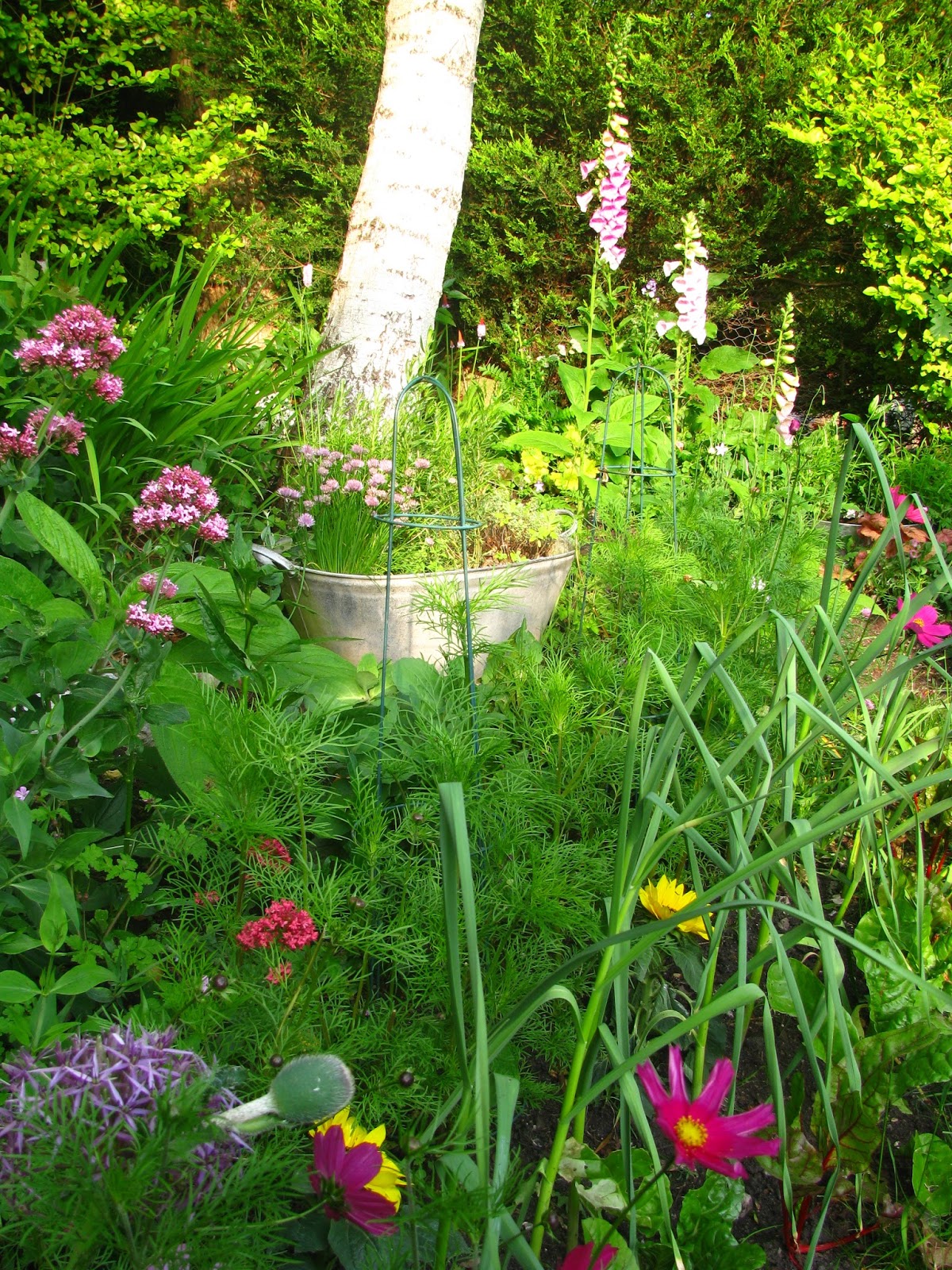
What I love about my herbaceous border this year, is the way that it seems to be blending so effortlessly with the woodland bank beyond. They are, of course, two totally different worlds - one natural and native, the other naturalised but undeniably artificial - but it has been a key aspect of how I am gardening here to blend the two, whilst simultaneously acknowledging their difference. I liken this border to the old-fashioned country cottage garden, sitting on the periphery of the countryside proper. To this end, I've got hold of three climbing frames that resemble, in my mind, the windows of an old abbey. It forms a barrier through which the oak tree can casually poke its new leaves, and upon which honeysuckle can clamber to its heart's content. It feels like a little bit of old England, a place through which a medieval monk would perhaps once have strolled.
Meanwhile down on the deck, I've been busy creating a little area that I call "the plantsman's corner." It's sited on our lower deck, where you can easily be hit in the head by tumbling buddleia flowers, providing a real hideaway from the rest of the garden, if not the entire neighbourhood. It has completely changed the feel of this little corner, turning it into a restful space in which I want to actively sit, to watch the world go by, listen to the bees, or read a book. It's now home to my autumn raspberry pot, asters, heucheras, and an interesting variety of penstemon - penstemon digitalis - worth a place for its foliage alone, with its deep crimson and green leaves contrasting each other to perfection. I also popped in a lovely red echinacea here, although as per the above paragraph, it has already felt the full weight of the slugs' appetite, who have eaten entirely through its blooms.
Finally today, and to our next instalment of "nicking other people's gardens and pretending they're part of your own," here's next door's stunning kniphofia, a patch which came up a couple of weeks ago, and have had me mesmerised ever since. The 25-or-so flower heads are enough to make me (proud owner of one flower earlier this summer) mad with envy. It seems to me that few flowers look so good in a clump as the red hot poker, and this really is a lovely little patch - something to aim for with my own stock next year.
Late summer is a beautiful, but fleeting, time of year. With my planting scheme, it's the real star towards which I've been aiming since March, but now that we're here, you can almost feel the tremble of the earth, as Autumn begins its slow encroachment. Blackberries are ripening fast, the leaves of the blueberry bushes are slowly fading into sunset tones, and there's a distinct increase in the number of spiders spinning webs across the pathways and between tree branches. I caught this one sitting patiently across our wildflower patch - it's a sure sign of where we are in the season.
Location:
Newton Abbot TQ12, UK
Friday, 30 September 2016
Farewell old friend!
April, come she will
When streams are ripe and swelled with rain;
May, she will stay,
Resting in my arms again.
June, she'll change her tune,
In restless walks she'll prowl the night;
July, she will fly
And give no warning to her flight.
August, die she must,
The autumn winds blow chilly and cold;
September, I remember,
Location:
Newton Abbot TQ12, UK
Tuesday, 30 August 2016
Between the seasons
We are caught somewhat between the seasons. The saucy, steamy, intense tones of August invoke a tale of perpetual summer, but slowly the mind wanders, from one page of the calendar to the next, and there's a realisation that, counter to the evidence on the ground, the year is slowly, yet irreparably, slipping away. First, though, to the endless summer, and my favourite plant of the last few weeks, this stunning coreopsis rosea. The label said it was a good one for the mid-border, as the mass of dainty flowers could be seen from some distance, and it certainly didn't lie. Even better, it's buzzing with bees, hoverflies, and the occasional butterfly. What I love most is that the plant's attraction isn't bound by its flowers - the foliage is beautiful in its own right. It's not fully hardy, so there's a question mark over whether it'll make a return next year; if not, it's certainly going out with a bang.
It's fair to say that my herbaceous border is the one spot of colour in a garden that is slowly nestling into the forthcoming autumn. It looks like it has more fight left too, with an intensity that is refusing to give way. Rudbeckia summerina yellow is the undeniable king here, its long-lasting fiery flowers lording it over all they survey. Other delights include fragrant oregano and lavender, whilst round the corner, the little skirts of heleniums blaze a trail into one of next year's projects, thus unknown, but possibly a spring border. I'm delighted with my late summer border, not least because less than two years ago, this was mostly concrete:
Up the side of the garden, where the land slopes and the soil is dry, thin, poor and shady, I've set about the process in a more naturalised manner. Foxgloves, periwinkle and a honeysuckle have now joined the dormant-lying polemonium (Jacob's ladder) and primula vialli, and with the introduction next year of red campion and snake's head fritillaries, we'll very much be looking at a patch of native flora - surely a perfect stop-off for moths and butterflies, and a perfect hunting ground for slow worms - rather like the one I disturbed recently in just this location.
Autumn is coming, but this year I'm determined to have a garden with interest extending through all twelve months of the year. This weekend, I popped in some new cyclamen, whilst also admiring the first green foliage of last year's returnees. Along with hellebores, cyclamens are my heroes of winter, flowering for months and not ceasing until they can pass their baton onto a successor - usually the primrose, crocus or early daffodil. So whilst the sun is still relatively high in the sky, and the heat of summer is still in full swing, it's fair to say that a part of my mind is somewhere in the midwinter, crunching through the frosts to enjoy these little wonders which, although they inhabit the same garden, know a very different world.
The birds have long since stopped singing, late summer flowering shrubs such as buddleja are finally on the wane, and there's even a small collection of freshly-laid leaves gathering in the corners. This is the time of year when I begin to most strongly sense the rhythm of nature, through the reassuring chirp of the grasshoppers and the reliability of the blackberry crop. The enjoyment of a season is always heightened by the firm understanding that everything is finite, yet will infinitely be followed by another - different - opportunity. For me, the summer-autumn divide is the most soulful and reminiscent of the seasonal changes - it is all-encompassing, and is perhaps the one time when I see the garden, the year, the wildlife, and all the planting, as one whole.
| Coreopsis Rosea |
It's fair to say that my herbaceous border is the one spot of colour in a garden that is slowly nestling into the forthcoming autumn. It looks like it has more fight left too, with an intensity that is refusing to give way. Rudbeckia summerina yellow is the undeniable king here, its long-lasting fiery flowers lording it over all they survey. Other delights include fragrant oregano and lavender, whilst round the corner, the little skirts of heleniums blaze a trail into one of next year's projects, thus unknown, but possibly a spring border. I'm delighted with my late summer border, not least because less than two years ago, this was mostly concrete:
![]() |
| Before - September 2014 |
| After - August 2016 |
Up the side of the garden, where the land slopes and the soil is dry, thin, poor and shady, I've set about the process in a more naturalised manner. Foxgloves, periwinkle and a honeysuckle have now joined the dormant-lying polemonium (Jacob's ladder) and primula vialli, and with the introduction next year of red campion and snake's head fritillaries, we'll very much be looking at a patch of native flora - surely a perfect stop-off for moths and butterflies, and a perfect hunting ground for slow worms - rather like the one I disturbed recently in just this location.
| Young slow worm... and lunch? |
Autumn is coming, but this year I'm determined to have a garden with interest extending through all twelve months of the year. This weekend, I popped in some new cyclamen, whilst also admiring the first green foliage of last year's returnees. Along with hellebores, cyclamens are my heroes of winter, flowering for months and not ceasing until they can pass their baton onto a successor - usually the primrose, crocus or early daffodil. So whilst the sun is still relatively high in the sky, and the heat of summer is still in full swing, it's fair to say that a part of my mind is somewhere in the midwinter, crunching through the frosts to enjoy these little wonders which, although they inhabit the same garden, know a very different world.
| Cyclamen |
The birds have long since stopped singing, late summer flowering shrubs such as buddleja are finally on the wane, and there's even a small collection of freshly-laid leaves gathering in the corners. This is the time of year when I begin to most strongly sense the rhythm of nature, through the reassuring chirp of the grasshoppers and the reliability of the blackberry crop. The enjoyment of a season is always heightened by the firm understanding that everything is finite, yet will infinitely be followed by another - different - opportunity. For me, the summer-autumn divide is the most soulful and reminiscent of the seasonal changes - it is all-encompassing, and is perhaps the one time when I see the garden, the year, the wildlife, and all the planting, as one whole.
| Rudbeckia summerina yellow |
| Late summer colour |
Location:
Newton Abbot TQ12, UK
Tuesday, 5 July 2016
A million miles from anywhere
Last week, Lizzie and I hit the Atlantic Highway through Cornwall, destination Padstow. Now, even though I'm a born-and-bred Devonian, the land across the border has always been something of a mystery to me - for no particular reason, I've seldom visited Cornwall in my life thus far - but the little north coast port is a favourite of Lizzie's and, as it turns out, is a delightful place to while away a day or two, especially if you're staying at a hotel as pleasant as the Metropole.
Padstow itself is a town of fine atmosphere, with a friendly mix of visitors and locals alike, centred around the little harbour, from where its fishing industry makes this more than a simple tourist hotspot. The myriad coastal shops are mostly rather lovely, and sell all the usual seashells and model boats, but there's also a luxury element to their wares - fine cookware and foodstuffs are a reminder of the town's affinity with cuisine, and the name of Rick Stein can be seen at every turn (hence the town's alternative name, 'Padstein.') We didn't see Rick on our trip, but were nearly knocked over by Paul Ainsworth, who was in the act of transporting a bottle of bubbly to one of his restaurants. Beyond the numerous shops and restaurants, one has to mention the war memorial, sat with prominence over the estuary, and notable for the adjacent wildflower meadow, stunning in the evening sunshine.
One of the town's top-rated attractions is the National Lobster Hatchery, which is dedicated to marine conservation and seafood sustainability. The centre is looking to combat the over-exploitation of the local waters, by working with fisheries to conserve the vulnerable lobster population, and through their work, both biodiversity and the local fishing community stand to benefit. When local fishermen catch a pregnant lobster they bring it here, and within the maternity tanks, the team grow baby lobsters from the eggs, leading them through their most vulnerable stage, before they are released back into the wild around the Cornish coast. It is reckoned that, in the wild, one in 20,000 lobster hatchlings will live long enough to breed - last year, 53,000 juveniles were released into the wild, so the benefits to sustainability are really very clear.
Taking the ferry across the Camel Estuary, and no doubt skimming over thousands of lobsters beneath, we make next for the settlement of Rock. If Padstow retains some of the grit and salt of fishing in its blood, then Rock is by contrast the playground of the rich. Properties here, which must hit six zeroes, are afforded spectacular views of the estuary, the beaches, and the ocean beyond, and the sailboats bobbing gentle in the breeze suggest a life of leisure. Rock Beach itself stretches off beautifully into the distance and out of view, and as we find a suitable spot to enjoy a Chough Bakery pasty, I notice a number of sand martins flitting across the beach, and diving into little sandstone nests. It also hasn't gone unnoticed that there's an awful lot of 'beach aster' in Rock, instantly recognisable because I'm growing it at home - perhaps one day, I'll end up with a display as magnificent as this.
Arriving back in Padstow, there's just enough daylight left to take a stroll along the coast path and into the countryside. In no time at all we've completely left the town behind us, and are in the middle of a glorious meeting between two worlds - to the left, wheat fields stretch away under playful swallows, whilst to the right, the cliffs give way to golden beaches. It's an amazing feeling of contentment to stand, wind blowing in your face, a million miles from anywhere - I get now why people flock here from all over.
A beautiful couple of days in this lovely corner of Cornwall, over all too quickly as we pack our bags and make our way back up the A30, vowing to return, and uttering the words: "Oh, we could easily do it as a day trip." I think it's fair to say, we haven't seen the last of Padstow.
| The Metropole Hotel, the 'Pride of Padstow' |
| Padstow |
Padstow itself is a town of fine atmosphere, with a friendly mix of visitors and locals alike, centred around the little harbour, from where its fishing industry makes this more than a simple tourist hotspot. The myriad coastal shops are mostly rather lovely, and sell all the usual seashells and model boats, but there's also a luxury element to their wares - fine cookware and foodstuffs are a reminder of the town's affinity with cuisine, and the name of Rick Stein can be seen at every turn (hence the town's alternative name, 'Padstein.') We didn't see Rick on our trip, but were nearly knocked over by Paul Ainsworth, who was in the act of transporting a bottle of bubbly to one of his restaurants. Beyond the numerous shops and restaurants, one has to mention the war memorial, sat with prominence over the estuary, and notable for the adjacent wildflower meadow, stunning in the evening sunshine.
| Padstow's war memorial |
| Wild flowers by the war memorial |
One of the town's top-rated attractions is the National Lobster Hatchery, which is dedicated to marine conservation and seafood sustainability. The centre is looking to combat the over-exploitation of the local waters, by working with fisheries to conserve the vulnerable lobster population, and through their work, both biodiversity and the local fishing community stand to benefit. When local fishermen catch a pregnant lobster they bring it here, and within the maternity tanks, the team grow baby lobsters from the eggs, leading them through their most vulnerable stage, before they are released back into the wild around the Cornish coast. It is reckoned that, in the wild, one in 20,000 lobster hatchlings will live long enough to breed - last year, 53,000 juveniles were released into the wild, so the benefits to sustainability are really very clear.
| Charlie the spiny lobster, one of the centre's residents |
| A juvenile lobster |
Taking the ferry across the Camel Estuary, and no doubt skimming over thousands of lobsters beneath, we make next for the settlement of Rock. If Padstow retains some of the grit and salt of fishing in its blood, then Rock is by contrast the playground of the rich. Properties here, which must hit six zeroes, are afforded spectacular views of the estuary, the beaches, and the ocean beyond, and the sailboats bobbing gentle in the breeze suggest a life of leisure. Rock Beach itself stretches off beautifully into the distance and out of view, and as we find a suitable spot to enjoy a Chough Bakery pasty, I notice a number of sand martins flitting across the beach, and diving into little sandstone nests. It also hasn't gone unnoticed that there's an awful lot of 'beach aster' in Rock, instantly recognisable because I'm growing it at home - perhaps one day, I'll end up with a display as magnificent as this.
| Young sand martins |
| Erigeron Glaucus 'Sea Breeze" - the beach aster in abundance |
Arriving back in Padstow, there's just enough daylight left to take a stroll along the coast path and into the countryside. In no time at all we've completely left the town behind us, and are in the middle of a glorious meeting between two worlds - to the left, wheat fields stretch away under playful swallows, whilst to the right, the cliffs give way to golden beaches. It's an amazing feeling of contentment to stand, wind blowing in your face, a million miles from anywhere - I get now why people flock here from all over.
| On the coast path |
![]() |
| Pause for a photo on the coast path |
A beautiful couple of days in this lovely corner of Cornwall, over all too quickly as we pack our bags and make our way back up the A30, vowing to return, and uttering the words: "Oh, we could easily do it as a day trip." I think it's fair to say, we haven't seen the last of Padstow.
| Rock Beach, looking over to Padstow |
Location:
Newton Abbot, Devon TQ12, UK
Wednesday, 8 June 2016
Ten reasons to love the garden now
It's June, the weather is warm, and the garden is starting to come into its own. A quick stroll up to the summerhouse and back revealed a whole host of new and exciting developments, showing that even if you take your eye off the ball for only a day or two, nature is ceaselessly whirling away creating. Gardening is, of course, a blink-and-you-miss-it way of life, but here's ten things happening now at Oak Tree Drive that simply make the heart sing.
1. Foxgloves are coming into their prime. After what seems like an eternity, these reliable natives are bringing a party full of colour to the woodland bank. They're also looking stately in the cottage garden theme, and what's more, the bumblebees are going crazy for them.
2. Birdsfoot Trefoil has arrived. I popped a couple of tiny plants into our wild grass area back in late winter, and today it has almost exploded onto the scene. Billed as an ideal plant for the wildlife garden, this is a food plant for many species of caterpillar, so hopefully the garden will be fluttering away forevermore.
3. Love-In-A-Mist seeds everywhere. Last year we had it in abundance in the front garden, and this year I grabbed some seedlings and planted out the back, where they've taken exceptionally well. A real beauty in my informal borders, and one that will flower for weeks to come, this is one of my personal faves.
4. Beach Asters - Erigeron Glaucus Sea "Breeze" - with their delightful daisy flowers and stunning pink petals, evoke memories of seaside holidays and walks through the dunes. I wasn't sure if these would take in our garden, so I was delighted to see the first flower heads form. Even better, the slugs have almost entirely ignored them.
5. What's better than a frog in your wildlife pond? Well, how about four frogs? I finally snapped a clear photo of one of these little croakers one evening last week - at this time, there were two more in the pond, and another skulking in the border.
6. Astrantia Major is looking regal, poking its delicate heads through the partial shade and into the sun. Apparently an old cottage garden favourite, this is a new one for me, but one I'll definitely look to expand upon as the years go by.
7. Red campion (left) is in its element. Just take a look around the hedgerows, roadside verges, and woodland and you'll see it in abundance. A great choice for our woodland garden, as it kicks into gear just as the bluebells and wild garlic fades away.
8. Primula Vialii (right) look exotic and exciting, yet grow brilliantly in our climate. I think they add a touch of class to the border, bringing the perfect mix of both jewel and woodland gardens.
9. The birdsong this spring has been exceptional, and it shows no sign of stopping yet. Just take a listen:
10. Summer fruits are on the way. It'll be a good few weeks yet, but the flowers and fruits of blueberries, strawberries, raspberries and blackberries are there for all to see. I can't wait to taste the first crumble of the year!
Location:
Newton Abbot, Devon TQ12, UK
Subscribe to:
Posts (Atom)