Showing posts with label Coast. Show all posts

Monday, 18 November 2019

A happy Burgh-Day

Well first-off, hello again world! Nich About Town has been on hiatus for most of 2019, but the time has now come to foray back into the wonderful online world. Not that anybody's missed out on much of an update since last year's honeymoon, for most of our energy this year has been put into our home's building project - more the follow on that.

So to Autumn 2019, and if it's November it must be (yet another) birthday. Last year, 18 November was spent on a plane flying back from Australia, so this year, as if to compensate, Lizzie secretly booked us afternoon tea at the Burgh Island Hotel. 


So  a little bit about the history. Built in 1927 at the height of the marvellous Art Deco style, the hotel quickly became one of the most popular, a real icon of the era. Its location, oppulence and architecture lent itself to the rich and famous, with notable guests including Lord Mountbatten of Burma (last Viceroy of India); Edward VII and Wallis Simpson; Noel Coward; Agatha Christie; and Winston Churchill. 

The world may long have faded since those confident days, but the hotel appears to have lost none of its charm over the decades. Our table in the Palm Court afforded views of both the beautiful coastline, and stunning bar, stocked to the rafters with every conceivable liquor. Tea, as expected, was top-notch; tasty scones with champagne strawberry jam and cream, sandwiches, cakes, a sumptuous spiced pumpkin creme brulee, and a choice of cocktail on arrival. Well, why not...


All-in-all a lovely place to while away a birthday afternoon, in a place that takes you 90 years back, and a thousand miles away from anywhere. Thanks Lizzie!

Saturday, 1 December 2018

The Great Pacific Adventure - Rarotonga

It's an odd feeling, something approaching culture shock, as our wind-battered aircraft touches down on Rarotonga's airstrip, which sits on the northern coast of the little island, parallel to the crystal-blue seas.  We've left Los Angeles, with its metropolitan population topping 13 million, and arrived in Avarua, national capital of the Cook Islands, and home to 5,445 souls.  The weather is a far cry from the holiday brochures, warm rain tumbling from the skies, and gales viciously bending the surrounding palm trees into new and unusual shapes.  The arrival committee, however, is far more welcoming, and in a lovely local gesture of friendship, we have gardenia garlands placed around our necks as we exit the airport.  There's really only two words you must know here - Kia Orana, as the locals greet natives and visitors alike, meaning "may you live a long and fulfilling life."  I think we're going to like it here.


Our hotel is a self-contained flat sitting just off Muri beach in the island's southeast corner.  Off the beach, the sapphire-blue Muri lagoon is separated from the Pacific Ocean by the coral reefs that surround the entirely of the island.  Here also sit four tree-shrouded motu - little uninhabited islands - which add structure and perspective to the scene.  Save for the venomous stonefish, which is easily avoided by wearing proper footwear in the water, there's no animal here that can kill, maim, or otherwise eat you - it's surely as close as one can ever get to actual paradise.


Our time on Rarotonga is short, and we wish to see both forest and coast on our visit, and so we hop aboard a 4x4 tour, courtesy of Raro Safari Tours, which offers excursions into the island's mountainous interior.  We're not talking any great distance here - at its widest, the island is not seven miles across, and a visit into the middle is half that distance again.  Along the way, we are shown fascinating pineapple and mango plantations, and significant cultural sites such as the Toka Akamaaraanga, a place from which ancestors embarked in little canoes, bound for new islands.  Exploration is a deep-rooted part of the Polynesian heritage, and Rarotongans are proud of the role they played in discovering the islands of the Pacific (which eventually, of course, led to the discovery of New Zealand) long before Europeans arrived in these waters.  Up in the mountains, the tracks are treacherous after the rains, but our driver (who calls himself 'V') soldiers on in the jeep, and we ascend through the mists until we are atop the second-highest point on the island.  From here, the view is exhilarating - lush forest all around, a glimpse of the sea below, and the island's highest point, a granite outcrop called "the needle," just visible through the thickening fog.  Just knowing that we are on nothing more than a speck of land in the middle of the enormous Pacific Ocean is both humbling and invigorating.  I even fancy I can see Captain James Cook and the HMS Endeavor anchored off the shore.


The Muri Lagoon, which has the intriguing property of becoming more beautiful with every look, turns even more azure as the wind and rain dies away, and eventually we are given a full taste of the beautiful South Pacific.  In such a climate, there's only one one thing to do, and so armed with snorkel mask and reef shoes, we set fourth into Pacific waters.  We don't go out too far - perhaps up to waist-height - and although the mainstay of the reef lies further out, we are still treated to a few corals, some dainty fish, and the odd sea slug.  The reef has one other secret that I only learn once the wind has dropped - for our entire time on the island, there's been a constant distant roar, like an aeroplane flying high overhead.  I had put this down to the sound of gales, but realised when swimming in the lagoon that it was actually the waves crashing against the reef edge half-a-mile or so away, a constant thunder in the background.


On our final evening on Rarotonga, we venture up to the nearby Te Vara Nui, the Island Nights cultural tour.  We're taken around a purpose-built centre to learn about the island's history, religion, social government, medicine, fishing, costumes, and coconuts (the 'tree of life.')  After this fascinating tour, we are seated for a buffet dinner, before a full show of dancing, drumming and fire, playing out the story of Tongaiti, a voyaging warrior who sailed into Rarotonga, sending his daughter to marry the island's chief so that Tongaiti and his family would be welcomed. Really, a fascinating watch, and a wonderful display of history and humanity - the perfect memory to take away from our time here.


No sooner has our plane touched down in Avarua, then we are queuing up to board our onward flight.  We've had an unbelievable few days, and grown remarkably accustomed to the stunning lagoon right on our doorstep, the friendly and welcoming locals, and tropical feel.  In Rarotonga, we've found an island that ticks off every reason for travel - an amazing place, well worthy of many more days exploration, and somewhere that neither of us will ever - ever - forget.

Tuesday, 27 November 2018

The Great Pacific Adventure - Los Angeles

"Los Angelenos, 
All come from somewhere
To live in sunshine
Their funky exile
Midwestern ladies
High-heeled and faded
Drivin' sleek new sports cars
With their New York cowboys"

So wrote Billy Joel, in what has been described as a "typical eastern American view of the west coast."  And that's the thing about Los Angeles - we've all got preconceived notions of the place.  Despite never been within a thousand miles of LA, I still feel as though I know it, as do billions of others around the globe, all thanks to the magic of Hollywood. 

It's also not somewhere I've ever clamoured visit, but as one of the Pacific's major transport hubs, there's always been a good chance of winding up there at some point, if only for a day or two - which is how we happened to be there in October.  Our own arrival into West Hollywood is, on its own, a cause of massive celebration, for after being stranded for some time at the international airport, we eventually resolved to take a taxicab through the dimly-lit and seedy underside of the metropolis.  Our driver, who we're sure carried a gun under the seat, drives at about 90mph, but this feels like the lesser of two dangers, and we're in a massive state of relief when he finally turns onto Sunset Boulevard, for what we've seen out of the window confirms our suspicions that this is not an entirely safe or friendly city.  Los Angeles, perhaps more than any other city on earth, has a reputation for a "step on anybody" culture, where success is measured by wealth and property, where there are big winners - but also massive losers.  However, our long journey is rewarded by very friendly hotel staff, and a spacious, safe and quiet room with a view over the distant city skyline.


The next morning, and everything feels so different.  The threatening edge is gone from the atmosphere, and Los Angelinos are making their way - somewhat slowly - up and down the boulevard in their huge pickups.  As we have less than 48 hours here, we opt for the hop-on-hop-off tourist bus, which whizzes around the main sites of Hollywood and Beverley Hills.  Our pick-up is the nearby Comedy Store, a well-known incubator for many of America's top laugh-out-loud acts, and we are almost bundled onto the first service of the day, which arrives 15 minutes late, causing the driver to wave us on without even checking our tickets.  From the top deck, Tinseltown opens up before us - the Capitol Records Building, Melrose Avenue, Paramount Studios - on an exhilarating ride around.


We are eventually deposited at the very epicenter of the show business world - Hollywood Boulevard - whose famous Dolby and Chinese Theater are known the world over (The Dolby hosts the Oscars, whilst the Chinese Theatre has around 200 celebrity handprints on its forecourt.)  In front of them both, and stretching down the the boulevard in both directions, are the Hollywood stars, embedded into the paving as a permanent reminder of film, music and television greats.  in my opinion, they've taken some liberties with who they let join the club, but looking beyond this, all the class acts are represented - Frank Sinatra, Humphrey Bogart, Ingrid Bergman, Audrey Hepburn, and Donald Duck.  It's something of a pass-time to search the stars, and we find many, if not all, of our favourites (note to those searching for the great Bill Murray, his star is not to be found on the Hollywood Walk of Fame - something to do with him riling the establishment up in just the wrong way.)


In all honesty, there's not actually much else to do on Hollywood boulevard, so we take a couple of local buses and navigate our way to Griffith park, home of a famous observatory.  Up here, the whole of the city - and, it seems, the whole of Southern California, are within our frame of vision.  The observatory itself is probably the most interesting place in the city - opened in 1935, it contains a large solar telescope for projecting images of the Sun, alongside the deeply absorbing Foucault pendulum, designed to demonstrate the rotation of the Earth.  Outside the walls of this scholarly institute, those who have made the journey up here are rewarded with the best on-foot views of the famous Hollywood Sign.  Surrounding the entirety of the site, the scrubby, dry landscape hints at snakes and scorpions - although it was the dry land itself that was to make headlines in the weeks following our visit, when the Californian tinderbox went up in smoke, with some of the worst fires in living memory.


The next morning, our bus takes us down the never-ending stretches of Santa Monica Boulevard, to the beach of (funnily enough) Santa Monica.  This is old-school America, its enormous wooden pier hinting at the leisure activities of an earlier time.  Upon the pier, we're instantly attracted to the Bubba Gump Shrimp co. shop, a spin-off from the Forrest Gump film, selling all manner of T-shirts and other merchandise.  The very end of the pier itself is another piece genuine Americana, for at America's very western edge, the pier marks the end (or beginning) of the historic Route 66, which once trundled some 2,448 miles from Chicago, until 1985, when it was officially removed (most of its distance having been upgraded to the great US Interstate system.)


Beyond the pier, we stroll along Santa Monica beach, although the weather is slightly grey, a little squally.  There's good reason for coming here though, for this is my first ever sighting of the Pacific Ocean, the great body of water that will be our almost constant companion for the next three weeks.  As for the rest of of coastal LA - that is, Venice Beach and the Marina Del Rey - they'll have to wait for our next lay-over in the City of Stars, for our time has already run out, and we leave in anticipation of our next destination, which will be altogether more exotic and extraordinary...

Sunday, 6 May 2018

Suddenly Summer!

Well, it's certainly the case that nobody can complain about the bank holiday weather this time around, as we bask in blue skies and full sun, whilst enjoying the all ever-rewarding three-day weekend.  So far this weekend (for 'tis only Sunday evening) we've been quite predictable - a trip for lunch in Torquay, lots of quality time spent in the garden, and a long and rewarding walk in the countryside today.

It was actually one of the most enjoyable walks I've ever been on, as we left the front door and headed over the hill towards the Teign Estuary.  The footpaths and public right of ways here are quick to leave the suburbs, and we were soon strolling in delightfully Devonian lanes, high banks giving way every now-and-then to field gates, from which one leans to take in spectacular views.  The banks were thick with scented English bluebells, stitchwort and red campion, to the delight of all manner of butterflies - peacocks, orange tips, speckled woods the most abundant.  Even better, when we paused at one gate to admire the vista, we noticed a rustling going on at the foot of the gatepost, glancing just in time to see the back half of a grass snake disappear into the undergrowth.  No time for a photo, but certainly a great wildlife moment for me - it's the first wild snake I've ever actually seen.


The lane here eventually wends its way to the village of Netherton, which looks like a lovely place to live, contains many a thatched cottage, and is home to the Mare and Foal Sanctuary at their idyllically-named Honeysuckle Farm.  We soon found ourselves walking through fields of rescued horses and, true to form, Lizzie was soon saying hello to one friendly equine.


Netherton behind us, we eventually came across the estuary, and Coombe Cellars pub, which was in its element in the midday sun.  Sail boats drifted by, people were paddling away in canoes, whilst others looked on from the shore sipping their drinks and watching the world go by.  We found a spot in the shade, and as we listened to the waters lapping the shore, I had the distinct feeling that I was on holiday.  Could you possibly want to be in any other part of the world on such a day?  I couldn't imagine it.


Moving on again, our walk turned from the lovely countryside, and we followed the Teign estuary - still tidal at this point - back towards Newton Abbot.  The walk here follows the historic Templar Way, although they're being a bit liberal when they call it a footpath, for here were slippery rocks and big trees blocking our path.  Nonetheless, it's a very lovely aspect - looking across the water we watched trains come-and-go, whilst up the estuary was the very familiar shapes of Hay Tor and Saddle Tor, and the hills of eastern Dartmoor.  Eventually we reached the A380 road bridge, under which we passed before picking up the Aller Brook, which guided our way home.  A six mile, four-hour adventure that we would both do again in a heartbeat, and no better way to spend a sunny Sunday in our wonderful part of Devon.

Tuesday, 30 May 2017

Goodbye, my Coney Island baby

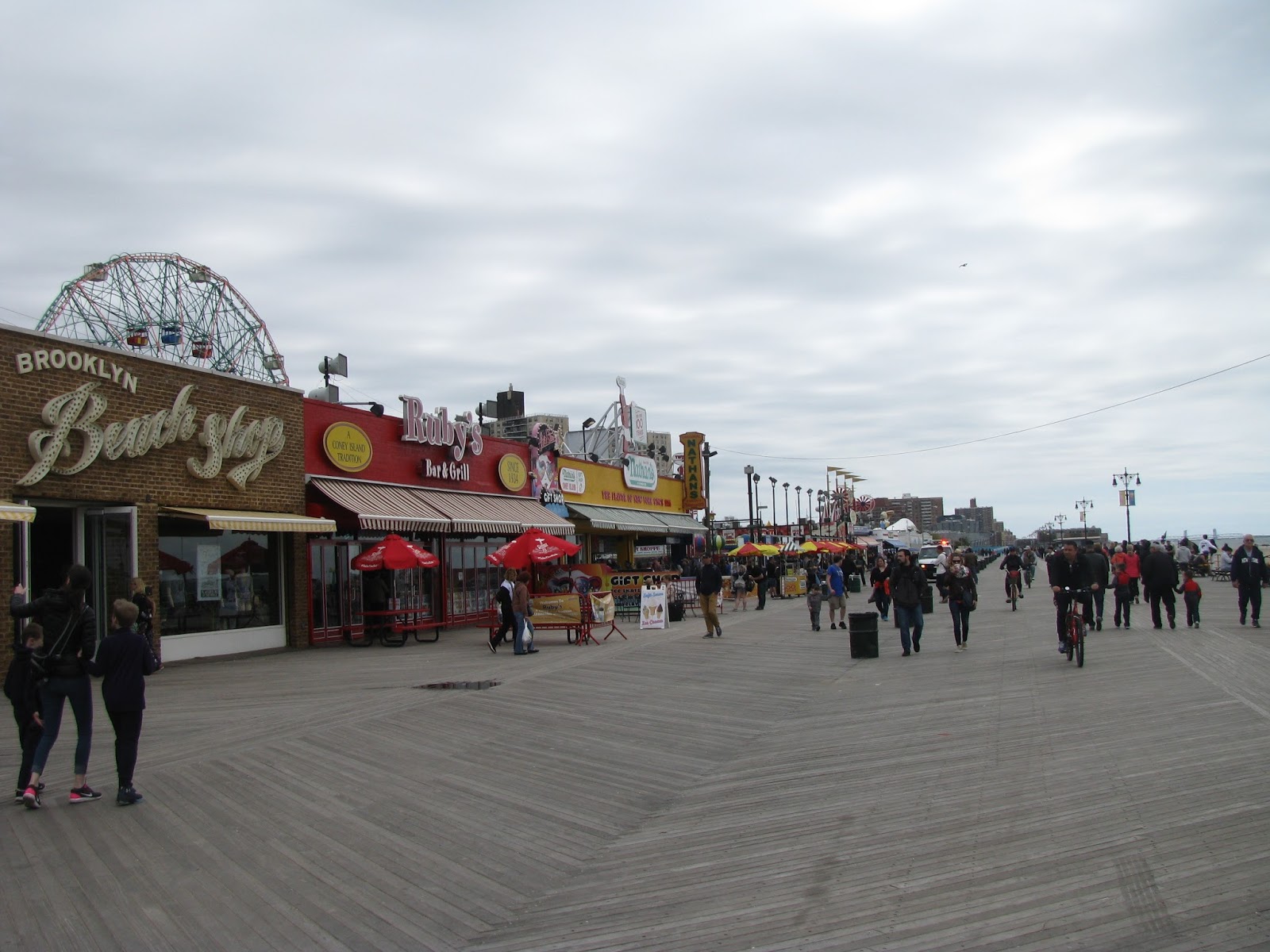
Our final full day in New York sees us jump on the subway for the 45-minute ride out to Coney Island, the self-proclaimed Playground of the World.  We've been lured here by the promise of good, old-fashioned American family fun, an iconic boardwalk, and throwbacks to the roaring 20s, when promenades along the beach and all-in-one stripy swim suits were very much the rage.  By the looks of it, the seaside resort does get very busy in the summer months, as New Yorkers make the short trip out to enjoy building sandcastles and taking a dip in the North Atlantic, but on our April visit, a biting wind cuts across much of the sun's warmth, blowing sand into our eyes, and rendering the beach virtually out of bounds.  Nonetheless, the boardwalk has its own charm, and the variety of shops offer up a few different souvenirs for the discerning tourist.


Coney Island boardwalk
A Coney Island map

First stop, offering shelter from the wind, is the New York Aquarium.  Formerly situated in Battery Park (see Following the Immigrants) the aquarium moved to this coastal location in 1957, and is now part of the Wildlife Conservation Society (WCS) which also oversees the city's other zoos.  The aquarium was rocked in 2012, when it suffered significant damage from Hurricane Sandy, flooding the facilities and shutting down the power supply.  Although staff who remained on-site at this time were able to save 90% of the creatures held there, the ramifications of the storm are still clear for all to see.  An enormous rebuild is therefore underway - even more than four years later - which understandably leaves some of the site inaccessible.


An old-fashioned aquarium mural

What the aquarium does have, however, is a wonderful array of tanks, amongst the very best that I have seen.  In Conservation Hall, we are taken on a journey around the world - the Amazon basin, the African lakes, coral reefs (the aquarium grows its own coral, aiding its sustainability agenda) and marine environments giving a flavour of the wondrous life that exists beneath the waves.  In fact, I've been so impressed by what I've seen, that I've since tried to remodel my own tank on their Amazon biotope.  Outside, there are penguins, sealions and otters, and a large circular tank housing small sharks, a temporary solution until the Ocean Wonders habitat is completed.  The aquarium is also planning an underwater viewing area for the penguins, an Explore the Shore coastal section, and an Alien Stingers exhibit.  Lots more to come back to one day, as they continue their recovery from the deadly force of nature.

A beautiful Amazon tank
A home-grown coral reef

Back on the boardwalk, and there's only one real choice for lunch - Nathan's Famous, who have been feeding this part of Brooklyn with old fashion hot dogs since 1916.  The brand is a popular one, and an American institution - they are the official hot dog providers to the New York Mets and New York Yankees baseball teams - located as they are in an unmissable yellow building, in front of which a sizable crowd is gathered.  We join the queue, and two cheese dogs later, we're pretty satisfied.  Looking around, we also realise that we've ordered on the lighter side, for the food is flying out of the kitchen, and some diners are tucking into weighty portions.

Nathan's Famous of Coney Island
Cheese dogs and fries

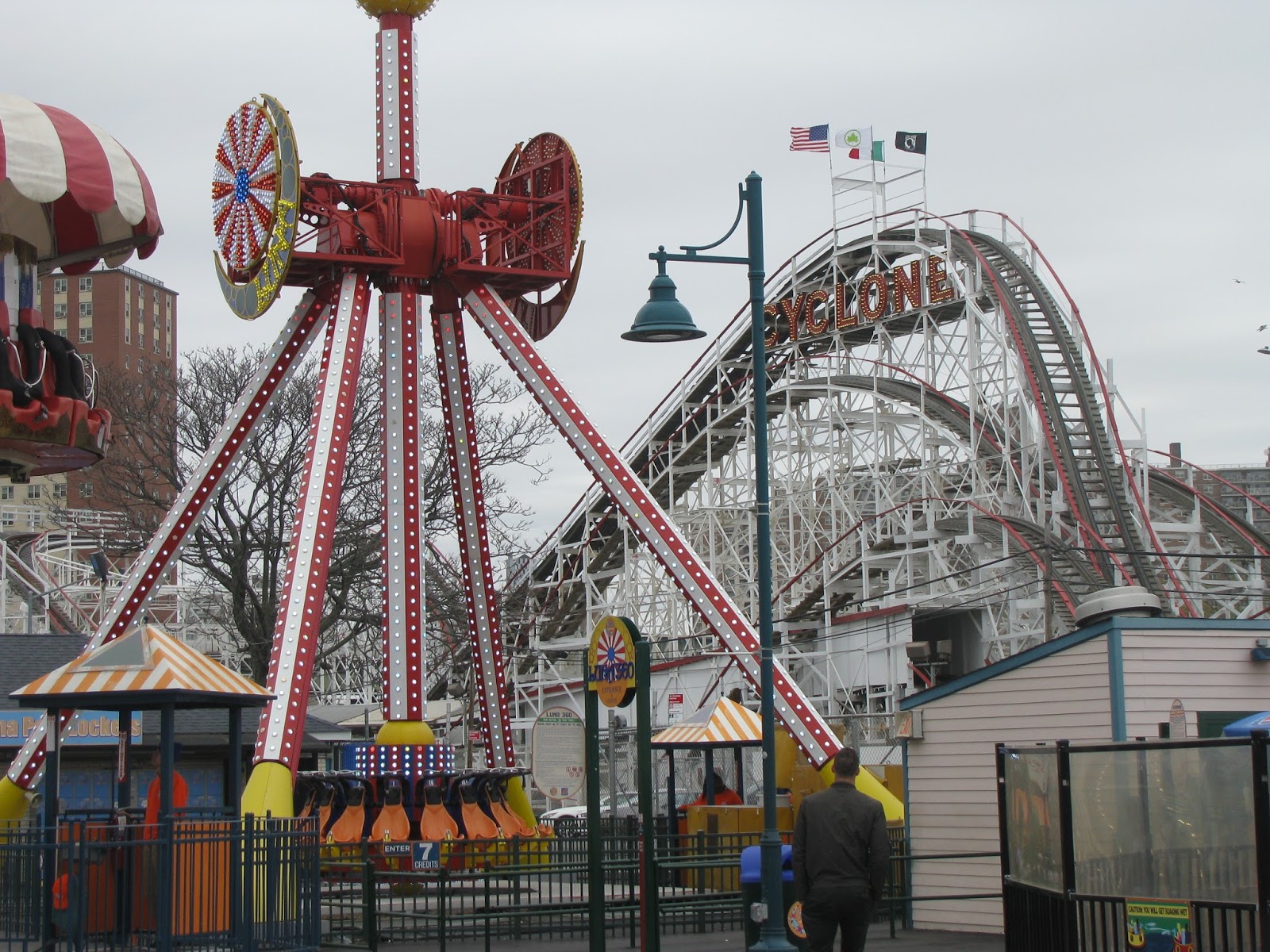
The rest of Coney island is dominated by Luna Park, a sprawling fairground with more than a hint of Paignton to its character.  Central to the park is the Cyclone, a rattling old wooden rollercoaster from the heyday of the amusement park.  A piece of history in its own right, it is known locally as the "Big Momma," with more than 2,500 feet of track and 12 drops.  Would I ride it?  Probably not, for despite its decent safety record and multi-million dollar investment in recent years, it looks a bit too rickety and dated for my liking!


Time is running out.  Evening sets in and, back in Manhattan, we catch the subway to 42nd Street, for the short walk to the Circle Line cruise terminal.  For our last evening in New York, we've made the decision to see the whole of Manhattan from the water, and as dusk sets in, we brave a chilly wind on an open-top boat, which takes us down the Hudson, past Ellis, Liberty and Governors Islands, across the harbour, and up the East River.  Watching the sun set and night take hold over the New York skyline is a special sight, and a memory that will linger for a long time.  It's also the perfect round-up from our trip, for playing out in front of us is everything we we've seen and done - the Financial District, the Brooklyn Bridge, the UN, the Chrysler Building, Southstreet Seaport, Battery Park, the Williamsburg Bridge, the Empire State Building, the Statue of Liberty, and numerous others - bound together in this wondrous, magical city.  From here, I understand what Scott Fitzgerald was talking about, when he wrote, in The Great Gatsby“The city seen from the Queensboro Bridge is always the city seen for the first time, in its first wild promise of all the mystery and the beauty in the world.”  It provides the most fitting farewell and a fond reflection of our time, all the more so for us, as we leave the city having embarked on a new chapter in our own relationship, doubly enshrining our New York trip amongst our happiest of memories.  

Monday, 17 April 2017

Lovely Lyme

Lyme Bay stretches its 60-mile arc from the promontory of Portland Bill, Dorset, to the shores of Torbay, South Devon.  A beautiful bay, it includes many places familiar in our lives - Teignmouth, Dawlish, Exmouth and Sidmouth all feature, as well as West Bay, best-known at the moment for the location of the ITV crime drama, Broadchurch.  Somewhere in the middle of this stretch of coastline, lying equidistance from the lovely county towns of Exeter and Dorchester, sits one of our favourite towns - the quiet, picturesque settlement of Lyme Regis.  On an Easter Saturday where the sun was certainly feeling a little shy, we made our way across the border to the Pearl of Dorset, for a morning of browsing in this most interesting of towns.


Lyme Regis is a lovely little town.  The shops are intriguing, there's a sense of community and civic pride, not a spot of litter to be seen on our visit, and a convivial atmosphere.  Our first port of call is the Beach House Cafe, which looks like your run-of-the-mill coastal cafe, but serves up one of the most delicious bacon baguettes I've ever eaten.  We sit and watch the world go by for half an hour, allowing the day to limber up and the shops to throw open their doors, before making for the town centre, and Lizzie's favourite shop, the Pug and Puffin, which sells all things dog.  Then it's onto Ammonite Fine Foods where I pick up a bottle of ale, the lovely independent bookshop Serendip, and an antiques market selling all manner of things.  There's no great number of shops in this little town centre - certainly nothing to keep you more than an hour - but what is there is different, local, and very nicely done.


Of course, the culture of Lyme Regis is built on fossils, and it's easy to imagine yourself stepping back into Victorian times here, perhaps to play the role of Professor Lidenbrock from the Jules Verne classic, Journey to the Centre of the Earth.  References to the Jurassic Coast are everywhere, and there's plenty to occupy the mind of anybody with even a passing interest in ammonites and trilobites.  I actually find it an amazing experience to hold the fossil of a creature that lived some 200 million years ago, and it almost baffles me with how blasé the locals are to such activity.  Then again, fossils are everywhere here - I suppose it's similar to how holidaymakers delight in seagulls back in Torquay.  For me, it's a chance to add to my own tiny collection of fossils - the fish below, at only 50 million years old, is much closer in time to my existence than it is to the ammonite (170 million year old,) and the orthoceras (the black one, which is around 400 million years old.)  Just think about that for a moment.


Out on "The Cobb" - that's the town's harbour wall (which apparently featured in Jane Austen's Persuasion) - the boats bob gently in the harbour, and the day trippers are gathering in number.  An old-fashioned aquarium sits here, offering visitors a fascinating insight into the local sea life of Lyme Bay.  There's mullet, wrasse, crabs and lobsters, starfish, pipefish and dogfish - all kept under the watchful eye of an old fisherman, with a treasury of tall tales to match.  Some of the non-fish elements that he has dragged up in his career are hung up on the wall - they include pieces of sunken ships, and the cockpit canopy of a red arrow plane that crashed in the 1980s.  The fisherman himself tells the crowd that he once dragged up a Spitfire, complete with pilot - and hey, who am I to disbelieve him?


Our morning complete, we leave the packed carpark for the road home, calling in at the Sidmouth Donkey Sanctuary, for a quick look at our favourite animals in action.  Then it's on to Greendale farm shop, not far from Exeter, where we are treated to this year's first sighting of a swallow - always a pleasure to observe, and always a very welcome sign that summer is on the way.  Westcountry days don't get much better than that.

Tuesday, 5 July 2016

A million miles from anywhere

Last week, Lizzie and I hit the Atlantic Highway through Cornwall, destination Padstow.  Now, even though I'm a born-and-bred Devonian, the land across the border has always been something of a mystery to me - for no particular reason, I've seldom visited Cornwall in my life thus far - but the little north coast port is a favourite of Lizzie's and, as it turns out, is a delightful place to while away a day or two, especially if you're staying at a hotel as pleasant as the Metropole.


The Metropole Hotel, the 'Pride of Padstow'
Padstow

Padstow itself is a town of fine atmosphere, with a friendly mix of visitors and locals alike, centred around the little harbour, from where its fishing industry makes this more than a simple tourist hotspot.  The myriad coastal shops are mostly rather lovely, and sell all the usual seashells and model boats, but there's also a luxury element to their wares - fine cookware and foodstuffs are a reminder of the town's affinity with cuisine, and the name of Rick Stein can be seen at every turn (hence the town's alternative name, 'Padstein.')  We didn't see Rick on our trip, but were nearly knocked over by Paul Ainsworth, who was in the act of transporting a bottle of bubbly to one of his restaurants.  Beyond the numerous shops and restaurants, one has to mention the war memorial, sat with prominence over the estuary, and notable for the adjacent wildflower meadow, stunning in the evening sunshine.

Padstow's war memorial
Wild flowers by the war memorial

One of the town's top-rated attractions is the National Lobster Hatchery, which is dedicated to marine conservation and seafood sustainability.  The centre is looking to combat the over-exploitation of the local waters, by working with fisheries to conserve the vulnerable lobster population, and through their work, both biodiversity and the local fishing community stand to benefit.  When local fishermen catch a pregnant lobster they bring it here, and within the maternity tanks, the team grow baby lobsters from the eggs, leading them through their most vulnerable stage, before they are released back into the wild around the Cornish coast.  It is reckoned that, in the wild, one in 20,000 lobster hatchlings will live long enough to breed - last year, 53,000 juveniles were released into the wild, so the benefits to sustainability are really very clear.

Charlie the spiny lobster, one of the centre's residents
A juvenile lobster

Taking the ferry across the Camel Estuary, and no doubt skimming over thousands of lobsters beneath, we make next for the settlement of Rock.  If Padstow retains some of the grit and salt of fishing in its blood, then Rock is by contrast the playground of the rich.  Properties here, which must hit six zeroes, are afforded spectacular views of the estuary, the beaches, and the ocean beyond, and the sailboats bobbing gentle in the breeze suggest a life of leisure.  Rock Beach itself stretches off beautifully into the distance and out of view, and as we find a suitable spot to enjoy a Chough Bakery pasty, I notice a number of sand martins flitting across the beach, and diving into little sandstone nests.  It also hasn't gone unnoticed that there's an awful lot of 'beach aster' in Rock, instantly recognisable because I'm growing it at home - perhaps one day, I'll end up with a display as magnificent as this.

Young sand martins
Erigeron Glaucus 'Sea Breeze" - the beach aster in abundance

Arriving back in Padstow, there's just enough daylight left to take a stroll along the coast path and into the countryside.  In no time at all we've completely left the town behind us, and are in the middle of a glorious meeting between two worlds - to the left, wheat fields stretch away under playful swallows, whilst to the right, the cliffs give way to golden beaches.  It's an amazing feeling of contentment to stand, wind blowing in your face, a million miles from anywhere - I get now why people flock here from all over.

On the coast path
Pause for a photo on the coast path

A beautiful couple of days in this lovely corner of Cornwall, over all too quickly as we pack our bags and make our way back up the A30, vowing to return, and uttering the words: "Oh, we could easily do it as a day trip."  I think it's fair to say, we haven't seen the last of Padstow.

Rock Beach, looking over to Padstow