Thursday, 11 May 2017

Natural wonders, MoMA masterpieces

Those who know me - or at least those who read the right hand side of my blog - will be aware that I love a good museum.  London's British Museum, Toronto's Royal Ontario Museum, and the Tropen Museum in Amsterdam are all up there in my opinion, and New York's American Museum of Natural History is one more to really savour.  We're wise enough now to know how to tackle these cultural leviathans, and success comes with knowing which galleries are your personal "must-sees," and which ones you'll accept having to miss.  The American Museum of Natural History spans several floors packed with artefacts of everything nature, with an additional focus on people of the world.  Lizzie, the Geography graduate, picks out the Earth and Planetary Sciences galleries, whilst the archaeologist in me immediately selects human origins and the Hall of South American Peoples.  Here lies a collection greater than anything amassed in Europe, creating a journey through the world of the Incas, the Nazca people, the Mayans, Oaxaca, Olmecs, Tolects and Aztec.  I'm in heaven at this point, the only downside being that there is simply so much, it's impossible to dwell on everything.  Some favourites, though, include some fabulous pieces of Nazca pottery and an Aztec sunstone.  

Aztec sunstone
Nazca pottery
There's something especially intriguing and mysterious about the civilisations that emerged in Mesoamerica - how did they first get there?  How did they develop such complex society?  And what do their remaining artefacts tell us about their ways of life?  My undergraduate dissertation examined the rise of polities in Mayan culture, possibly the most mysterious civilisation ever known, for their emergence appeared to come straight out of an inhospitable jungle environment.  Even now, nobody is really sure how Mayan society began, nor how it suddenly disappeared again - it seems that the rainforest swallowed these secrets, and is unlikely to ever give them up again.  Nonetheless, Mayan ceramics do survive, and give us a taste of the complex artistic and cultural complexity of these most interesting people.
Mayan ceramic sculpture

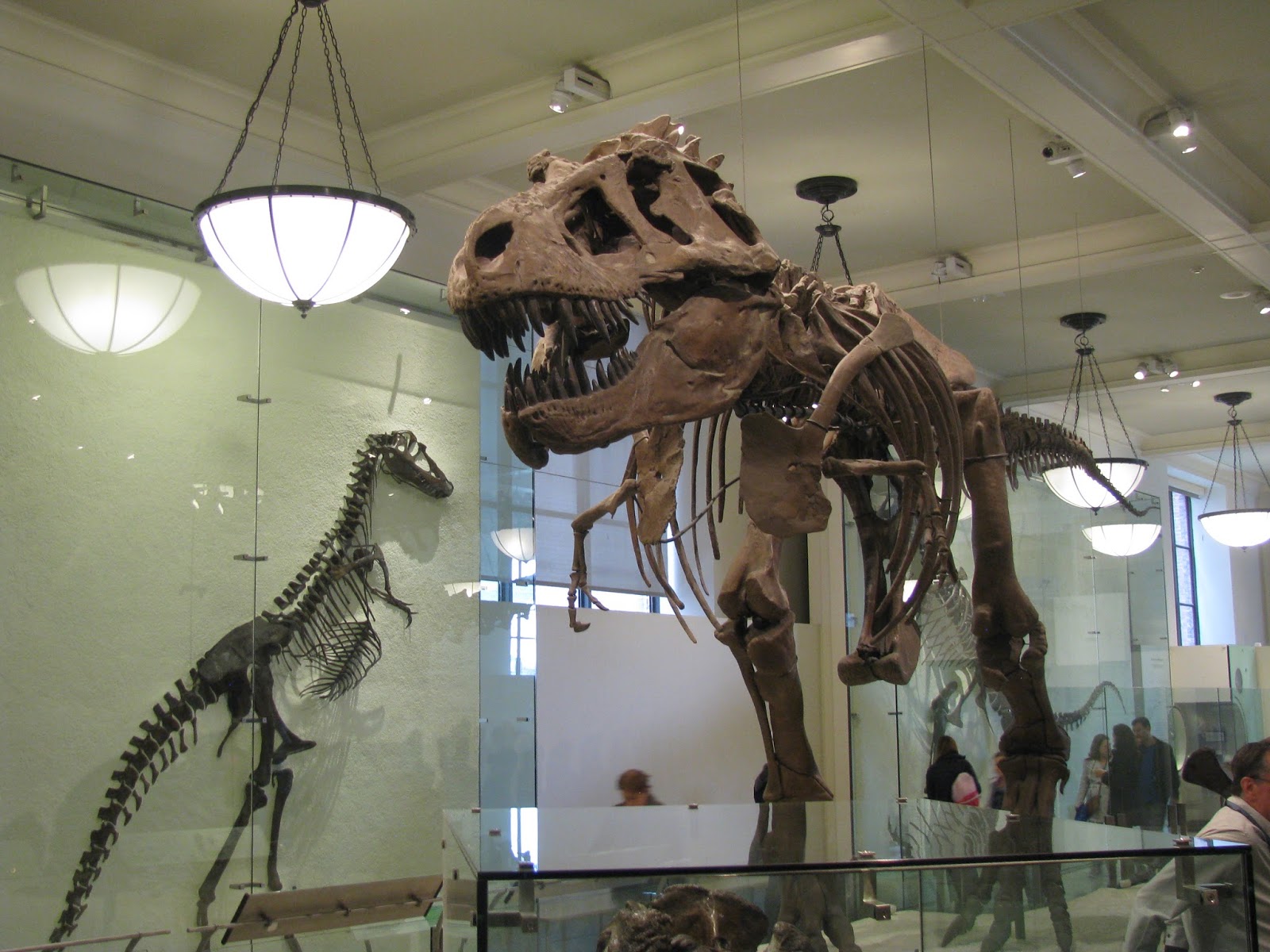
Beyond the world of human history, we of course explored the dinosaur gallery, where there are some wonderfully complete skeletons of the tyrant lizards that once roamed and ruled on Planet Earth.  Stegosaurus, Allosaurus, Tyrannosaurus, Triceratops are the kings of these galleries, which are divided into two parts - ornithischian dinosaurs, characterised by backward-pointing extension of the pubis bone, thought to have helped support enormous stomachs that these dinosaurs needed to digest tough vegetation - and saurischian dinosaurs, characterised by grasping hands, in which a thumb is offset from other fingers.


Stegosaurus
Tyrannosaurus

The following morning saw us take the subway up to Midtown, to one of the world's foremost art galleries, the Museum of Modern Art (MoMA.)  Now, this one I've wanted to visit for years, for within its walls are some of my most favourite paintings.  If I'm being honest, there's a lot of modern art that I simply don't connect with, and so we make a plan to be fairly brief, seeking out what we most want to see - the 1880s-1950s collection - which is conveniently all located on one floor.  Hot picks for me include my most favourite work of all, I and the Village by the Russian-French, Belarusian artist, Marc Chagall.  The painting was finished in 1911, and seems to evoke thoughts of the 'old country,' a place of simplicity and folklore.  As with much of Chagall's work, there are religious undertones - the green face wears a St Andrew's cross and holds the tree of life, whilst in the background an Orthodox church sits amongst other dwellings.  To me, it's as if the artist is painting a dream - one of his village, perhaps of his childhood, and a subconscious fondness or longing for the natural pleasures of home.  I connect to this - and even felt a little emotional approaching the canvas - for this is a painting I have admired for a long time, and seeing it face-to-face (there's an artistic pun in there, if you look at the painting!) is inspirational - definitely a big one to tick off my list.


Marc Chagall's I and the Village

Beyond Chagall's wondrous painting, there is a host of other brilliant works, including Henri Rousseau's The Sleeping Gypsy, Picasso's Three Musicians, Dali's The Persistence of Memory, Monet's Water Lilies, Matisse's Dance, Cezanne's The Bather, Munch's The Storm, Gauguin's The Seed of the Areoi, and Andy Warhol's Campbell's Soup Cans.  Perhaps most famous of all, the museum is also home to the Van Gogh painting, The Starry Night, complete with its very own security guard and crowd of admirers soaking up its undeniable beauty.  All in all, this is a heavyweight in the world of art galleries, with a giant of a collection that puts it firmly amongst the greatest collections in existence.  We come away in an uplifted and buoyant mood, honoured to have been in the presence of such iconic and enduring masterpieces.

The Sleeping Gypsy

The Three Musicians

Saturday, 6 May 2017

The Central Park Fairytale

New York, New York, (so good they named it twice!); the most famous city on Earth, home to the world, epicentre of the American dream.  If anything happens, it happens here first in this cosmopolitan, metropolitan conurbation, where six-lane highways snake as living serpents through a dense high-rise of 17 million, destination Manhattan Island.  These are brash, macho, uncompromising streets, upon which many of the most iconic moments have occurred on the big screen, leaving an oddly familiar backdrop of yellow taxis and subway smoke drifting up from the sidewalks and into the misty morning air.

At the very core of Manhattan sits the city's most famous green space, if ever the terms "lungs of the city" applied anywhere, Central Park.  For us, unceremoniously unloaded at our Downtown hotel the previous night following an unprecedented wait at US Immigration, it's an obvious first stop, a place to refresh and recharge.  What is immediately striking is the peace of the park, for at the very heart of one of the planet's biggest cities sits a haven of plants and birds, with fresh spring flowers still very much in bloom.  We take the steps up to Belvedere Tower, built as a lookout in 1869, and now home to the New York Meteorological Observatory.  For a lookout tower, it's a romantically beautiful structure, and the views of the surrounding park and the city beyond are unbeatable.


Central Park
Belvedere Tower

Our early visit to Central Park is not entirely accidental.  From the tower, I spot a wooden jetty projecting out into a small body of water called Turtle Pond.  We find it and stay a while to take in the view, and whilst Lizzie is lining up the perfect shot on her camera, I fumble around in my pocket for the ring.  The result is a combination of bemusement, sniffles and (I hope) delight.  She said yes, anyway!  Arm-in-arm and newly-engaged, we stroll from here to the Shakespeare Garden, again lovely with the tulips and newly-unfurled ferns, through the winding woodland paths known as The Ramble, around The Lake and over Bow Bridge, down The Mall and through The Dairy, past The Pond and out into 59th Street.  There's a persistent drizzle at this point which is slowly soaking us, but we're on cloud nine, and Central Park has delivered the perfect introduction to the city.

She said yes, and I'm a happy man!
The Shakespeare Garden

Following a special lunch at the Park Lane Hotel, which sits three doors up from the very famous Plaza and has a restaurant overlooking the park and the horse-and-carriages that ply the street in front, we return to the gates of the park, to pay a visit to Central Park Zoo.  It's not the biggest zoo in the world, but it's certainly one of the most well-kept, with some astonishing habitats for the animals in their care.  Red pandas (you don't often see these active,) snow leopards and grizzly bears are undoubted highlights, as are the characterful and playful sea lions, stealing the show in the centre of the zoo.  A quiet day for a visit - being a rainy, out-of-season, Wednesday - but this really works in our favour, and there are moments where we appear to have the whole place to ourselves - just the way I like it.


Red panda
Snow leopard

The rain is actually setting in by the time we're finished and, still feeling a touch of jet-lag, we slowly head back to our lodgings, making an obvious stop off at the NHL store on nearby 6th Avenue, where there are plenty of jerseys from which to choose, yet only one real choice given our location for the next week - a vintage style New York Rangers jersey, bringing the dollars out for the first time.  There's more fun to be had in store, of course, and who wouldn't take the chance to lift hockey's premier trophy, the Stanley Cup?  It also sets us up nicely for the evening's play-off clash - this one is Nashville versus St Louis - watched on TV from the comfort of bed and ending what has been - in more ways than one - a very unique, especially memorable, fairytale day.

A true hockey champion

Monday, 17 April 2017

Lovely Lyme

Lyme Bay stretches its 60-mile arc from the promontory of Portland Bill, Dorset, to the shores of Torbay, South Devon.  A beautiful bay, it includes many places familiar in our lives - Teignmouth, Dawlish, Exmouth and Sidmouth all feature, as well as West Bay, best-known at the moment for the location of the ITV crime drama, Broadchurch.  Somewhere in the middle of this stretch of coastline, lying equidistance from the lovely county towns of Exeter and Dorchester, sits one of our favourite towns - the quiet, picturesque settlement of Lyme Regis.  On an Easter Saturday where the sun was certainly feeling a little shy, we made our way across the border to the Pearl of Dorset, for a morning of browsing in this most interesting of towns.


Lyme Regis is a lovely little town.  The shops are intriguing, there's a sense of community and civic pride, not a spot of litter to be seen on our visit, and a convivial atmosphere.  Our first port of call is the Beach House Cafe, which looks like your run-of-the-mill coastal cafe, but serves up one of the most delicious bacon baguettes I've ever eaten.  We sit and watch the world go by for half an hour, allowing the day to limber up and the shops to throw open their doors, before making for the town centre, and Lizzie's favourite shop, the Pug and Puffin, which sells all things dog.  Then it's onto Ammonite Fine Foods where I pick up a bottle of ale, the lovely independent bookshop Serendip, and an antiques market selling all manner of things.  There's no great number of shops in this little town centre - certainly nothing to keep you more than an hour - but what is there is different, local, and very nicely done.


Of course, the culture of Lyme Regis is built on fossils, and it's easy to imagine yourself stepping back into Victorian times here, perhaps to play the role of Professor Lidenbrock from the Jules Verne classic, Journey to the Centre of the Earth.  References to the Jurassic Coast are everywhere, and there's plenty to occupy the mind of anybody with even a passing interest in ammonites and trilobites.  I actually find it an amazing experience to hold the fossil of a creature that lived some 200 million years ago, and it almost baffles me with how blasé the locals are to such activity.  Then again, fossils are everywhere here - I suppose it's similar to how holidaymakers delight in seagulls back in Torquay.  For me, it's a chance to add to my own tiny collection of fossils - the fish below, at only 50 million years old, is much closer in time to my existence than it is to the ammonite (170 million year old,) and the orthoceras (the black one, which is around 400 million years old.)  Just think about that for a moment.


Out on "The Cobb" - that's the town's harbour wall (which apparently featured in Jane Austen's Persuasion) - the boats bob gently in the harbour, and the day trippers are gathering in number.  An old-fashioned aquarium sits here, offering visitors a fascinating insight into the local sea life of Lyme Bay.  There's mullet, wrasse, crabs and lobsters, starfish, pipefish and dogfish - all kept under the watchful eye of an old fisherman, with a treasury of tall tales to match.  Some of the non-fish elements that he has dragged up in his career are hung up on the wall - they include pieces of sunken ships, and the cockpit canopy of a red arrow plane that crashed in the 1980s.  The fisherman himself tells the crowd that he once dragged up a Spitfire, complete with pilot - and hey, who am I to disbelieve him?


Our morning complete, we leave the packed carpark for the road home, calling in at the Sidmouth Donkey Sanctuary, for a quick look at our favourite animals in action.  Then it's on to Greendale farm shop, not far from Exeter, where we are treated to this year's first sighting of a swallow - always a pleasure to observe, and always a very welcome sign that summer is on the way.  Westcountry days don't get much better than that.

Friday, 17 March 2017

Early spring in the woodland garden

On an afternoon where spring certainly felt like it had replaced winter, I took a stroll up to the back of the garden, to the woodland bank.  Often overshadowed by numerous trees during the heart of the summer, right now it's an airy and interesting spot, the perfect place to while away some garden time, and a wonderful escape from hubbub of life.

The woodland bank, indeed the whole woodland garden, feels as though it has taken on an air of natural establishment.  The planting here is part-natural, part-manmade, but I really feel - for the first time - like the balance between my work and nature's in settling into rhythm up here.  Nestled into the many ferns that form the backrdop to the main woodland border sit some stunning hellebores, in full bloom at the moment, robust and uncompromising, but a reliable choice for years of uninterrupted pleasure.  It seems to be a very common phenomenon for gardeners to remove the leaves during the flowering hellebores in order to highlight the blooms, but I like to keep mine in the way nature intended - and if this means stooping to get a better view of the flower, then so be it - seeking these things out is one of the joys of gardening to me.


Complementing the hellebores is the rich and dainty purple of the latest addition, pulmonaria - also known as common lungwort or, as I like to call them, lady's cowslips - a perfect woodland plant that I can already tell will become a firm favourite.  I really like these unassuming plants, not just for their flowers (which do strike a remarkable similarity to another favourite, the cowslip) but also for their mottled silver-green foliage.  They've only recently gone into the ground, but they look as though they've always been there, and more importantly, they look like they belong.


I was delighted and surprised to notice that snakes head fritillaries - both last year's, and new bulbs I planted in the Autumn, have come up.  I almost missed the new bulbs, until Lizzie pointed them out, their delicate little heads drooping solemnly and bobbing the the breeze.  Even more of a surprise was last year's plants, for these have returned, only with a white flower instead of the usual mauve.  I'n not really sure why this is, but I'll live with it nonetheless - the colour almost adds to the delicacy.


Dotted patches of daffodils rise high above the new green of the wild garlic to give a timeless, native atmosphere - I feel like the Romans may have seen a similar scene when they clambered around these slopes, two thousand years ago.  Periwinkle rambles through the undergrowth here, and in a few short months, for the promise of summer is a sure one - the bank will be littered with the pinks and whites of myriad foxgloves. The woodland garden will grow, flourish, nurture and delight for months to come - but it all starts here, in early spring.

Saturday, 11 March 2017

Major's Garage

When I was young, I remember my grandma telling me about her own childhood, and how the appearance of a car in the neighbourhood was always a big event.  It seems alien to us now, with several cars per household and vehicles clogging up every artery of the road network, that there was ever such a time, when the roads were peaceful, and driving was an activity of pleasure and leisure.  I can only imagine Newton Abbot on a soporific 1920s morning - beach-goers waiting at the railway station for a locomotive to Torquay, children skipping in Courtney Park, the gentle pulse of the market town - shattered suddenly by the hum of an Austin 7.  And if that did happen in this corner of town, the chances are that the driver of this iconic vehicle would pull in for a refill at Major's Garage.

Cecil Major - my great-grandfather - developed a career which saw a lifelong relationship with motoring.  By the age of 18, he began working as a motor engineer and chauffeur in the employ of Sydney Williams, who owned a garage on Quay Road, Newton Abbot.  The mechanical knowledge he gained in this role led him into the First World War, where he served in the Royal Army Service Corps (ASC) in France, between 1915 and 1918.  The ASC were responsible for land, coastal and lake transport, the supply of food, water, fuel and domestic material, and the supply of technical and military equipment.

Cecil in his ASC uniform

Returning from the war, Cecil was able to establish his own garage in Oak Place, 
Newton Abbot, where he specialised in repairs and overhauls, and produced the beautiful business card seen below, in which Cecil highlighted his promise of the best possible service.  He was then approached by Mr Hendy, the landlord of a nearby property on Queen Street, and asked to start a new garage, a few doors up from the town's railway station.  Alterations were made to the property behind the house at 157 Queen Street to create Major's Garage, and Cecil arranged with local petrol companies to install the hand pumps and petrol tanks.  Major's Garage was also known around the town as Station Garage.  My grandma always said how hard Cecil worked, and how he put in long hours to ensure the business was a success.  

Business card from Cecil's first garage at Oak Place, Newton Abbot

Cecil worked his garage, and the family lived in the upstairs building, for 20 years, during which time the re-alignment of street numbers meant that the property was re-numbered 177-79 Queen Street.  The property was leased under "Queen Anne's Bounty," an historic scheme offering assistance to poorer living.  This came to an end in 1946, and due to his age - and the fact that his son Derek seemed unlikely to pursue a career in the same business - Cecil declined the opportunity to purchase the property.  When the lease ended, a Mr Cecil Jackson and a Mr Albert Carpenter paid Cecil for the goodwill of the business of Major's Garage, the electric petrol pumps, oil cabinets, electric battery charger, tools and equipment, and also paid his legal costs in connection with the sale.  The money was enough for the family to buy the house at 8 St Michael's Road in Decoy, Newton Abbot.

Cecil at the pumps with his son Derek - my grandfather - in the car.  c.1935

Major's Garage was marked on the OS maps of the time

Thus ended the family's connection with garage work and mechanics.  After Cecil had sold the business, it became Ted's Garage for many years, before being demolished.  The site is now home to flats and a sewing shop, betraying nothing of its automotive history.