Showing posts with label Art. Show all posts

Saturday, 25 January 2020

The sitting boy

A boy sat in a large and crowded marketplace
His thoughts were loud, his mind a race of everything he saw, he smelt, he heard,
He felt her ocean eyes look long upon the sitting boy
Her joy aplomb! A little toy to make or break
She watched her pup, her prize, her cup, her simple fish
That caught the wires between their gaze
Igniting in the red-hot fires which smoked their days
And only she could smile and see him sitting
Empty and forgotten, waiting long
For hope from rotten choices which have done him wrong
His hopes, his fears, his dreams, his years.


Edvard Munch's Séparation

Monday, 24 December 2018

Merry Christmas!


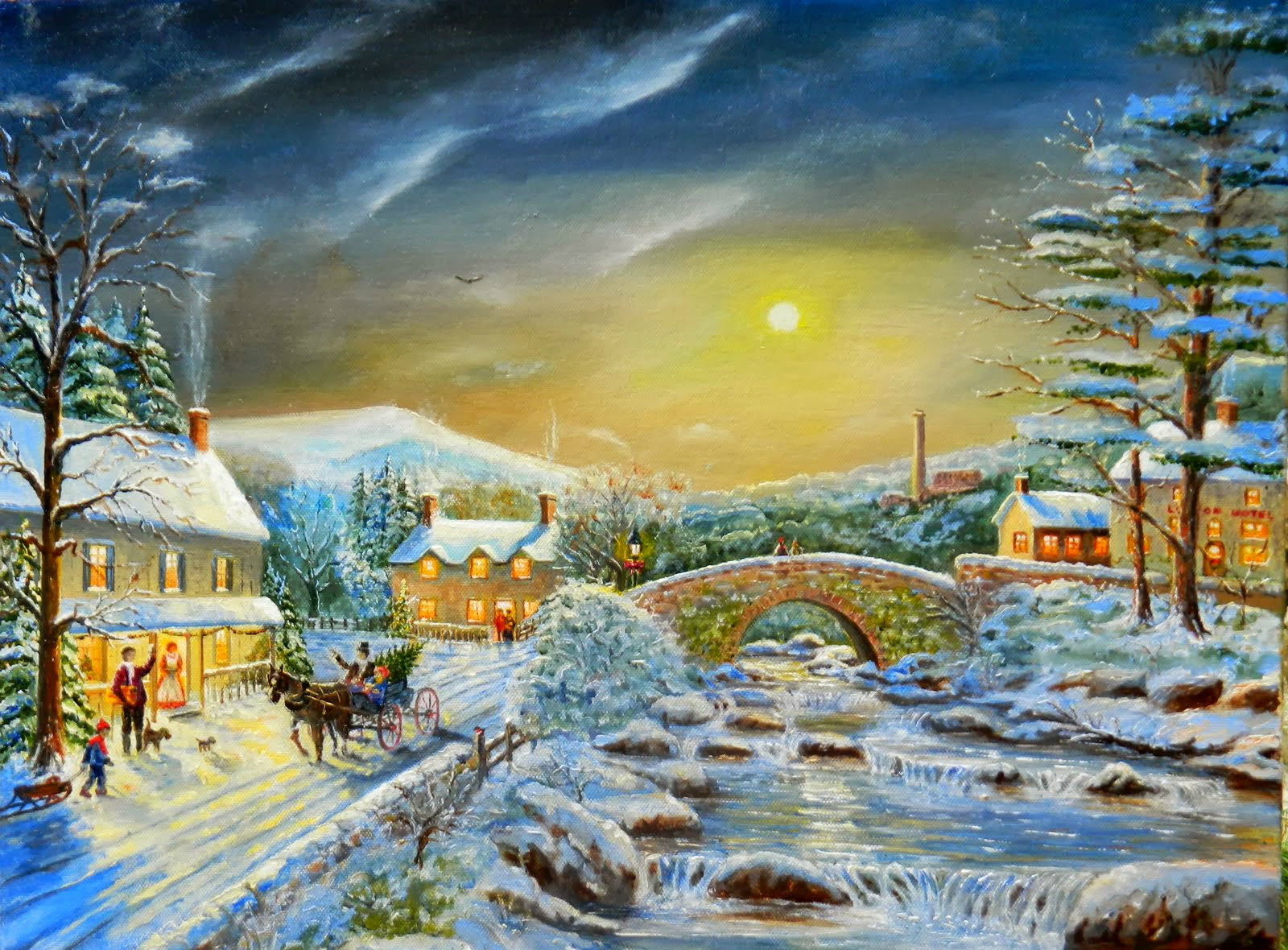
 Local art by Annie Meakin depicts a snowy Ivybridge in Devon.  See more online.

Wednesday, 16 May 2018

But I could have told you Vincent, this world was never meant for one as beautiful as you

traiThese words have been ringing around my head this week.  On Sunday night we sat down to watch Loving Vincent, a film following the events that led to the death of Van Gogh.  The story is told through the Armand Roulin, son of the postman Joseph, whose job it is to deliver the final letter from the late artist to his brother.  The story begins in the south of France at Arles, then heads north, through a brief stop-over in Montmartre, before moving on to Auvers-sur-Oise, where Roulin meets the cast of characters that knew Vincent, and witnessed his final days.  Initially, Armand Roulin doesn't want the journey, nor does he see the point of the delivering a dead man's letter, but he is soon absorbed into the artist's world, and as the waters become murkier, so one question remains unanswered - how did Vincent, a man said to have been in a good mental state at that time, come to die so suddenly by a gunshot wound to the stomach?  In the end, of course, Armand has to satisfy himself that some questions remain unanswered; that some thirsts cannot be quenched; that people are not perfect; and that even the strongest of us cannot always manage the burden.  


Portrait of Armand Roulin, 1888


The world is full of phoney, vitriolic people with empty hearts and vacant minds.  As Van Gogh found to his ultimate cost, sometimes the only path is to follow your heart, spill out whatever is inside, grab all the wonder that you see in the world and do your best to share it, even with those who will not listen or look.  Vincent Van Gogh's soul emanated a beauty that was so far beyond the reach of other men, yet battled for his place in a society where he had been rejected by inferiors.  And in the end?  The world remembers Vincent - a man who created 800 paintings and sold only one in his lifetime - as the undisputed father of modern art.  As Joseph Roulin tells his son towards the end of the film: "The trick is to know what you are fighting for."  Perhaps Vincent knew that he would live on, long after death had taken his body away.  Perhaps he knew what he was fighting for, all along.

Self portrait, 1889

Created exclusively using 65,000 individual oil paintings, Loving Vincent has hit me to the point of tears, both for its poignant message and its perfect homage to the great artist.  How the directors (Dorota Kobiela and Hugh Welchman) managed to incorporate so much from Van Gogh's huge body or work into the film is incredible, and seeing so many of his masterpieces - along with lesser-known paintings - weaved seamlessly into the narrative is a joy to behold. 
A must-see film for art lovers, culture vultures, and anyone who just believes there's more to life - more to being human - than flesh, blood and bones.

Landscape with carriage and a train, 1890

"In the life of the painter, death may perhaps not be the most difficult thing.  For myself, I declare I don't know anything about it.  But, the sight of the stars always makes me dream.  Why, I say to myself, should those spots of light in the firmament be inaccessible to us?  Maybe we can take death to go to a star, and to die peacefully of old age would be to go there on foot.  For the moment, I am going to go to bed because it's late, and I wish you goodnight and good luck with a handshake, your loving Vincent."
Starry night over the Rhone

Friday, 28 July 2017

Knight Time

We love a good art trail here on Nich About Town. I mean, we really love a good art trail.  Seriously, we just love a good art trail.  So it should come as no surprise that, when the city of Lincoln put together their very own knights trail, we just had to get up there and see what all the fuss was about.  The trail commemorates the 800th anniversary of the (second) Battle of Lincoln, in which the barons of England, largely reunited after the death of their bitter enemy King John, rose to fight for the nine-year-old King Henry III, against Prince Louis of France, who had entered London and proclaimed himself King of England.  At the time of the battle - May 1217 - Lincoln Castle (a strategically important site) was under siege from the French forces, but William Marshal, first Earl of Pembroke, was mobilising an army of knights to join him in nearby Newark, to march to Lincoln and relieve the castle.  Their campaign was a success, although ironically they took revenge on the people of Lincoln, who they believed had aided the French troops, by sacking the city.

There's a second part to this story, also being celebrated along the trail.  Following the establishment of Henry III as king, the Charter of the Forest was sealed in November 1217.  The Charter, sealed under the regency of the aforementioned William Marshal, re-established the rights of access to the royal forest, which had been eroded by William the Conquerer.  The charter, often overlooked in British history, provided real rights and protections for common men in England, against the abuses of the aristocracy, allowing various activities around gathering fuel, charcoal burning, pasture, grazing, and cutting turf.  This was economic protection for free men - a unique document in its time.

In total, there were 36 knights to discover, spread across the city centre, from the Cathedral Quarter on the top of the hill, to the Brayford Pool at the bottom, with Lincoln's famous and aptly-named Steep Hill sandwiched between the two.  Our trail began at the top, and there was an appropriate reminder that we are but a handful of miles from Sherwood Forest, with Lincoln Green, a knight celebrating the legendary outlaw, complete with bow and arrows.


In the shadow of the great cathedral - a real marvel in its own right - sat several more knights on our trail.  My eye was particularly drawn to the knight called Inside Out, created by an artist truly inspired by both the interior and exterior of the cathedral.  On one side, the flying buttresses and vaulted ceiling are displayed in stunning detail, whilst on the other, the beauty of Lincoln's stained glass windows - and in particular, the legend of that most curious characters, the Lincoln Imp.  Legend says that two imps were sent to Earth to do the Devil's work in the 14th century, and on wreaking havoc in Lincoln Cathedral (in which they smashed tables, threw rocks, and tripped up the Bishop!) one was turned to stone by an angel.  The second was given the chance to escape, but is said to return to the cathedral, creating a draft as it circles the building in search of its missing comrade.


Leaving the cathedral and heading towards Lincoln Castle, we almost immediately run into Knight of the Skies, which pays homage to the region's wartime heritage and association with Bomber Command.  It's a regular theme around the whole city, for there were several airfields in Lincolnshire from where RAF pilots set off during the dark days of war, many never to return again.  The knight's shield proclaims the motto of Bomber Command - Strike Hard, Strike Sure - whilst the artist has gone to some length to portray the crew returning from a night of horror in the skies, walking amongst the poppies to commemorate the fallen.


Down the hill, just outside Lincoln's fabulous archaeology museum, sits another of my favourites, named The Luttrell Psalter.  The design is based on a Medieval text of the same name, which was produced in Lincolnshire in the 1300s, and is considered one of the most important documents of the period.  The knight's design features all manner of mythical and wondrous creatures, the sort that dwell deep in the forests, mountains and swamps of 14th century England.  To me, it evokes an age before we knew so much, when imagination turned the mundane into mystery.  The artist apparently applied an ageing technique to the painting, in order to give a unique appearance.


If one knight was designed to provide a centrepiece for the entire trail, it would have to be Knight in the Forest, a beautifully-decorated sculpture which displays the native flora and fauna that can be seen around Lincolnshire and beyond.  It isn't a stretch of the imagination to transport yourself back to the ancient forests, where our badgers, foxes, deer, squirrels and owls roam freely, threatened only by the appearance of the occasional woodsman.  Stunningly designed, an easy favourite that perfectly sums up the trail - and the Charter of the Forest - to me.


Ok, so there's one more knight worthy of mention as, following on from Lincoln City FC's remarkable 2016-17 season, they also put one together in red-and-white stripes.  Remembering some of Torquay's encounters with Lincoln in the past, a sword-wielding knight certainly wouldn't look too out of place in their defence, and although I'm not completely sure about the lipstick, there's no denying that the football club has been a source of great celebration here recently, which lends itself nicely to a trail celebrating the city's long and fascinating history.


Of course, there were several other knights all worthy of mention, but I'll leave you to see what you think of the rest, by visiting my Flickr album.  As for me - well, after a tiring day hiking around trying to spot them all, there's only one real choice of drink for the evening - A Knight's Ale, available from the Lincoln Castle shop.  You know it's going to be a good mix when an art trail meets with a good delve into English history - thanks Lincoln, always a pleasure.

Thursday, 11 May 2017

Natural wonders, MoMA masterpieces

Those who know me - or at least those who read the right hand side of my blog - will be aware that I love a good museum.  London's British Museum, Toronto's Royal Ontario Museum, and the Tropen Museum in Amsterdam are all up there in my opinion, and New York's American Museum of Natural History is one more to really savour.  We're wise enough now to know how to tackle these cultural leviathans, and success comes with knowing which galleries are your personal "must-sees," and which ones you'll accept having to miss.  The American Museum of Natural History spans several floors packed with artefacts of everything nature, with an additional focus on people of the world.  Lizzie, the Geography graduate, picks out the Earth and Planetary Sciences galleries, whilst the archaeologist in me immediately selects human origins and the Hall of South American Peoples.  Here lies a collection greater than anything amassed in Europe, creating a journey through the world of the Incas, the Nazca people, the Mayans, Oaxaca, Olmecs, Tolects and Aztec.  I'm in heaven at this point, the only downside being that there is simply so much, it's impossible to dwell on everything.  Some favourites, though, include some fabulous pieces of Nazca pottery and an Aztec sunstone.  

Aztec sunstone
Nazca pottery
There's something especially intriguing and mysterious about the civilisations that emerged in Mesoamerica - how did they first get there?  How did they develop such complex society?  And what do their remaining artefacts tell us about their ways of life?  My undergraduate dissertation examined the rise of polities in Mayan culture, possibly the most mysterious civilisation ever known, for their emergence appeared to come straight out of an inhospitable jungle environment.  Even now, nobody is really sure how Mayan society began, nor how it suddenly disappeared again - it seems that the rainforest swallowed these secrets, and is unlikely to ever give them up again.  Nonetheless, Mayan ceramics do survive, and give us a taste of the complex artistic and cultural complexity of these most interesting people.
Mayan ceramic sculpture

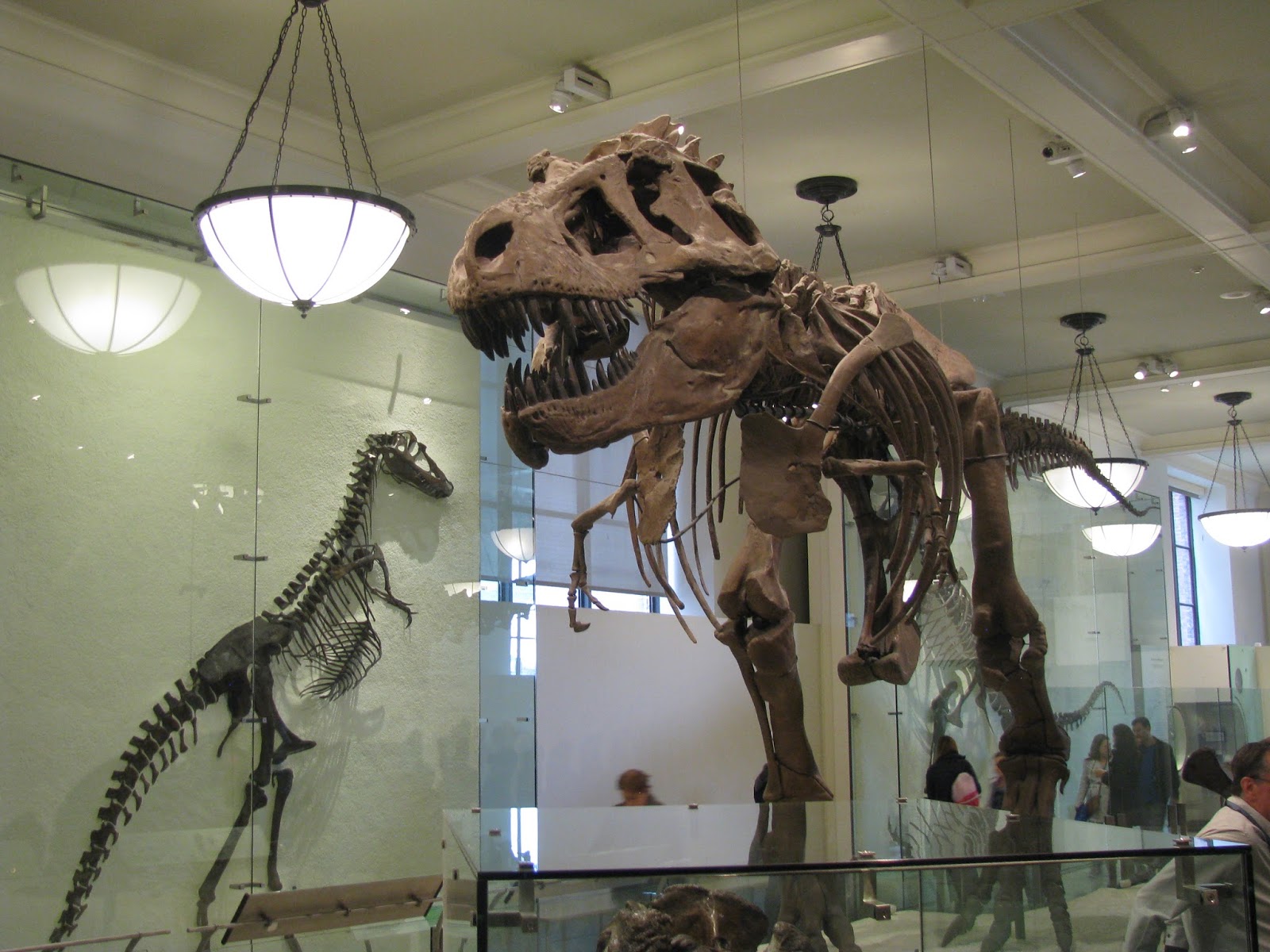
Beyond the world of human history, we of course explored the dinosaur gallery, where there are some wonderfully complete skeletons of the tyrant lizards that once roamed and ruled on Planet Earth.  Stegosaurus, Allosaurus, Tyrannosaurus, Triceratops are the kings of these galleries, which are divided into two parts - ornithischian dinosaurs, characterised by backward-pointing extension of the pubis bone, thought to have helped support enormous stomachs that these dinosaurs needed to digest tough vegetation - and saurischian dinosaurs, characterised by grasping hands, in which a thumb is offset from other fingers.


Stegosaurus
Tyrannosaurus

The following morning saw us take the subway up to Midtown, to one of the world's foremost art galleries, the Museum of Modern Art (MoMA.)  Now, this one I've wanted to visit for years, for within its walls are some of my most favourite paintings.  If I'm being honest, there's a lot of modern art that I simply don't connect with, and so we make a plan to be fairly brief, seeking out what we most want to see - the 1880s-1950s collection - which is conveniently all located on one floor.  Hot picks for me include my most favourite work of all, I and the Village by the Russian-French, Belarusian artist, Marc Chagall.  The painting was finished in 1911, and seems to evoke thoughts of the 'old country,' a place of simplicity and folklore.  As with much of Chagall's work, there are religious undertones - the green face wears a St Andrew's cross and holds the tree of life, whilst in the background an Orthodox church sits amongst other dwellings.  To me, it's as if the artist is painting a dream - one of his village, perhaps of his childhood, and a subconscious fondness or longing for the natural pleasures of home.  I connect to this - and even felt a little emotional approaching the canvas - for this is a painting I have admired for a long time, and seeing it face-to-face (there's an artistic pun in there, if you look at the painting!) is inspirational - definitely a big one to tick off my list.


Marc Chagall's I and the Village

Beyond Chagall's wondrous painting, there is a host of other brilliant works, including Henri Rousseau's The Sleeping Gypsy, Picasso's Three Musicians, Dali's The Persistence of Memory, Monet's Water Lilies, Matisse's Dance, Cezanne's The Bather, Munch's The Storm, Gauguin's The Seed of the Areoi, and Andy Warhol's Campbell's Soup Cans.  Perhaps most famous of all, the museum is also home to the Van Gogh painting, The Starry Night, complete with its very own security guard and crowd of admirers soaking up its undeniable beauty.  All in all, this is a heavyweight in the world of art galleries, with a giant of a collection that puts it firmly amongst the greatest collections in existence.  We come away in an uplifted and buoyant mood, honoured to have been in the presence of such iconic and enduring masterpieces.

The Sleeping Gypsy

The Three Musicians

Sunday, 18 December 2016

Goodwill and togetherness

Carollers gather for a song of praise.  A horse and wagon trundle past, and there's the tring-tring of a bell, as a young cyclist peddles through the slush.  People are enticed by the warm glow of the Imperial Electric Theatre, and all the other inviting lights that line the path of Queen Street.  A little further up the town, the Globe Hotel throws open its doors to winter travellers, whilst flower ladies sell holly and mistletoe on the kerb.  Austins, the drapers, is busy with customers admiring the finery, and all through the air is the smell of coal and wood fires from the nearby houses.  It is a quarter past five in the afternoon, but the edge is taken off the bitter temperatures by the lovely, iconic ringing of the bells emanating from the very centre of the town, St Leonard's Tower.  It's Christmas in Newton Abbot.

Much has changed since the Victorian inspiration behind these paintings, yet so many of the details in the above description still hold true in our little market town. The air of togetherness, the goodwill and feeling of community, which binds us so strongly at this time of year, are overwhelmingly evident in these paintings, and is a message that we can all take into the festive period, in amongst all the shopping and the rushing.  I wish every reader of this blog a happy, merry, peaceful and meaningful Christmas.

Queen Street - detail from an original painting by Annie Meakin, on a card sold in aid of Dame Hannah Rogers Trust

The Clock Tower - detail from an original painting by Annie Meakin, on a card sold in aid of Dame Hannah Rogers Trust

Tuesday, 18 October 2016

Goodbye rhinos

Was it really back in sunny August that we stepped out on safari and followed the rhino trail around South Devon?  Well, believe it or not, the trail has ended already, with a crescendo of art, colour and horns adorning Paignton Zoo for one weekend only.  Here was a chance to see all our friends together again, and to catch up on some of the more outlandishly-located creatures that we missed the first time around.  Before that, however, here's a round-up of some of the rhinos we found since my last blog post.

Big Sweetie, an ingenious piece of art that incorporates everything sweet shop.  Foam shrimps, gummy bears, twister lollies, it's a trip down memory lane for the sugar fiend, and one of the funniest rhinos on the trail.  I particularly like the "for keeps" love heart, once again bringing the conservation message home; afterall, nobody wants to lose the Javan and Sumatran rhinos.  Meanwhile, in Torquay town centre, Rhino an old lady who swallowed a fly (get it?) takes us through that particularly quirky nursery rhyme, with a granny rhino displaying each stage of the story, from the spider, the bird, the cat, the dog, the cow, the horse... She's dead of course!  Rhino an old lady comes complete with her own horn fly too, a little touch that perfectly completes the piece.

On Paignton Sea Front,
Rhinoctopus stole the show in my eyes, a lovely seabed scene in which a large pink octopus takes centre stage.  Incorporating coral and clownfish, it's a tropical nod to biodiversity that really appealed to my fishy tastes.  Paignton has also been the home of Oh I Do Like To Be Beside the Seaside, a take on the traditional British beach holiday, complete with sand castles, ice creams, and good old Punch & Judy.  It sort of fits perfectly in the faded glory of Paignton's Torbay Road, a throw-back to the days when this really was a destination of distinction, but celebrating the still-beautiful stretch of coastline that makes up this wonderful bay.


To Paignton Zoo, where the great gathering of rhinos was in full swing, all lined up neatly like a conservation army.  Here we had a chance to sweep up some of those we missed, such as Stella, which showcases endangered animals in the stars, and Rhino Why the Caged Bird Sings, which just has an intrinsic beauty that I'm not sure I even understand.  The impact of having so many rhinos in one place is a sight not-to-be-missed, giving - for the first time - a real understanding of the scale of the project.  I mean, what an effort by Paignton Zoo, once again giving the people of South Devon a world-class art trail for all ages.  Through the mindless moments of vandalism and antisocial behaviour of a tiny minority, the project has shone through to give a summer of pleasure to thousands of locals and tourists alike - we two included.  Thanks to the zoo for this, and for their conservation work generally.  You can see a gallery of all rhinos on my Flickr page.

Finally, to my favourite.  Or favourites, as there's two that stand out for me.  the first, Blossom, we snapped at Bernaville Nurseries near Exeter.  It appeals to the gardener within me, and would surly look perfect up by our summer house.  The second, which would also not look out of place in our back garden, is Woodland Safari, a celebration of native nature, and a reminder that you don't need to travel far to enjoy a safari of your own, to find fascination in the British countryside, and do your bit to help our embattled wildlife no matter where you live.  I guess that's the message that this project has spent a summer trying to get across - it certainly wasn't wasted.  So bye bye rhinos; and let's hope it's only the sculptures to which we bid farewell.

Saturday, 13 August 2016

Great Big Rhinos!

Three years ago, I blogged about a fabulous series of gorillas that had made its way to South Devon, as part of the Paignton Zoo and Wild in Art initiative to raise awareness around conservation.  It was - and it remains - one of the greatest art trails I've ever seen, taking us from the streets of Exeter to the coast of Torbay, with all manner of places dotted in between.  Following the trail, the gorillas were auctioned in aid of Paignton Zoo's conservation projects around the world - if you're lucky and look hard enough, you can still see one-or-two of them on display in public places.

The memory of the fantastic gorilla trail may have faded, but now we've been invaded again - this time by rhinos - as Paignton embarks on another awareness campaign that has kids and adults alike rushing, camera in hand, to get a glimpse of one of these life-size masterpieces.  Forty-two of them, to be precise.  Our own trail, which is still far-from-complete, began in Exeter, with an immediate favourite, Cath, which makes a thought-provoking statement on conservation.  Beautifully designed, the rhino carries with it the heart of Exeter's stunning Cathedral.  The foundations of Exeter Cathedral were laid nearly 1000 years ago - will we ensure the Javan and Sumatran rhinos have the same time ahead of them?


Another personal favourite is Dino Rhino, a take on the extinction of other once-prevalent species.  The evocative portrayal of prehistoric scenes, mingled with close-ups of long-lost sabre-tooth cats and woolly mammoths, really bring impact to the artist's question, do we really want the rhino to be just another distant memory?


Aquamarhino stands proud in Exeter's Princesshay shopping centre, perhaps a comment on our own consumption of the earth's natural resources.  A net of fish flounder - one brilliantly incorporated into this rhino's eye - suggesting that if our current trends continue, even more biodiversity will be wiped out of existence.


Down in Torbay, the rhino madness continues with Sun's Out, Horns Out, Lizzie's favourite on the trail, and certainly a fun design that is best suited to Torquay's sea front.  You certainly have to admire the attention to detail - from the splattered ice cream and bright armbands, down to the dainty sandals.


Up on Babbacombe Downs, meanwhile, the rhino Tranquillity surveys what must be the best view on the trail.  This one speaks of a world at peace, of perfect nature cooling down under the watercolour of an African sunset.  Perhaps the artist is giving us a glimpse of what we should enjoy, value and connect with in this world, as well as a reminder that the best things in life really are free.


There are, of course, many more rhinos that we haven't got to yet - Be sure to check out my Flickr page, which I'll be updating as we go around ticking these off the map.  You can - and probably should - also see the Great Big Rhinos webpage, for more about the art trail and conservation of these beautiful, iconic creatures.


Saturday, 19 December 2015

A happy home, the joys of family, warmth, comfort, love, and togetherness

The below Thomas Kinkade painting is entitled The Night Before Christmas and, looking from the outside, encapsulates what this time of year means to me.  A happy home, the joys of family, warmth, comfort, love, and togetherness.  

It's easy to get swept along with the commercialism of Christmas, to buy a mountain of presents for loved ones, to seek out that too-good-to-be-true bargain in the sales, to go online on Christmas Day, in order to instantly spend those vouchers you only just received in a card from a long-lost grandparent or auntie.  We're all guilty of betraying our own underlying principles from time-to-time, but for me this Christmas, I'm going to make the extra effort to look within myself, to seek out the joy I can freely bring to others, and to take delight in all the wonderful things I have around me - a brightly-coloured cyclamen at the back of the garden; a robin snatching a peanut from the bird table; the words of a simple but beautifully arranged Christmas carol; and maybe - just maybe - the smiling face of a Christmas snowman.

In a weary world where the meaning of Christmas can be so easily lost, I wish every reader of this blog a peaceful, uplifting and fulfilling Christmas.


Saturday, 21 December 2013

The Season of Giving


I love a good Thomas Kinkade painting at this time of year, and the gentle snow falling on this pretty community really appeals to me.  There's nothing quite like those freezing December dusks, the big day so close you can touch it, and an extension of good will presenting itself from shoppers, travellers, and musicians on the icy pavements and sidewalks of our cities, towns and villages.  Not that we get ever so much snow down here in the balmy Westcountry, but it's still a wonderful, beautiful, heart-warming time of year that makes you appreciate just how good it is to be home, sweet home!

I hope everybody enjoys this season of giving, and finds some time for peace, love, and human spirit, in an often-weary world.

Tuesday, 13 August 2013

Great Gorillas!

Ah what more could you ask for than a relaxing start to the weekend, fish and chips by the sea, a refreshingly salty stroll, a bunch of colourful gorillas and... wait, huh?

For those of you not living in South Devon, you might not know that we’ve been invaded.  They arrived last week by flotilla and now you can’t go anywhere in Exeter or Torbay without catching a sight of them.  No I’m not talking about hoards of grocks, although they’re here too, but a much rarer and altogether more peaceful group has recently landed on our shores – wild gorillas.

The Great Gorillas Project is a public art event taking place in both Torbay and Exeter for the next ten weeks.  Thirty life-size gorilla sculptures, and a number of smaller ones designed by local schools – are now gracing the streets, parks and open spaces of the region to highlight the threat facing wild gorillas.  It all coincides with Paignton Zoo’s 90th birthday; they’re hoping to raise a significant sum of money towards conservation projects for these rare and wonderful creatures.

Well this blog loves the quirky things in life, so Lizzie and I headed out on the trail of some of these sculptures, starting at our place of work, the University of Exeter.  Inside the new Forum building sits Takamanda, designed by an Exeter student who sent her gorilla on a globetrotting adventure to collect the stamps of other endangered animals, an inspired idea.


Our trail continued that evening in Babbacombe, where Hope was looking whimsically out to sea.  According to the guide, "Hope is designed to remind us what this event and the work of Paignton Zoo is all about.  She features the beautiful images of two of the Zoo's most iconic and endangered species.  The artist's aim is to inspire hope."


A short walk across the Downs, we come to a gorilla called Back of Beyond.  "The gorilla is the master of those untamed places in which he makes his home," says the guide.  "With so much of the world unexplored, we can fantasise about lost continents, obscure rivers and forgotten volcanoes in this cartographic mash up."  What an amazing design too - I wish I could get this map on paper.


The next day in Exeter, we rediscovered the gorilla trail around the city centre, meeting along the way X-Ray Ape (inspired by the artist's own broken bones), Miss Prints (showcasing a number of endangered animal prints, furs and feathers), and Mr Bumble, undoubtedly the most well-dressed gorilla on the trail, who is "so fond of fruit, he wears it on his suit."


Back in Torquay, the clever folk of South Devon College have painted their gorilla into legendary detective Poirot, and Hoopers department store has gone the whole hog, furnishing its window with art deco clothes and accessories.  In addition to Poirot, the harbourside is full of gorillas.  By Paigton Zoo's Living Coasts lies Hippocampus Guttulatus, covered in seahorses to help increase awareness of Torbay's two species of seahorse, whilst across the inner harbour is sparkly blue Barry and Five Minutes To Midnight, covered in clocks to represent the Domesday phrase and highlight the urgent need to save endangered gorillas.  This is a tough call, but Five Minutes to Midnight is probably my favourite gorilla on the trail.


What a wonderful art exhibition, I only wish I could have featured all the gorillas we have seen so far.  We can't wait to go back on the trail and pick up the Paignton and Brixham gorillas in the near future.  In the meantime, everyone should check out the Great Gorillas Project to see the serious conservation work behind this beautiful art trail.