Showing posts with label Exeter. Show all posts

Tuesday, 18 October 2016

Goodbye rhinos

Was it really back in sunny August that we stepped out on safari and followed the rhino trail around South Devon?  Well, believe it or not, the trail has ended already, with a crescendo of art, colour and horns adorning Paignton Zoo for one weekend only.  Here was a chance to see all our friends together again, and to catch up on some of the more outlandishly-located creatures that we missed the first time around.  Before that, however, here's a round-up of some of the rhinos we found since my last blog post.

Big Sweetie, an ingenious piece of art that incorporates everything sweet shop.  Foam shrimps, gummy bears, twister lollies, it's a trip down memory lane for the sugar fiend, and one of the funniest rhinos on the trail.  I particularly like the "for keeps" love heart, once again bringing the conservation message home; afterall, nobody wants to lose the Javan and Sumatran rhinos.  Meanwhile, in Torquay town centre, Rhino an old lady who swallowed a fly (get it?) takes us through that particularly quirky nursery rhyme, with a granny rhino displaying each stage of the story, from the spider, the bird, the cat, the dog, the cow, the horse... She's dead of course!  Rhino an old lady comes complete with her own horn fly too, a little touch that perfectly completes the piece.

On Paignton Sea Front,
Rhinoctopus stole the show in my eyes, a lovely seabed scene in which a large pink octopus takes centre stage.  Incorporating coral and clownfish, it's a tropical nod to biodiversity that really appealed to my fishy tastes.  Paignton has also been the home of Oh I Do Like To Be Beside the Seaside, a take on the traditional British beach holiday, complete with sand castles, ice creams, and good old Punch & Judy.  It sort of fits perfectly in the faded glory of Paignton's Torbay Road, a throw-back to the days when this really was a destination of distinction, but celebrating the still-beautiful stretch of coastline that makes up this wonderful bay.


To Paignton Zoo, where the great gathering of rhinos was in full swing, all lined up neatly like a conservation army.  Here we had a chance to sweep up some of those we missed, such as Stella, which showcases endangered animals in the stars, and Rhino Why the Caged Bird Sings, which just has an intrinsic beauty that I'm not sure I even understand.  The impact of having so many rhinos in one place is a sight not-to-be-missed, giving - for the first time - a real understanding of the scale of the project.  I mean, what an effort by Paignton Zoo, once again giving the people of South Devon a world-class art trail for all ages.  Through the mindless moments of vandalism and antisocial behaviour of a tiny minority, the project has shone through to give a summer of pleasure to thousands of locals and tourists alike - we two included.  Thanks to the zoo for this, and for their conservation work generally.  You can see a gallery of all rhinos on my Flickr page.

Finally, to my favourite.  Or favourites, as there's two that stand out for me.  the first, Blossom, we snapped at Bernaville Nurseries near Exeter.  It appeals to the gardener within me, and would surly look perfect up by our summer house.  The second, which would also not look out of place in our back garden, is Woodland Safari, a celebration of native nature, and a reminder that you don't need to travel far to enjoy a safari of your own, to find fascination in the British countryside, and do your bit to help our embattled wildlife no matter where you live.  I guess that's the message that this project has spent a summer trying to get across - it certainly wasn't wasted.  So bye bye rhinos; and let's hope it's only the sculptures to which we bid farewell.

Saturday, 13 August 2016

Great Big Rhinos!

Three years ago, I blogged about a fabulous series of gorillas that had made its way to South Devon, as part of the Paignton Zoo and Wild in Art initiative to raise awareness around conservation.  It was - and it remains - one of the greatest art trails I've ever seen, taking us from the streets of Exeter to the coast of Torbay, with all manner of places dotted in between.  Following the trail, the gorillas were auctioned in aid of Paignton Zoo's conservation projects around the world - if you're lucky and look hard enough, you can still see one-or-two of them on display in public places.

The memory of the fantastic gorilla trail may have faded, but now we've been invaded again - this time by rhinos - as Paignton embarks on another awareness campaign that has kids and adults alike rushing, camera in hand, to get a glimpse of one of these life-size masterpieces.  Forty-two of them, to be precise.  Our own trail, which is still far-from-complete, began in Exeter, with an immediate favourite, Cath, which makes a thought-provoking statement on conservation.  Beautifully designed, the rhino carries with it the heart of Exeter's stunning Cathedral.  The foundations of Exeter Cathedral were laid nearly 1000 years ago - will we ensure the Javan and Sumatran rhinos have the same time ahead of them?


Another personal favourite is Dino Rhino, a take on the extinction of other once-prevalent species.  The evocative portrayal of prehistoric scenes, mingled with close-ups of long-lost sabre-tooth cats and woolly mammoths, really bring impact to the artist's question, do we really want the rhino to be just another distant memory?


Aquamarhino stands proud in Exeter's Princesshay shopping centre, perhaps a comment on our own consumption of the earth's natural resources.  A net of fish flounder - one brilliantly incorporated into this rhino's eye - suggesting that if our current trends continue, even more biodiversity will be wiped out of existence.


Down in Torbay, the rhino madness continues with Sun's Out, Horns Out, Lizzie's favourite on the trail, and certainly a fun design that is best suited to Torquay's sea front.  You certainly have to admire the attention to detail - from the splattered ice cream and bright armbands, down to the dainty sandals.


Up on Babbacombe Downs, meanwhile, the rhino Tranquillity surveys what must be the best view on the trail.  This one speaks of a world at peace, of perfect nature cooling down under the watercolour of an African sunset.  Perhaps the artist is giving us a glimpse of what we should enjoy, value and connect with in this world, as well as a reminder that the best things in life really are free.


There are, of course, many more rhinos that we haven't got to yet - Be sure to check out my Flickr page, which I'll be updating as we go around ticking these off the map.  You can - and probably should - also see the Great Big Rhinos webpage, for more about the art trail and conservation of these beautiful, iconic creatures.


Wednesday, 29 July 2015

Stunning Streatham

Being in the employ of the University of Exeter means I'm lucky enough to work in a very beautiful part of the city.  We frequently enjoy the grounds of a sunny lunchtime, but for a more in-depth look, we took a weekend stroll - with Mum and Terry - to sample some of the many delights on this most extraordinary campus.

What I like most about this campus are the many little pockets, easily missed if you're in a hurry or don't stop to look, that teem with all manner of life.  First stop, Reed Pond, is a lovely setting, really just a stone's throw from the main road into the city centre, but somehow of another world.  I adore the arboreal backdrop, the duckweed sitting softly on the water's surface, and the stunning dragonflies that skim across the surface, a sure sign that wildlife is alive and well here.

Reed Pond

Through the trees and up the hill sits Reed Hall, an Italianate mansion donated to the (then) Exeter Technical and University Extension College by former Exeter Mayor, Alderman W H Reed, in 1922.  Back then, this was Streatham Hall, but in recognition of the Mayor's generosity, the hall was renamed in his honour.  Surrounding the hall, some of the grounds team's finest work goes into the stately gardens, so that they are always kept up-to-date, in colour, and ready to impress.  On display last weekend, white alyssum and blue ageratum, apparently designed to represent the colours of the University (although on a recent tour, the Scottish head of grounds told us he liked to consider it the Saltire.)

Reed Hall gardens
Reed Hall

Onto my personal favourite part of the gardens, to the plantation running roughly parallel to Stocker Road, but with views and an atmosphere that leave you believing you're in the density of a rainforest.  You'd be hard-pushed to know that the watercourse here is actually man-made, so delightful and natural is the landscaping, the slow trickle of the stream competing only with birdsong on an otherwise silent campus.  Where the plantation yields, so views are afforded across another pond, in an almost-exotic aspect, and just lovely in the hot summer sun.  I have walked down this footpath so many times, in every season and in every weather, and every time it offers a slightly different experience.  Today it's a red admiral butterfly, resting easily on a leaf (although, to my misfortune, it takes wing as soon as my camera lens comes close.)

Pond on North Park Road

Moving on, we take a moment to enjoy the colourful planting around the Library and the Stocker Road entrance, before visiting the wildflower meadow, which sits in the centre of Streatham Court.  If the number of bees is a good indicator of wildlife value, then this square is terrific - it simply buzzes with life.  We've been cultivating our own wild patch at home, so this makes an excellent reference point for us.

Planting outside the Library
Wildflowers at Streatham Court

We end our little tour by wandering up Taddiforde Valley.  Known to be full of colour when the magnolias blossom in spring, on our visit it's a more subdued, welcome pocket of shade.  The birdsong once again flutters through the air, and there's a definite feeling that not only are we on the edge of the campus, but also on the very borders of the city itself - for beyond, the fields roll away into mid Devon.  And this was always the joy of Streatham Campus for me - it's a short walk into the city centre, and an equally short walk into the countryside.  How many other top universities can boast that?

Taddiforde Valley
Taddiforde Valley

A lovely little tour around a stunning campus, which makes me feel very lucky to have at my fingertips, every day of the week.  For gardens that the public can visit and wander around for free, I simply don't think it can be beaten.  You can see the latest updates from the grounds team on their Budding News blog.

Monday, 31 March 2014

Not right, not fair, not guilty

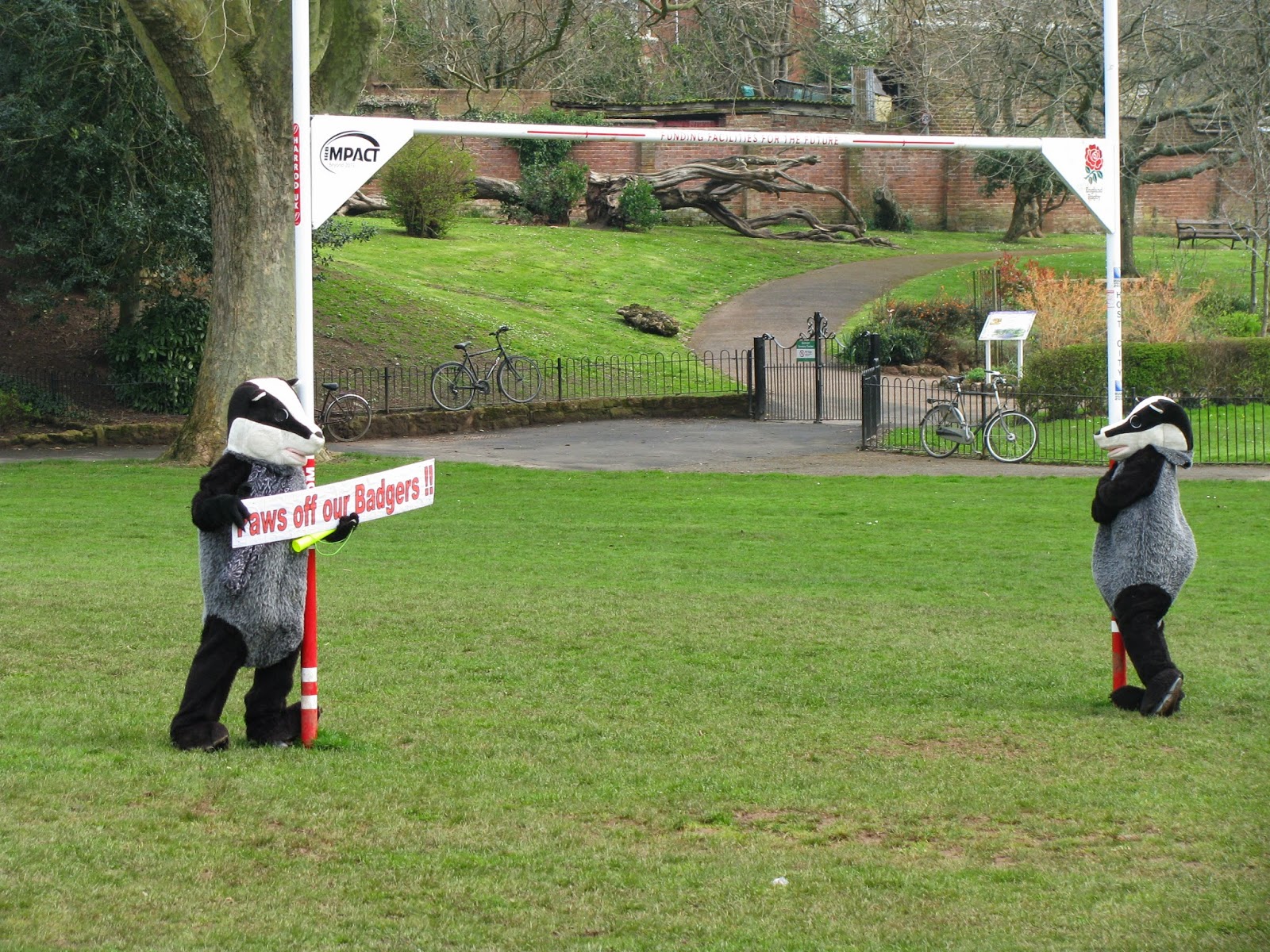
Hundreds turned out in Exeter on Saturday to show their condemnation and outrage at the Government's disastrous badger cull policy.  The Badger Army has been noisily making its way around the country, and finally came to the Devon capital, to Belmont Park, a stone's throw from our flat.


Owen Paterson blamed badgers for moving the goalposts - it looks like he's finally proven right!

Those who know me will know I am vociferously opposed to this cull, which has no basis in science or ethics.  The badger cull is nothing more than a cynical attempt by the current administration to dangle a carrot in front of dairy farmers, in a last-gasp attempt to be seen to be doing something.  They know, as well as we know, that this policy will not reduce TB in cattle.  This blog believes the Government should take a modern, forward-thinking and holistic approach to the problem of bovine TB, one that actually delivers benefits to both our wildlife and struggling farmers.  As is overwhelmingly demonstrated by the science, there can no place for a cull of badgers in tackling this problem long-term.


Badger Army in Belmont Park

But in a much larger sense, this is not simply a badger issue.  The obsessive, state-endorsed demonisation of the badger over the last 12 months should send a chilling feeling down the spine of any wildlife lover.  In our countryside, we have the last, best, greatest resource on earth.  On our doorsteps we can enjoy, for no financial cost at all, the thrill of spotting deer in a forest, the pleasure of bird-watching in a meadow, the joy of feeling summer butterflies come flapping by your face on a warm August day.  If we allow the persecution and obliteration of one iconic native species, who knows where the madness will take us, next time a creature is blamed for another of man's mistakes in the agricultural industry.  It's not like the industry doesn't have form when it comes to cutting corners and compromising on bio-security - we all remember mad cow disease, we'll never forget foot-and-mouth.

Marching down Sidwell Street

I remember the first time I saw a badger - I was 17, and on a late-night wander to the kitchen, noticed the security light spring on outside.  I tentatively peeked, expecting to see a cat, but to my surprise I witnessed a badger, on its hind-legs, peering gingerly over the top of a low-standing bird table.  The same badger visited for some months after that, and each time I would follow it from within the house, clamouring room-to-room for another peek of this magical creature.  It was an experience I will never forget, a memory of the natural world that will stay with me forever.  Nobody has the right to deny our children that same pleasure.


Marching through the Cathedral Green

The Government will not win this fight - we cannot let it, because if it does, nothing in our beloved countryside is safe from the sheer exploitation and cynical short-sighted politics of those who view our greatest natural resource only in terms of profit.  British wildlife is not ours to own.  It is not ours to abuse.  It is not ours to scapegoat.  It is not ours to kick around like a cheap political football.  It is ours to enjoy, ours to care for, ours to nurture, and ours only so we can pass it on to the next generation.  Stop the blame.  Stop the lies.  Stop the cull.


Wednesday, 18 December 2013

Starting out

I don't think it ever crossed my mind how much there is to do when you move into a new place.  First, there's all those companies to notify; energy suppliers, insurance firms, not to mention those all-important magazine subscriptions.  Then there's the council.  Oh, and the bank.  And, if you're like us, you also have to order virtually every piece of furniture and arrange deliveries around work hours.  The joys of moving... Now I understand why parents always used to moan so much about it!

Lizzie works out the intricacies of clothing rails

Seriously though, after what has been a very busy few weeks, we're finally getting settled, and people can expect invitations soon.  Last week alone we've got hold of a new bed, a new mattress, a sofa, a coffee table, bookshelves, a washing machine, drawers, clothing rails, bedside tables, and we've finally reconnected to the World Wide Web.  In short, normal service has resumed, and just in time for Christmas.

Chaos in our new lounge
A more relaxed living space

We're renting a second-floor flat in a lovely period property, with front-facing views onto golf range and Exeter's dry ski slope, in a very quiet part of the city centre, ten minutes' walk from the shops, a twenty-five minute walk to work, and absolutely no reason to use the car again in that awful Exeter rush hour that has claimed so many hours in recent years.  I'd go so far as to say it's a joy being able to leave the office and walk home, when I would usually be stuck amidst thousands of other stressed motorists, trying in vain to get out of the city and home for the day.

Our new dining table and chairs
Our lovely new bed

So, this is where all my blogs will be coming from for the next few months at least - not too shabby, I'm sure you'll agree (and sometimes when I come through the front gate, I pretend we own the whole house!)

Home (or at least part of it)

Tuesday, 13 August 2013

Great Gorillas!

Ah what more could you ask for than a relaxing start to the weekend, fish and chips by the sea, a refreshingly salty stroll, a bunch of colourful gorillas and... wait, huh?

For those of you not living in South Devon, you might not know that we’ve been invaded.  They arrived last week by flotilla and now you can’t go anywhere in Exeter or Torbay without catching a sight of them.  No I’m not talking about hoards of grocks, although they’re here too, but a much rarer and altogether more peaceful group has recently landed on our shores – wild gorillas.

The Great Gorillas Project is a public art event taking place in both Torbay and Exeter for the next ten weeks.  Thirty life-size gorilla sculptures, and a number of smaller ones designed by local schools – are now gracing the streets, parks and open spaces of the region to highlight the threat facing wild gorillas.  It all coincides with Paignton Zoo’s 90th birthday; they’re hoping to raise a significant sum of money towards conservation projects for these rare and wonderful creatures.

Well this blog loves the quirky things in life, so Lizzie and I headed out on the trail of some of these sculptures, starting at our place of work, the University of Exeter.  Inside the new Forum building sits Takamanda, designed by an Exeter student who sent her gorilla on a globetrotting adventure to collect the stamps of other endangered animals, an inspired idea.


Our trail continued that evening in Babbacombe, where Hope was looking whimsically out to sea.  According to the guide, "Hope is designed to remind us what this event and the work of Paignton Zoo is all about.  She features the beautiful images of two of the Zoo's most iconic and endangered species.  The artist's aim is to inspire hope."


A short walk across the Downs, we come to a gorilla called Back of Beyond.  "The gorilla is the master of those untamed places in which he makes his home," says the guide.  "With so much of the world unexplored, we can fantasise about lost continents, obscure rivers and forgotten volcanoes in this cartographic mash up."  What an amazing design too - I wish I could get this map on paper.


The next day in Exeter, we rediscovered the gorilla trail around the city centre, meeting along the way X-Ray Ape (inspired by the artist's own broken bones), Miss Prints (showcasing a number of endangered animal prints, furs and feathers), and Mr Bumble, undoubtedly the most well-dressed gorilla on the trail, who is "so fond of fruit, he wears it on his suit."


Back in Torquay, the clever folk of South Devon College have painted their gorilla into legendary detective Poirot, and Hoopers department store has gone the whole hog, furnishing its window with art deco clothes and accessories.  In addition to Poirot, the harbourside is full of gorillas.  By Paigton Zoo's Living Coasts lies Hippocampus Guttulatus, covered in seahorses to help increase awareness of Torbay's two species of seahorse, whilst across the inner harbour is sparkly blue Barry and Five Minutes To Midnight, covered in clocks to represent the Domesday phrase and highlight the urgent need to save endangered gorillas.  This is a tough call, but Five Minutes to Midnight is probably my favourite gorilla on the trail.


What a wonderful art exhibition, I only wish I could have featured all the gorillas we have seen so far.  We can't wait to go back on the trail and pick up the Paignton and Brixham gorillas in the near future.  In the meantime, everyone should check out the Great Gorillas Project to see the serious conservation work behind this beautiful art trail.


Wednesday, 9 May 2012

Exeter Looking Back, Exeter Looking Forward

Seventy years ago, the city of Exeter had wrought upon it the most devastating chapter of its history.  Exeter had long been considered one of Britain's most beautiful cities, from its medieval bridge, through its winding streets, to its magnificent cathedral.  On the evening of 4th May, 1942, this was altered forever, as the Blitz came shockingly to this peaceful city.

Devon had seen its fair share of German bombs in the course of the Second World War, with the enormous naval base of Plymouth bearing the brunt of the raids.  Exeter, however, was different; it had little military importance and, although a railway junction, there was little strategic gain to be made from the destruction of the city.  Military strategy, however, was not on Hitler's mind when the city was targeted - Exeter was a revenge bombing.  In March 1942, the R.A.F. razed the beautiful German city of Lubeck, and in retaliation the German high command highlighted several English cities - amongst them Bath, York and Norwich - to receive similar punishment.  As much of the information was taken from Baedeker travel guides, these raids became known as the Baedeker Raids.

Exeter had already received two minor raids in April, but nobody could have predicted the events that unfolded in the very early hours of 4th May.  At 01.36 in the morning, around 20 Luftwaffe bombers flew up the River Exe and dropped incendiary bombs, designed to ignite and cause roof fires. Despite the heroic efforts of firefighters, the flames spread quickly, and by 02.15 the High Street was ablaze.  At 02.50, the bombers turned around to return to their base, leaving behind a city engulfed in an inferno. 

Firefighters battled through the night, as Exeter lost historic buildings and unique architecture.  Among the biggest architectural losses was Bedford Circus, one of England's most notable pieces of Georgian town planning, widely regarded to be on a par with Bath's Royal Crescent.  Through the burning night, the city lost 1,500 houses (with a further 2,700 receiving substantial damage), 400 shops, 150 offices, 50 warehouses, and 36 pubs.  Eyewitnesses claimed that in some places the fires burned for a week afterwards.  In the morning, residents emerged to find a foreign city, flattened and unrecognisable - a scene that was repeated across Europe in six years of very cruel war.

The human cost of all the bombing raids on Exeter during the Second World War stood at 265 killed, 111 seriously injured, and 677 injured to a lesser extent.  Many of the dead were fireguards who gave their lives trying to protect the city. 


Exeter's Latin motto is Semper Fidelis, meaning ever faithful.  There can perhaps be no more fitting a motto for a city that, following this dreadful night, kept its faith and its belief, as was so iconically enshrined in the photos of the cathedral, poking through the devastation.  After the war, the rebuilding of the city began - there was a faith in a new age, more peaceful and prosperous than anything ever known before.  This culminated in the publication of Thomas Sharp's Exeter Phoenix Plan, which led to the city's new centrepiece, Princesshay shopping precinct, the first pedestrian-only shopping street in the country.  Building began in 1949 when the then Princess Elizabeth unveiled a commemorative plaque.  The Phoenix sculpture, one of Exeter's most prominent public sculptures, was erected in the centre in 1957 by Hughes of Exeter, on the sight of their former premises, to symbolise the city's growth out of the ashes.  Exeter was back on its feet and ready to move forwards.


The Princesshay shopping precinct survived until the turn of the 21st century, when it was torn down and replaced with a newer, more modern facility.  For some (but certainly not all!), this more accurately signifies the return of Exeter's prosperity over a period of some 65 years.  Opened in 2007, the new precinct has been a hit with residents and non-residents alike, so much so that, two days before the 70th anniversary of the bombing raid, it was revisited by  the now Queen Elizabeth II, as part of her Jubilee tour.  The crowds were out in their thousands to welcome Her Majesty, who looked radiant and lovely, truly regal in every sense.  Beyond the excitement of the day, however, lies a much more poignant meaning to her visit, for there can surely be no more proper a tribute to those who lost their lives in the Exeter Blitz than the sight of a crowd of thousands cheering their monarch, at the very heart of the city, under a very British flag.  It is surely a sight that every Blitz victim would have wanted to see.


With thanks to the always brilliant Exeter Memories website for the three black-and-white photos, http://www.exetermemories.co.uk/