Showing posts with label Seaside. Show all posts

Tuesday, 30 May 2017

Goodbye, my Coney Island baby

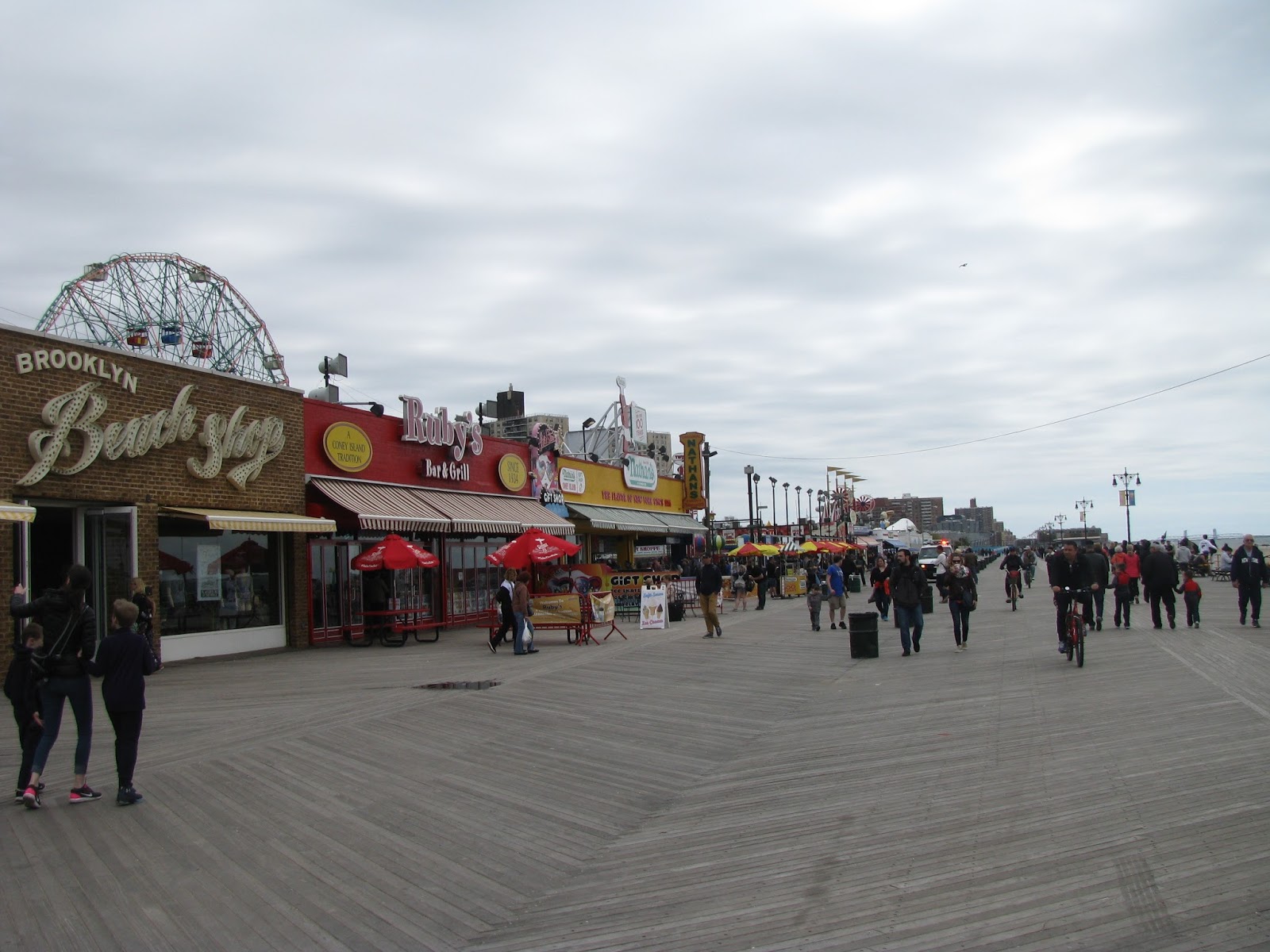
Our final full day in New York sees us jump on the subway for the 45-minute ride out to Coney Island, the self-proclaimed Playground of the World.  We've been lured here by the promise of good, old-fashioned American family fun, an iconic boardwalk, and throwbacks to the roaring 20s, when promenades along the beach and all-in-one stripy swim suits were very much the rage.  By the looks of it, the seaside resort does get very busy in the summer months, as New Yorkers make the short trip out to enjoy building sandcastles and taking a dip in the North Atlantic, but on our April visit, a biting wind cuts across much of the sun's warmth, blowing sand into our eyes, and rendering the beach virtually out of bounds.  Nonetheless, the boardwalk has its own charm, and the variety of shops offer up a few different souvenirs for the discerning tourist.


Coney Island boardwalk
A Coney Island map

First stop, offering shelter from the wind, is the New York Aquarium.  Formerly situated in Battery Park (see Following the Immigrants) the aquarium moved to this coastal location in 1957, and is now part of the Wildlife Conservation Society (WCS) which also oversees the city's other zoos.  The aquarium was rocked in 2012, when it suffered significant damage from Hurricane Sandy, flooding the facilities and shutting down the power supply.  Although staff who remained on-site at this time were able to save 90% of the creatures held there, the ramifications of the storm are still clear for all to see.  An enormous rebuild is therefore underway - even more than four years later - which understandably leaves some of the site inaccessible.


An old-fashioned aquarium mural

What the aquarium does have, however, is a wonderful array of tanks, amongst the very best that I have seen.  In Conservation Hall, we are taken on a journey around the world - the Amazon basin, the African lakes, coral reefs (the aquarium grows its own coral, aiding its sustainability agenda) and marine environments giving a flavour of the wondrous life that exists beneath the waves.  In fact, I've been so impressed by what I've seen, that I've since tried to remodel my own tank on their Amazon biotope.  Outside, there are penguins, sealions and otters, and a large circular tank housing small sharks, a temporary solution until the Ocean Wonders habitat is completed.  The aquarium is also planning an underwater viewing area for the penguins, an Explore the Shore coastal section, and an Alien Stingers exhibit.  Lots more to come back to one day, as they continue their recovery from the deadly force of nature.

A beautiful Amazon tank
A home-grown coral reef

Back on the boardwalk, and there's only one real choice for lunch - Nathan's Famous, who have been feeding this part of Brooklyn with old fashion hot dogs since 1916.  The brand is a popular one, and an American institution - they are the official hot dog providers to the New York Mets and New York Yankees baseball teams - located as they are in an unmissable yellow building, in front of which a sizable crowd is gathered.  We join the queue, and two cheese dogs later, we're pretty satisfied.  Looking around, we also realise that we've ordered on the lighter side, for the food is flying out of the kitchen, and some diners are tucking into weighty portions.

Nathan's Famous of Coney Island
Cheese dogs and fries

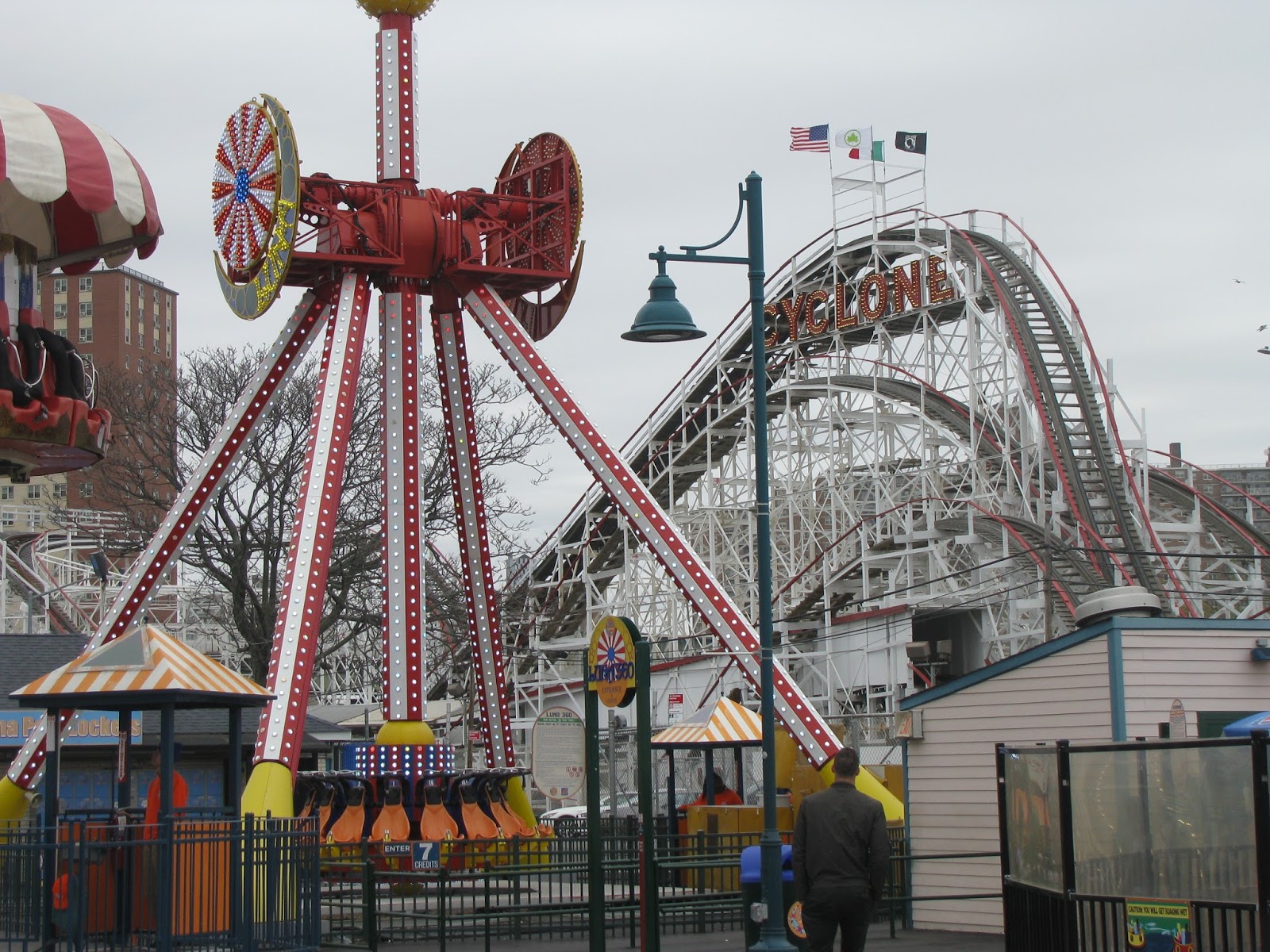
The rest of Coney island is dominated by Luna Park, a sprawling fairground with more than a hint of Paignton to its character.  Central to the park is the Cyclone, a rattling old wooden rollercoaster from the heyday of the amusement park.  A piece of history in its own right, it is known locally as the "Big Momma," with more than 2,500 feet of track and 12 drops.  Would I ride it?  Probably not, for despite its decent safety record and multi-million dollar investment in recent years, it looks a bit too rickety and dated for my liking!


Time is running out.  Evening sets in and, back in Manhattan, we catch the subway to 42nd Street, for the short walk to the Circle Line cruise terminal.  For our last evening in New York, we've made the decision to see the whole of Manhattan from the water, and as dusk sets in, we brave a chilly wind on an open-top boat, which takes us down the Hudson, past Ellis, Liberty and Governors Islands, across the harbour, and up the East River.  Watching the sun set and night take hold over the New York skyline is a special sight, and a memory that will linger for a long time.  It's also the perfect round-up from our trip, for playing out in front of us is everything we we've seen and done - the Financial District, the Brooklyn Bridge, the UN, the Chrysler Building, Southstreet Seaport, Battery Park, the Williamsburg Bridge, the Empire State Building, the Statue of Liberty, and numerous others - bound together in this wondrous, magical city.  From here, I understand what Scott Fitzgerald was talking about, when he wrote, in The Great Gatsby“The city seen from the Queensboro Bridge is always the city seen for the first time, in its first wild promise of all the mystery and the beauty in the world.”  It provides the most fitting farewell and a fond reflection of our time, all the more so for us, as we leave the city having embarked on a new chapter in our own relationship, doubly enshrining our New York trip amongst our happiest of memories.  

Sunday, 9 March 2014

Sunshine and Sunfish

The first sunny weekend of the year, and time to get out and see what’s on offer following the crazy weather of late.  These sorts of weekends, rare though they are, can be a joy in Devon – the sun is shining, everywhere is being readied for the holiday season, but as it’s still too early for the tourists, we find we have the county more-or-less to ourselves.  We’ll hop on a train to Plymouth then…


We’re not regular Plymouth-goers – it’s a little out of our way from Exeter – but the city is well worth a day every so often and, if you can look beyond its harsh post-war architecture, there lies a city steeped in history.  They call Plymouth “the Ocean City”, a nod to the sea from which it shares a unique, intrinsic bond.  Quite fitting, then, that one of the first things we should run into is an art installation celebrating the ocean.  Lined up off Royal Parade in the city centre, fifteen ocean sunfish sculptures, each designed by local apprentices, and decorated by local artists and students, stand dazzling against the concrete.  Their existence is down to a project called Making Waves, which aims to encourage young people into apprenticeships, as well as raise awareness for marine conservation.  We’re lucky to have caught them all in one place – in a few days, they will be shipped off to locations all around the city, forming a public art trail, the likes of which gripped locals in Torbay and Exeter in 2013.  There's no space in this blog to show you all the designs I liked, but I'll get back to you later about which was my favourite.

Ocean sunfish (source: Wikipedia)

A short stroll from the city centre brings us to Plymouth Hoe, where the breeze hits you straight off the sea, and I fancy you can taste the maritime history.  This is home to Plymouth’s fantastic, humbling war memorial, bearing the names of several thousand sailors who lost their lives in war, a testament to the city’s naval heritage and bravery.  Beyond the memorial, Plymouth’s most famous son, Sir Francis Drake, looks out on an ocean from which he made his fortune (and a green, on which he payed his bowls), whilst across the way, Smeaton’s Tower provides perhaps the city’s most famous landmark.  The lighthouse was finished in 1759, cost £40,000, and was largely the work of Cornish tin miners, who built the tower out on the dangerous Eddystone Rocks.  The Douglas Lighthouse superseded Smeaton’s Tower in 1882, and the people of Plymouth paid for it to be dismantled and reassembled on the Hoe, so grateful were they for the countless lives saved.


Our stroll along the Hoe gives way to the massive naval defenses of a once-mighty empire, and we descend down to the Barbican and our destination, the National Marine Aquarium.  Locals will remember when this aquarium first opened, and I recall how excited I was on my first visit, wide-eyed and fascinated as I was taken on a journey from the marine life of Plymouth Sound, around the coasts of Britain, through the deep Atlantic and into the tropics.  Today, the aquarium has lost none of its charm, and the life contained within its walls is simply stunning.  There are no sunfish, but the sharks, rays, octopi, seahorses, crabs, lobsters, and jellyfish make for a vibrant couple of hours.  


The star of the show, the beautiful Loggerhead Turtle named Snorkel, punctuates our visit to the aquarium.  Washed up on Sennen Cove beach, Cornwall, in 1990, it was discovered that her eyesight was so poor that she could not hunt for food, and a decision was taken not to release her back into the wild.  At 25, she should have many years ahead of her, a life that could have been cut so short had she not been found 24 years ago.  She's everybody's favourite, and you can see why - her serene, peaceful presence is mesmerising.


A day in Plymouth - well worth it if the weather's good, and if you like your maritime history, marine wildlife, or just a good old bask in the early Spring sunshine.  And as for which sunfish was my favourite... Well it could have been any of them, but I think this one just captures the spirit of our day in the city.

Thursday, 6 February 2014

"God said: Noah, build yourself a boat; make it nice and waterproof, guaranteed to float"

Noah's Ark on Mount Ararat by Simon de Myle

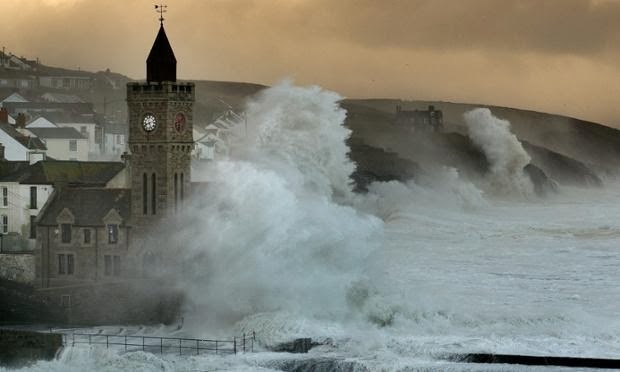
Well maybe we haven’t reached this stage yet but down here in the Westcountry, it’s all getting a little bit Biblical, and with a never-ending series of storms constantly battering out coastline from the Atlantic, it’s getting harder to believe that Spring should be just around the corner.

Porthleven, Cornwall (Source: The Guardian)
Dawlish seafront (Source: The Guardian)

We all woke up on Wednesday to heart-breaking scenes in Dawlish, the destruction of our iconic railway line, touted by many as the country’s most beautiful train ride.  Local travellers will tell you that “no two journeys are ever the same” along this stretch – the scenery changes by the minute, influenced by the position of the sun, the clouds, the weather, the seasons, the brooding moods of the Exe, the mist of the Teign, and the ever-menacing presence of the English Channel.  One day you’ll be waving to a family on a bucket-and-spade holiday, the next you’ll be jumping back as an angry wave smashes against the carriage window. 

Dawlish seafront (Source: The Guardian)
The railway at Dawlish (Source: The Daily Telegraph)

That rapid transformation perhaps best sums Devon up - taking a journey from Exeter to Newton Abbot on this line is like looking into the window of the county’s soul.  Sometimes calm, occasionally ferocious, ever beautiful, as gentle as innocent love, but with a cavalier streak that won’t hesitate to kill.  If you’re Devonian, the land – and the sea – will teach you to take the rough with the smooth, and thus we are a people brought up in tune with our surroundings – we respect it, we understand its power, we love it and we fear it, we wouldn’t change it for the world.

The most beautiful journey in England (Source: Dawlishwarren.info)

My thoughts and prayers go out to everyone affected by our terrible and destructive winter weather.  Good, hardworking people, whose homes are damaged, whose businesses have been swept away, whose livelihoods are now in jeopardy, from our county cousins on the Somerset Levels to our troubled friends in Cornwall, from Oddicombe beach to Exmouth seafront, up and down our coastline, in our estuaries and up our river valleys.  Winston Churchill once famously spoke over the wireless to a fallen France, and perhaps his words will resonate around our embattled county today, bringing with them some comfort for those affected, and some hope for the future:

“Good night then: sleep to gather strength for the morning.  For the morning will come.  Brightly will it shine on the brave and true, kindly upon all who suffer for the cause, glorious upon the tombs of heroes.  Thus will shine the dawn.”


Stay safe, Devon.  I'll see you in the morning.


Wednesday, 21 August 2013

Go Fish!

Across Torbay lies a remote, almost mythical town.  It's a place I've only set foot in a handful of times in my life, and even then not for at least fifteen years.  After all, it's too far to travel, there's no reason to go there, there's nothing to see, it's a bit too... fishy.

On another stunning summer's day, Lizzie and I thought it time to put right these misconceptions and hop on the ferry to Brixham, that lesser-known third town that makes up Torbay.  You certainly can't complain at the price of the trip - a one-way ticket from Torquay costs just £1 per person, representing quite a bargain!


Fishing and Brixham are impossible to separate; they're a bit like... well... fish and chips.  The town is known as the Mother of the Deep-Sea Fisheries, and was once the largest fishery in the country, its trawlers helping to establish the industry in places such as Hull, Grimsby and Lowestoft.  You certainly don't need to visit the town to hear about its affinity with the sea, and the Brixham fisherman's reputation for bravery is known throughout Devon, as is the town's pride in its heritage.


Brixham is also famous as the landing point of William, Prince of Orange, and his Dutch army, who took their first British footsteps here on 5 November 1688.  The Prince of Orange (later King William III) would make his famous declaration, "The Liberties of England and The Protestant Religion I Will Maintain", before marching on to London to assume the throne. Apparently, many people in the area still carry Dutch surnames, being direct descendants of soldiers in that army.


Around Prince William Quay, the clouds now ominously gathering, we catch site of the fantastic lifeboats that have saved countless lives on this stretch of coastline.  The Brixham lifeboat dates back to the night of 10 January 1866, when a terrible storm swept the breakwater away, and gale force winds stopped fishing boats from entering the harbour.  Legend has it that, in the pitch-black of night, the local women brought everything they could carry to the quayside, to make a giant bonfire to guide their men home.  When dawn finally broke, one hundred lives had been lost and over fifty vessels destroyed.  News of the tragedy shocked the city of Exeter, whose citizens funded the Brixham lifeboat - now known as Torbay Lifeboat Station.


One of the reasons we came to Brixham was the see the town's two great gorillas - Bob and Nacho.  Nacho marks the furthest point on the trail, and I must say it feels like a long way from the trail's other extreme, the University of Exeter.  The artist behind Nacho designed him to be a Mexican wrestler whilst Bob, sponsored by Bob Hill Haulage, has been cleverly painted to resemble a lorry.


The rain spots having given way once more to glorious sunshine, and after a satisfying ice cream on the harbour side, it's time to leave Brixham.  The town, busy though it may be with summer tourists, seems like another world to me.  I don't feel like Torquay is just across the water, nor do I feel I am only a stone's throw from the familiar rivers and towns of my south Devon home.  It's as if I am a traveller, discovering a new and exotic place for the first time - and in a way, I suppose, that's exactly the case.  Watching the town disappear on the ferry back across the bay is like saying farewell to a newly-made friend, someone that you were at first unsure of, but have now come to understand, by learning the fascinating story lying behind the deep and soulful eyes.  Brixham, let's not leave it another fifteen years!