Showing posts with label Italy. Show all posts

Wednesday, 25 November 2020

Makin' mosaics

Lockdown (the second) has given us all a chance to slow down and look at things in a more leisurely way, and for me it's taken me back into  some of my travel photos from my past.  In 2008 I interrailed around Europe, visiting several  amazing cities and fabulous sites along the way.  On one sunny morning in Rome, I took the Metro out of the city in the direction of Ostia.  Something incredible happened that day -  though descended underground in blazing blue-skied sunshine, our train emerged 20 minutes later into a cacophonous thunder storm, and some of the heaviest rain I've ever seen.  Flashes of lightning and howling winds gave an apocalyptic feel - and I made an about-turn and caught the very next train back to Rome.  Incidentally it was on exiting Rome's Porta S. Paolo station that I ran into the Pyramid of Caius Cestius.  "A pyramid in Rome?!?", I hear you scream?  Well, yes, actually.  Built between 18-12 BC, and thought to be based on the pyramids of Nubia (which had been attacked by Rome a decade earlier), the structure is the tomb of the aforementioned Caius Cestius, who may have been a Roman general on that military campaign.  You can only imagine how exotic it must have looked 2,000 years ago.  

Anyway, I digress.  Take two, and the following day my train did emerge in more palatable weather, delivering me at Ostia Antica, the remains of an ancient Roman city, the major port of Rome itself.   In its heyday it sat at the very mouth of the Tiber, although two millennia of silt have had the final say, and the remains of the town are now a good two miles inland.  British archaeology is my true calling, but Ostia Antica must stand alone as the singular greatest archaeological site I've ever visited.  Now, granted I haven't yet been to Pompeii, but I defy even that famous city to impress me more.  It wasn't just that the site was so amazingly preserved, with its street system and buildings, its theatre and its mosaics - it was that on this day, I had the whole place virtually to myself, the town mine to wander and explore to my heart's content.  And I did. I spent all day there.  They couldn't get me out of the place.

One of the things that most stuck with me at Ostia was the abundance of mosaics, both on walls and floors.  And even more amazing to me was that, with a few exceptions, they didn't even bother to fence them off - you could walk on actual 2,000-year-old Roman mosaics of the highest quality.  Now as someone from Britain who sees even the most basic Roman mosaics placed behind glass in order to preserve them (Dorchester literally built a house over theirs) this was something of a revelation, although I couldn't bring myself to trot over them, but diligently marvelled from the sidelines.  

There are many - many - mosaics at Ostia, but my favourite depicts scenes of great importance to the city - fishing, shipping, and trade.  Far beyond anything else, they've stuck with me, and are probably the first thing I think of when I think of Rome (sorry, Colosseum!)  I forget, and cannot find any authoritative source to tell me, exactly where this mosaic was situated - could it have been a market, or a merchant's place of business?  The amphora clearly suggests trade to me, and it's an activity taking place with northern Africa (the palms are the giveaway - palms aren't native to Italy).  Whatever your interpretation, they're just stunning in my opinion.


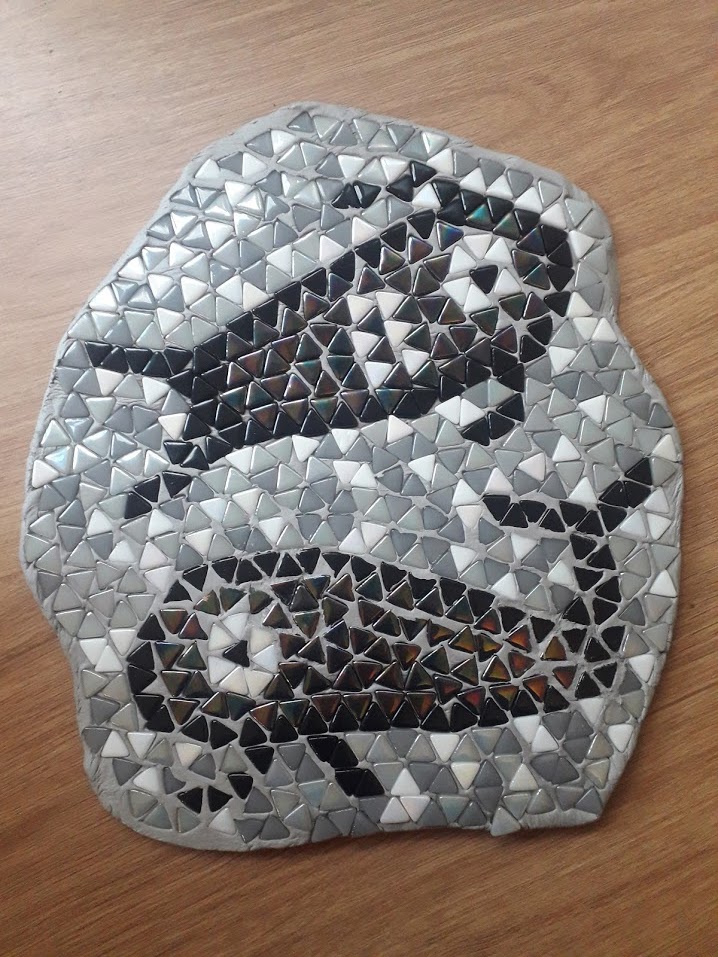
So stunning, in fact, that over lockdown #2 I decided to grab a slab of air-drying clay, a big bag of glass pieces, and attempt my own version for the garden.  Now, I know it's a shadow of the original, but in a weird and wonderful way it ties in with our location - the Roman Army are known to have camped at Milber Down hillfort just up the road from us, and I have often sat in the garden imagining Imperial soldiers scrabbling down the slopes of what now forms our decking.  Fanciful maybe, but the mere fact that the same people who camped so close to here were also trading with Egypt across the Mediterranean should make us all marvel and the extent of the Roman Empire.
You can see all my photos from Ostia Antica in my photo album.  So that's how my lockdown's been going - what home adventures have you been on? 

Thursday, 5 June 2014

On the Ferrovia Circumetnea

Our final day of living the Sicilian life sees us once again at Catania’s central railway station for the short trip to Riposto.  It is as if the Italian transport network knows our time is nearly up, and after a week of frustration at its hands, there is one more twist of the knife, the ticket machine swallowing our ten euro note whole.  For Lizzie, it’s the final straw – for me, it’s utterly typical of a system crippled by inefficiency, ramshackle to the very point of collapse, a bit like a smashed pottery vase that has been glued back together with pritt stick.  One thing I shan’t miss is Sicilian public transport.

Unfortunate, then, that for our final day, we’ve chosen to take the Ferrovia Circumetnea, whose beat-up little trains complete a near-full circuit of Mount Etna, starting in Riposto, and ending in the suburbs of Catania.  The guard on board has apparently never heard of tickets before (biglietto, the only word in Italian we were sure we knew!), nor has he heard of Catania, but we do eventually pay our fares, as our little train chugs, mechanically, out of Riposto and up into the lush hills.  It’s amazing at how quickly the urban sprawl falls away, and soon we are passing almond groves, vineyards, and rustic little settlements, all the time ascending.  A glance around the train is something of a surprise – we assumed it would be populated by tourists, but Sicilians in these parts rely on the railway as a means of getting to-and-from the city, and to my eye, we’re the only non-natives on the carriage.

Up into rural Sicily on the Ferrovia Circumetnea

The train has many stops on its long journey around the volcano, and our ticket acts as a “hop-on hop-off” service, so we break the journey at the hill town of Randazzo.  Sleepy, peaceful, and empty are all words that accurately describe the town – there is barely anybody around, save for groups of old men who sit around the squares putting the world to rights, and staring with surprise as we walk by.  Perhaps, after all the places we’ve visited, we’ve finally gone “off the beaten track” and wandered into a world unused to our presence.  Or maybe it’s just because everything is closed, save the local convenience store, and the archaeology museum, which is intriguingly housed in Castello Svevo, a little fortification that once made up a much larger castle.  Inside, ancient vessels, coins, and ornaments present a cute collection, whilst down in the cells, a group of traditional Sicilian puppets are the undoubted highlight.  The museum curator, probably bored rigid in the silence, makes us feel very welcome, and tells us all about the town’s church and its festivals.  Back outside, we eat lunch on Piazza San Martino, making a sharp exit when a huge swarm of bees comes buzzing through the square, no doubt following their queen to pastures new.  If I were a bee, I’d happily stay in Randazzo – it’s pretty, it’s rural, and nothing will ever disrupt its total lack of activity.


Randazzo station
Piazza San Martino with Castello Svevo

Back on the train, the scenery gets serious as we lurch west, and come around the north side of the volcano, where snow still sits on the crags, a brilliant contrast to the dark rock underneath.  Away from the mountain, the undulating landscape stretches off into the distance, green, fertile, and lovely in the summer sun.  We stop at many unnamed little platforms, before entering a landscape populated with pistachio trees.  We don’t get off at Bronte, but the town is famous for the nuts, and around 85% of all pistachio nuts eaten in the whole of Italy are grown and processed here, in these hills.

The north side of Etna
The rolling landscape north of Etna

After Bronte, the train begins a long descent, and then something odd happens; we go underground.  Stranger still, whilst under there, our rural little train pulls into a station akin to a London tube stop.  This unexpected twist is the town of Adrano, which we are told is worth an hour’s stroll, and so we take an escalator up to ground level, and wander into town.  There’s nothing here, save for a small park, a Norman castle and a church (the latter two are closed), and we are quick to retrace our steps back to the tube, where a 45-minute wait gives us a chance to reflect on our week.  Certainly we’ve enjoyed ourselves, but this has not been an easy or relaxing holiday, and I think in many ways, we’re both relieved to be heading back home, having suffered too long in the heat, and fallen victim too often to Sicilian inefficiency and inconsistency.

Adrano's Norman castle

After Adrano, and our reappearance in the open air again, the landscape becomes slowly less dramatic, steadily more ugly, and we are soon rattling through the suburbs of Catania.  I’m almost asleep when we finally reach the terminal station, Catania Borgo, and as the travelling crowds quickly disperse (lucky them, they know where they’re going), we are once again left scratching our heads at a map that has consistently failed to get us where we want to be.  In the end, we shove it back in the bag and follow our noses, down unnamed streets, across unsigned squares, dodging traffic and sweltering under a ceaseless sun.  It is an ending that perfectly encapsulates what our week has all been about – indeed, what I think Sicily is all about – to forget everything you know about anything, to throw caution into the wind, to leave it all up to fate, and to wait and see what ends up happening.  It may well be that we return from Sicily with a more fatalistic approach than when we arrived; but perhaps that’s just how you become when you've lived a few days in the shadow of a great, active volcano.

Tuesday, 3 June 2014

The ancient Greek jewel of Siracusa

Siracusa, Sicily, arguably the most historic city on the island, if not in the whole Mediterranean, greets us with a rather smutty introduction, our train reaching its terminus station following mile-upon-mile of dirty, suffocating, petrochemical plants.  It's not quite the welcome we expected from a city dubbed "more Greek than ancient Greece", but we arrive in good spirits and set off for the Neapolis, an archaeological park north of the city centre.  The sun beats down early.  The roads are not signposted.  The city's street layout is in stark contrast to that in the guidebook.  The pavements give way, without warning, to wide roads of heavy traffic.  We take several wrong turns.  An elderly couple point us in the right direction, but even when we think we've found the site entrance, all we've actually found is a local market.  Astoundingly, getting to one of the island's most famous tourist attractions is made just about as difficult as it could possibly be.  Even when we finally get there, the ticket office is nowhere near the park, but a quick glance around reveals exactly why things are the way they are - the infrastructure for Neapolis has been purely set up to cater for the coach tour.  There are no independent travellers here, so there is nothing to assist them - why would anyone in their right mind try and walk here from the railway station after all?

Parco Archeologico della Neapolis sits in an enormous site, about a twenty-minute walk from central Siracusa, and contains the monumental remains of a once very powerful city.  We've just about beaten the tour groups here, but feeling them hot-on-our-tail, we're quick to make for the most famous site in the complex - the enormous ancient Greek theatre.  Built in the 5th century BC, reconstructed in the 3rd century BC, then modified by the Romans, it is one of the largest ever built by the ancient Greeks, with 67 rows, divided into nine sections, with eight aisles.  It's difficult to see the original edifice, covered as it is with wooden boards for modern performances that no doubt take place here year-round, but you can still get an idea of its complexity and enormity.  What I like best, however, isn't the theatre at all, but rather what lives within, for out of holes in the porous terraces dart colourful little lizards that, by my reckoning, have probably been living on this site since the Greeks first put on shows all those centuries ago.


Ancient Greek inscription at the theatre
A theatre lizard

As it turns out, the authorities at the Neapolis (and just about all the visitors too) are only interested in the theatre, and so we stroll into the nearby ancient Roman amphitheatre without even having to show our ticket.  This, too, is sizeable, but crumbling, overgrown, and far more atmospheric.  Siracusa became a Roman colony in 21BC, and the conquering army wasted no time in building themselves a further entertainment venue.  The amphitheatre is classically Roman, but has a gruesome addition - a square reservoir in the middle of the arena, in which the blood and bodies of wild beasts and wild men would be swept during barbaric competitions.  It is said that the weak and enfeebled from the audience were allowed to make their way up to this reservoir at the end of the spectacle, and drink from it, the belief being that the blood of the vanquished would make them strong again.  Somewhat disgusted, we leave, running almost immediately into a stall selling fresh blood-red orange juice.  Putting the matter of gladiatorial combat behind us, we enjoy a refreshing drink in the company of an eccentric accordionist, who provides one of those holiday moments you just don't forget.


Siracusa's Roman amphitheatre

The old town of Siracusa, called Ortigia, sits across a bridge on a small island jutting out into the sea.  We make our way there via the Catacombs of San Giovanni, an underground honeycomb in which there were once several hundred burials.  Legend has it that Saint Paul himself stopped and preached in one of the crypts on his way from Malta to Rome (Acts 28:12 states: "We put in at Syracuse and stayed there three days"), and it is well established that this is one of the earliest Christian sites in Europe, featuring many ancient tombs and frescoes.  Unfortunately (or fortunately, depending on your point of view), the bodies were removed during the Second World War, when Siracusans used the space to shelter from the relentless Allied bombings of 1943, but one nonetheless gets a sense of both spirituality and mortality.


The church of San Giovanni (St. John)

Ortigia comes as something of a relief after another battle with the Sicilian road system, and by the time we get to the island, we're almost too tired to explore.  Pizza revives us, and we go in search of the Temple of Apollo, built in the 6th century BC, and something of a prototype for how temples would eventually look across the entire Greek world.  A short walk up the hill, we come to the gentle Piazza Archimede, named in honour of the great Greek mathematician, physicist, engineer, inventor, and astronomer who met a sticky end in Siracusa in c.212 BC, when he was killed by a Roman soldier, despite specific instructions that he should not be harmed.  It is then only a stone's throw to the centre of Ortigia, and the magnificent Piazza Duomo, described as the "loveliest square in Sicily."  The cathedral itself (incidentally, the only church on our trip to Sicily to charge entrance, albeit a paltry two euros) is just as historic as every other part of the city, its nave incorporating another very ancient Greek temple, dedicated to Athena, and converted to a church with the advent of Christianity.  


The Temple of Apollo, Ortagia
Piazza Duomo

Beyond the cathedral, the Castello Maniace marks the tip of Ortigia, watching over the sea and keeping the city safe since AD1240.  Nowadays, the site is part-military, part-university, and although it accepts visitors, it only accepts them before lunchtime, and we are left locked out, peering through the bars of a large iron gate.  It scuppers our plan for our remaining couple of hours, so instead we browse the shops of Ortigia, which are situated on curious winding streets, all the time wending our way back to the new part of town.


A street in Ortagia

Siracusa has exhausted us, and we leave with aching legs and mixed feeling about the city.  I love the city's history, its reputation as one of the most important ancient Greek cities on the Mediterranean, and its confident nod to its past, and I do feel we've seen much more of the place than the aforementioned coach tourists.  However, Siracusa has been one very tough nut to crack, and as we pull out of the station and make our way through all those smelly petrochemical plants, I get the distinct feeling we will probably never be back.  Perhaps that fact alone makes it worth visiting this corner of Sicily; or perhaps we should have just done it by coach.

Sunday, 1 June 2014

Aci Castello, Acitrezza and around

Following three days of fairly hectic running around, our fourth full day is due to be a leisurely affair, beginning with a trip on Catania's tourist bus, to see the out-lying coastal villages of Aci Castello and Acitrezza.  Touristy it certainly is, but I must admit there is a delight in having the hard work done for you for a change, and we climb with eagerness onto the top-deck.  A very empty bus departs, and we are soon out onto the open road - a term I use loosely, as the roads are never open in Catania, and we crawl out of the city centre and to the coast.

Aci Castello, seven or eight miles out of Catania, is the site of an imposing castle, built in 1076 by the Normans upon an earlier Byzantine fortification.  The castle juts out into a stunningly clear Ionian Sea, and were it not for its great age, it would probably be considered an eye-sore.  Instead, it is iconic; black, harsh, powerful, and totally out-of-keeping with the beautiful Sicilian coast.  Typically Norman, the castle seems virtually impenetrable from sea attack, bearing clear resemblance to the great Norman castles back home.  In all honesty, I never even knew the Normans got this far south, but here's the clear proof.


Aci Castello

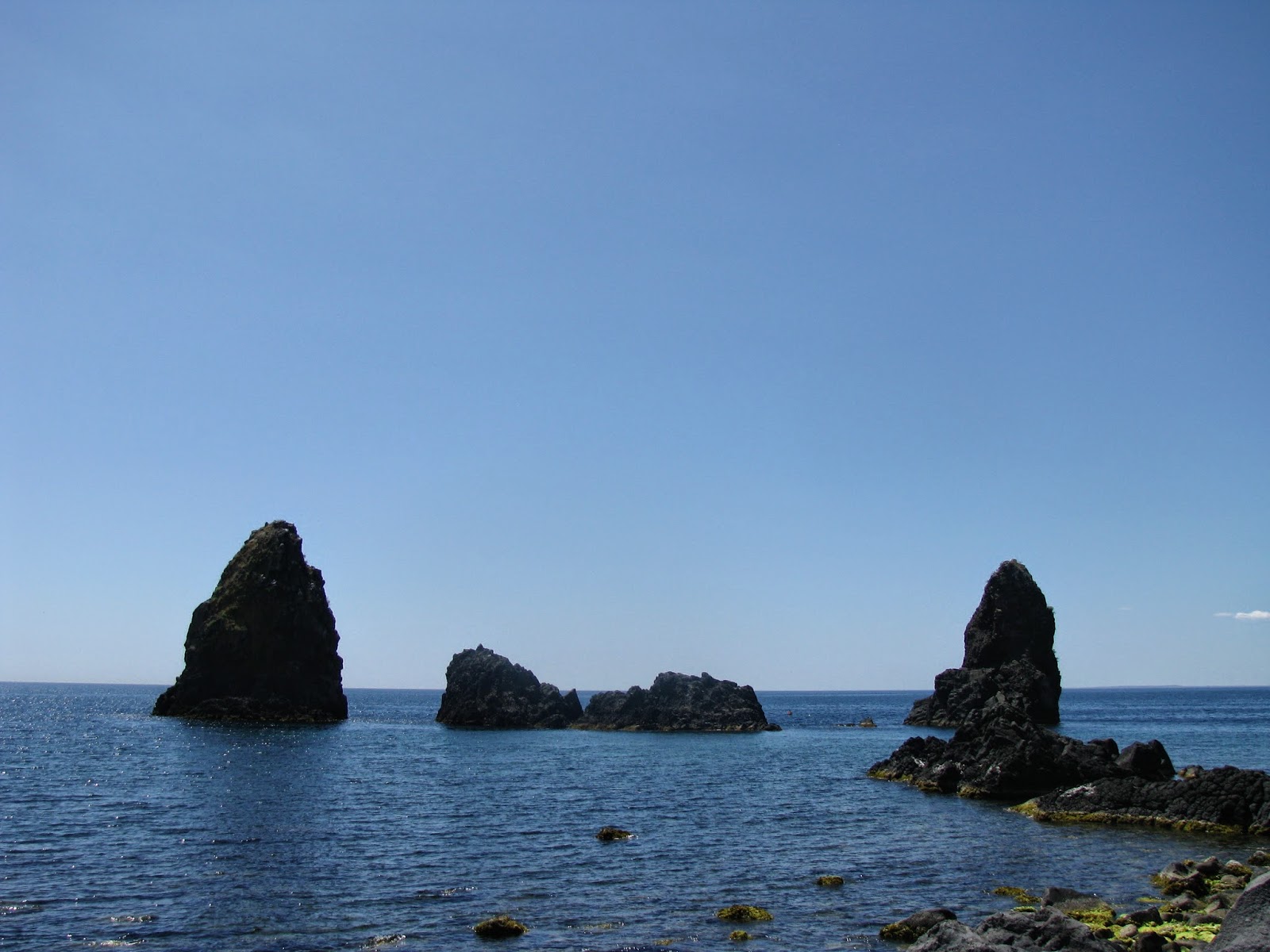
Just down the road from the Norman castle lies Acitrezza, a little fishing village with little to keep the visitor, save for its prettiness and its famous columns of basalt rocks that stand just off the coast.  These rocks are known as the "isole dei ciclopi" (islands of the Cyclops) and, according to local legend, were flung by Polyphemus, a man-eating giant and Cyclops, in an attempt to strike the ship of Ulysses (Odysseus).  Pope's translation of Homer's Odyssey goes as follows:

"These words the Cyclops' burning rage provoke:
From the tall hill he rends a pointed rock;
High o'er the billows flew the massy load,
And near the ship came thund'ring on the flood.
It almost brushed the helm, and fell before:
The whole sea shook, and refluent beat the shore.

A larger rock then heaving from the plain,

He whirled it round - it rung across the main:
It fell and brushed the stern: the billows roar,
Shake at the weight, and refluent beat the shore."

The stacks of Acitrezza

All knowledge of Greek mythology already used up (and the Odyssey has made its way sharply up my reading list!), we hop aboard our bus and turn back towards Catania, all to the tune of commentary from the tour guide.  We see a few new streets, but one sight makes my heart leap - the official club shop of Calcio Catania, the city's Serie A football club, which I have been looking for since day one.  We can't stop the bus, but making a mental note of where it was on Via Etnea, we return that afternoon, and I umm-and-arr, before choosing Catania's away shirt, which is white with a blue and red cross.  Even better, as it is last season's stock, it's for sale at only 15 euros, although the cashier has apparently never heard of cash, let alone change (the smallest note in her till is twenty euros, and no coins!) and chaos ensues, not for the first time at a cash desk in Sicily.


Calcio Catania, the city's football club

Following this retail success, we wander down Via Etnea, stop for a gelato brioche, and then find the city's Roman amphitheatre open for a stroll.  Only a small part of the structure now remains, but it is preserved in the very centre of Piazza Stesicoro, surrounded by traffic, almost an inconvenience.  Inside, stray cats sleep, and we are the site's only visitors, having the freedom to roam around the ancient corridors and rooms, although I feel there's something a little creepy about the place, as large gates shut off tunnelled sections that continue under the modern buildings and, staring through the bars and into the dark, I get the distinct feeling we're not quite alone.

Catania's Roman Amphitheatre
Exploring the amphitheatre

Our evening in Catania is another quiet affair, and as we have a busy day ahead, it's a simple stroll to a nearby restaurant for some first-class Sicilian food.  Pasta all round, Italian wine and beer, and a soporific atmosphere complete the most restful, least hassled day of our trip.


A picturesque restaurant

Thursday, 29 May 2014

The train to Taormina

Taormina, Sicily’s resort town, sits with regality on the cliff tops overlooking the emerald Ionian Sea.  It’s 45 minutes or so from Catania, by way of a local train on which, I could quite easily believe, we are the only paying customers. On arrival, it is advised that you catch a bus up to the town, and the reason for this becomes almost instantly clear.  The road ascends, clings to the cliff edge, and takes countless hairpin bends, up-and-round, up-and-round, as we climb higher and higher above the water.  The driver, clearly not one for passenger comfort, throws the bus all over the place, swerving here-and-there to avoid on-coming traffic, and with each glance out the window, the crash barriers protecting us from the cliff edge look flimsier and flimsier.


The regional train to Taormina

The ancient Greeks also saw the worth in visiting Taormina, building as they did a stunning theatre in the seventh century BC.  The Teatro Greco, arguably the most well-known archaeological site on Sicily, has the wow factor on two levels – it is both beautifully preserved and stunningly positioned, with views out to sea and also up to Etna creating, I suppose, a never-ending show of nature.  The theatre in its current form has been largely remodelled by the Romans (perhaps in the second century AD), and it’s so easy to visualise the throngs cheering, clapping, laughing and drinking.  There are throngs on our visit too – ubiquitous international tour parties, of which French is today’s primary flavour, being led around the site and being spoken at about the importance of this particular arch, or that special wall.  Maybe they’ve learned more than us, but for me, the theatre is a place for fun, for exploration, somewhere to work out for yourself what happened when.  Anyway, we’ve spotted something fascinating that most people probably haven’t even noticed – wildflowers, poking out of gaps in the stone, that somehow make the place feel both more archaic, but also more alive.  Only the appearance of a rain shower, rolling in black from the hills, gives us cause for worry, but we make the best of it and shelter under ancient arches, marvelling about how it suddenly feels like Britain.


Taormina's ancient theatre - still used for modern performances
Wildflowers grow between the stone terraces

Taormina is a lovely town –lively, pretty, interesting and historic.  Down from the theatre, the narrow main street, Corso Umberto, offers numerous restaurants, a few tacky souvenir shops, but also some real gems, including a couple of particularly colourful shops selling locally-made ceramics.  The street gives way to the picturesque Piazza IX Aprile, paved black-and-white like a giant chessboard, and said to be “the balcony of Taormina” because of its breathtaking view over the coast.  The street is also home to Taormina’s Duomo, a simple little cathedral more reminiscent of a parish church, but with a light and airy interior.  We take lunch in a restaurant on Corso Umberto, a window table with the same commanding view over the Ionian, without a doubt the finest view I have ever seen from the dinner table.  Down on the sea, a luxury five-masted yacht, surely the property of a multi-millionaire, drifts leisurely by, confirming this corner as one of the wealthiest parts of the island.

Piazza IX Aprile
Lunchtime in Taormina

For the afternoon, we stroll around the city’s main green space, Giardini della Villa Comunale, with its tropical vegetation, interesting war memorial, and quirky structures (that would look more at home in the Jungle Book), whilst gelato melts onto our hands and drips onto the paving in the increasingly humid air.  Sensing the need to cool off, we head with rapidity to the town’s cable car, which takes us down the cliff and drops us onto a picture-postcard beach for a paddle.  Neither of us are beach people, but it’s the perfect antidote to the scorching heat and, flip-flops at the ready (I hate them, but this area is known for spiky sea urchins), we wander into the waves.  I like the Ionian Sea, not just because we’ve paddled in it, or because of its crystal, fish-abundant waters, but also because I cannot think of a more historic sea anywhere in the world.  It teems with life, but it also teems with the past – you can feel it on the waves, a sense of the cataclysmic coming-together of the Greek and Roman worlds of old.

Giardini della Villa Comunale
The beautiful Ionian Sea at Taormina

Monday, 26 May 2014

Etna Excursions

Morning in Sicily's volcanic city, and we are out on the pavements early.  There's a cool freshness to the air, and although the sun is already shining bright, it's as if Catania's atmosphere has been thrown in the icebox.  Today we escape the city; today we become more intrepid; today we explore Etna National Park, in the company of Go Etna tour guides, Francesco and Davido.

Our drive up to the national park, in the company jeep, is via Giardini Naxos, a nearby resort, to pick up our other travelling companions, a couple from Vienna.  Davido doesn't speak any English, but along the way we chat with Francesco about our trip, Etna, and our lives.  Where do we live?  Why did we choose Catania?  Are we married?  Why not?  Francesco is Sicily-born, but moved to Germany aged just four when his father found work in Dusseldorf and Cologne.  Making a conscious decision to return to his roots several years later, he took the job as an Etna guide when the company was founded by a businessman from Hamburg.  His past means that, despite being a son of Sicily, his German is better than his Italian and, whilst he tells us that we will be his "English translators" for the day, in truth his English is almost flawless too.

Our jeep

The spirit on our drive up the volcano is jovial and exciting, despite the fact that we are pulled over by the Carabinieri for tourist papers and documents to be examined.  These are Italy's military police, a step above the run-of-the-mill state police, and with a reputation to match.  Machine guns in hand, they speak with our guides, whilst everybody in the jeep sits, plays the dumb foreigner, and tries very hard not to look suspicious.  Five minutes later, there is laugher as we drive away and, having cleared whatever security arrangements were required, we breathe-easy once again.

The Etna scenery is not to be missed, and if anybody here makes it to Eastern Sicily, I strongly recommend you take an excursion up here.  The land, black from volcanic activity, holds a greater variety of life than you would think, and plants, in a testament to the strength of nature, grow out of a seemingly dead landscape in abundance.  Under our feet, a gravelly, crumbly covering of lava rock suggests the park is bone-dry, but less than an inch underneath, the soil is moist and rich.  This has enabled plant life to establish itself here, whilst water access for animals is harder, and the park supports no creature larger than a fox.

Etna National Park
Plant life on Etna

We make many stops along the course of the day, and Francesco is very keen to point out old and new lava flows, and the vast variety of plant life.  At one stop, equipping us with flashlights and helmets, we are taken down into a lava cave, created by a previous eruption.  It is now hot in the open air, but inside the cave the mercury drops to freezing, our breath clearly visible in the chill.  In days gone by, the locals used these caves to store ice, picked from further up the mountain, and it comes as no surprise to learn that one of Italy's finest exports, gelato, has its origins in this very region.

In the lava cave

Back outside, we are taken to part of the Etna park called Monti Sartorius, named after a German scientist who created the first geological map of Etna.  A steep walk ensues and we scrabble up a crumbly volcanic cone, 1,667 metres above sea level, whilst the wind gets violent around us, and the stench of sulphur makes it difficult to breathe.  Twice I nearly get blown from my feet, and with little to hold onto except Lizzie, it's a frighteningly exhilarating experience.  At the summit, two craters, both dormant, but not extinct - as Francesco points out, nobody knows exactly where the next eruption will be up here, and with 150 separate networks of underground lava tunnels running in the park, it could occur anywhere.

In Monti Sartorius
Volcanic cone, Monti Sartorius

Our fascinating hike over, we are driven to a traditional Sicilian farmstead - an agriturismo - for lunch. An experience I don't ever expect we'll have again, the six of us sit around a little table in a little hall, enjoying an antipasto starter, a second course of long macaroni and delicious fennel risotto, and a third course of meat and salad (we never worked out quite which meat it was, but it came served under an aubergine slice, covered in a tomato sauce and cheese), all washed down with a glass of Etna Rossa wine.  Francesco knows the owners of the farm, and they are proud that everything they serve is grown, or reared, on-site.  After lunch, we have some time to look around, to see the long field of vines, the fine view of the mountains, and the beauty of silence.  I'm not entirely sure where we are, but it's way out in the wilderness, far away from the city smells or the noise of traffic, and probably as close as we'll ever get to that sun-baked, unchanging Sicilian lifestyle so beautifully portrayed in The Godfather films.  The farmstead also has a little shop selling produce, and from here we buy a jar of local honey, and I try the local liqueur, Etna Fire, which at 70% alcohol, leaves me gasping for breath, and everybody else in fits of laughter.  Not to be perturbed, our Austrian friend then goes and buys a bottle of it for his 92-year-old mother - "You know what will happen," Francesco says, and makes the sign of the cross, to even greater laughter.

Enjoying traditional Sicilian food
Vines at the agriturismo

After lunch, we travel through the hills, looking down on remote towns like Linguaglossa (so called because its layout resembles the shape of a tongue), and eventually arrive at the Alcantara River, which forms some impressive waterfalls, fast-flowing and dangerous.  The Alcantara rises to the northwest of Etna, and flows around its north face, eventually meeting the Ionian Sea at Giardini Naxos.  Up here, it has carved through rocks with such smooth grace, resembling a fibreglass film set, almost too perfect to be natural.  Further down the river, at a safer location, Lizzie and I eschew our shoes and socks, and go for a paddle.  The river here is absolutely teeming with life - there are thousands of tadpoles, abundant fish, and water-skaters that flit all across the water's surface.  In the shadow of the hill town called Castiglione di Sicilia, it's a refreshing fun, memorable end to our excursion.

Paddling in the Alcantara
Castiglione di Sicilia

After the fresh air and natural beauty of Etna, the busy, ugly city of Catania comes as something of a shock.  Entering the city in rush hour, we are treated to more chaotic traffic scenes, but Davido picks through them with a cool, calm head and, after some time, we are dropped back at our hotel, exhausted. Exhausted, but thrilled, for I think I've understood something about Sicilian identity today - they feel about this volcano, and indeed its surroundings, rather like we Devonians feel about Dartmoor, with the same love, fear, respect, and deep-rooted attachment.  It's this attachment that brought Francesco back here from Germany, and despite its menacing presence over Catania, it is everything to the identity of the city.  I get that, I like it, and I respect Sicilians for it.

Etna at sunset

Friday, 23 May 2014

Catania Part II

All the guidebooks about Sicily devote at least a paragraph to Catania’s pescheria, or fish market, which lies just around the corner from the Duomo.  It’s an awesome experience, that’s for sure, to enter so suddenly such a dark and unusual place, for underneath the dank railway arches and stripy canopies is a world absolutely teeming with activity.  If you want to bag a denison of the deep, this must be one of the greatest places to do it, for caught straight off the Catanian coast is every type of edible sea creature, from baskets of crabs to huge swordfish, sliced thickly and to order.  The market also offers fantastic displays of fruit and vegetables, as well as cups of snails (apparently a popular dish in Sicily.)  Surely the busiest part of the city, locals and tourists alike mingle in the narrows, haggling with stallholders, and jostling to make way for the frequent scooters and motorbikes that slip, wasp-like, through the crowds.  An intense, real, unsanitised life pervades here, and I think the pescheria may be the best embodiment of the city.


Catania's fish market

If you’re able to escape the fish market (and we do, albeit with a punnet of unfortunately sour nectarines), you could almost walk straight in to Castello Ursino.  The fortification was built in the 1200s as a royal castle of Emperor Frederick II, the King of Sicily, to show the population who was boss, and during the devastating earthquake of 1693, the castle was one of the few buildings to remain standing.  Its position is somewhat unusual, being the centrepiece of a fairly attractive piazza, but this does not tell the whole story.  Castello Ursino once looked out over a cliff onto the sea, but following a series of volcanic eruptions and earthquakes, it now sits nearly a mile inland.  Inside, the dark museum gives a hint at a once-miserable lifestyle, the prison / torture tower a particular low point.

Castello Ursino

Catania is actually a very interesting city, if you pick-and-choose your areas, and the United Nations agree – the city centre makes up part of the UNESCO World Heritage Site known as Late Baroque Towns of the Val di Noto (essentially a collection of Baroque town centres across the Southeast corner of the island.)  To see the whole city centre on foot in a day is just about possible, but to get a better overview (and because we are both dead-on-our-feet) we hunt down a rather touristy alternative and climb aboard the bright red sight-seeing road train which, for five euros, gives you a 45-minute overview of the city.  It’s also an exhilarating way to experience Catanian traffic at its best – that is, lawless – and it soon becomes apparent that the horn on Sicilian models are attached simultaneously to both accelerator and brake.  I find Sicilian drivers curious – they drive too fast, they don’t indicate, they beep incessantly, but there’s never any trace of anger, aggression or urgency in their faces.  In fact, far more people stop to let you cross a road here than would ever do in London, Birmingham or Bristol.  The roads of Catania are chaotic – frighteningly so – but it tends to work in a way it wouldn’t back home, because Catanians drive with a lackadaisical, give-a-shrug attitude that this part of the world is renowned for.  It’s that same attitude which ensures the busses never run on time, trains simply don’t turn up, and street signs are unreliable, but if you can shift your mind-set to their way of thinking, you’d fit in quite nicely.  There’s only one small problem with that – I can’t.

The oh-so-touristy road train

Back in the evening, we take it easy on the hotel’s roof terrace, commanding views over the surrounding roof tops.  The roof terrace is a great place to be – we have all the sounds of the city, a beautiful view looking as far as the coast, but nobody in Catania has any idea we are here.  Up above, swifts are amassed here in their hundreds, their calls filling the air all evening long, giving us a free show of nature in the very centre of this black old city, whilst in the distance, tomorrow’s destination reminds us, with a pale waft of smoke, who’s really in charge around here.

Our hotel roof terrace at night

Wednesday, 21 May 2014

Catania Part I

That feeling again.  That rare, exuberant feeling.  The one where you step out, once again, onto the streets of a foreign city.  That foreign city smell (it's different to how cities smell at home), the signs that make no sense, the moment you almost forget to look the opposite way when you cross the road.  Fume-belching, ramshackle busses, battered old cars in faded carnival colours, graffiti over every wall ("Mafia = Merda"), illegal street sellers, beggars, stray dogs, all playing out their lives under an indomitable Mediterranean sun.  It's intriguing travel heaven, it's sweaty travel hell, and it's name is Catania.

Catania, Sicily's second city, enjoys a well-located life on the island's east coast, in the looming shadow of Mount Etna, Europe's largest active volcano.  They say Catanians love the volcano - it protects them, it defines them, but it also punishes them, most notably in March 1669, where the lava flow reached the city, broke through the defenses, and caused massive damage (24 years later, a 7.4 magnitude earthquake would finish the job.) The resulting reconstruction saw the city centre built in the Baroque style, and the local population made extensive use of black volcanic rock, which gives Catania a smouldering, weary, melancholy feel.  Nonetheless, it's our base for the week, and we arrive with all the usual excitement, our feet itching to get out and see what we can find.

Etna smokes, Catania trembles

Up the city's main street, Via Etnea, Lizzie and I grab a gelato, do some window browsing, and head for the shade of Giardino Bellini, the city's premier gardens, named in honour of the composer, Vicenzo Bellini, who was born in the city in 1801.  The well-planted, lovely park is obviously a popular choice with residents, for it is a busy place, and who can blame them - the park represents a green oasis, nestled into a sea of lava rock, a perfect place to rest awhile, to gather one's thoughts, and to watch the world go by.

Grabbing a gelato or two on Via Etnea
Giardino Bellini

The next morning, and we have a lot to tick off our list.  We're staying in Catania all week, but with all our other plans, we only really have a day or so to get under the skin of the city.  We make a short detour to the church of San Nicolo, built following the 1669 eruption of Etna, and designed to be the biggest church in Sicily.  This ambition was achieved, but at such great cost that the project was bankrupt before the interior could be furnished.  Alas, what is left is an enormous, impressive, empty space - probably the biggest empty space in Sicily - but one which is almost a sad experience, and a warning to those looking to be the biggest and the best.  As is always the case, it's what's inside that matters most.

The empty space inside San Nicolo

Leaving San Nicolo behind, it's a short stroll to the city's Roman theatre.  Not being the types to pass up the opportunity to look at some ancient ruins, we are almost too eager to enter, and as some of the first guests of the day, our twenty-euro note is accepted with scorn and derision.  Chaos ensues in the ticket booth, but they eventually scrape together the last of their change, send us on our way, and we are soon picking through stone tiers, and looking down on an ancient stage which, over the centuries, has become submerged by a natural underground stream.  Stray cats prowl in the rows, one pounces on a butterfly but misses, and we stroll around the site, which we have virtually to ourselves.  All around, old palazzos and apartments overlook the ancient structure (which actually has its origins in Greek rather than Roman culture - the Romans rebuilt here) and for the archaeology graduate, it's hard to imagine a better view.

Catania's Roman Theatre

Catania's centre is delightfully compact, so it's a five-minute stroll into the very heart of the city, which is symbolically punctuated by the Duomo.  Catania Cathedral, dedicated to Saint Agatha, is a cool retreat against the increasing strength of the sun.  Inside the surprisingly light interior, there are the usual shrines to Mary, but nowhere near as ornate or wealthy as some that I have seen in Italy, and elsewhere on the Continent.  Out on the Piazza del Duomo, the cathedral's exterior stands dominant and eternal, whilst in the centre of the square, the crowds admire a lava sculpture of an elephant carrying an obelisk on its back. Probably a prehistoric sculpture, the elephant is synonymous with the city, and can be found on the Catania's coat of arms, and on the badge of the local football team.  The sculpture itself is impossible not to like, with its playful shape and jolly grin, and may be my favourite piece of the city.

Catania's beautiful Duomo
The city's iconic elephant