Showing posts with label Railways. Show all posts

Thursday, 5 June 2014

On the Ferrovia Circumetnea

Our final day of living the Sicilian life sees us once again at Catania’s central railway station for the short trip to Riposto.  It is as if the Italian transport network knows our time is nearly up, and after a week of frustration at its hands, there is one more twist of the knife, the ticket machine swallowing our ten euro note whole.  For Lizzie, it’s the final straw – for me, it’s utterly typical of a system crippled by inefficiency, ramshackle to the very point of collapse, a bit like a smashed pottery vase that has been glued back together with pritt stick.  One thing I shan’t miss is Sicilian public transport.

Unfortunate, then, that for our final day, we’ve chosen to take the Ferrovia Circumetnea, whose beat-up little trains complete a near-full circuit of Mount Etna, starting in Riposto, and ending in the suburbs of Catania.  The guard on board has apparently never heard of tickets before (biglietto, the only word in Italian we were sure we knew!), nor has he heard of Catania, but we do eventually pay our fares, as our little train chugs, mechanically, out of Riposto and up into the lush hills.  It’s amazing at how quickly the urban sprawl falls away, and soon we are passing almond groves, vineyards, and rustic little settlements, all the time ascending.  A glance around the train is something of a surprise – we assumed it would be populated by tourists, but Sicilians in these parts rely on the railway as a means of getting to-and-from the city, and to my eye, we’re the only non-natives on the carriage.

Up into rural Sicily on the Ferrovia Circumetnea

The train has many stops on its long journey around the volcano, and our ticket acts as a “hop-on hop-off” service, so we break the journey at the hill town of Randazzo.  Sleepy, peaceful, and empty are all words that accurately describe the town – there is barely anybody around, save for groups of old men who sit around the squares putting the world to rights, and staring with surprise as we walk by.  Perhaps, after all the places we’ve visited, we’ve finally gone “off the beaten track” and wandered into a world unused to our presence.  Or maybe it’s just because everything is closed, save the local convenience store, and the archaeology museum, which is intriguingly housed in Castello Svevo, a little fortification that once made up a much larger castle.  Inside, ancient vessels, coins, and ornaments present a cute collection, whilst down in the cells, a group of traditional Sicilian puppets are the undoubted highlight.  The museum curator, probably bored rigid in the silence, makes us feel very welcome, and tells us all about the town’s church and its festivals.  Back outside, we eat lunch on Piazza San Martino, making a sharp exit when a huge swarm of bees comes buzzing through the square, no doubt following their queen to pastures new.  If I were a bee, I’d happily stay in Randazzo – it’s pretty, it’s rural, and nothing will ever disrupt its total lack of activity.


Randazzo station
Piazza San Martino with Castello Svevo

Back on the train, the scenery gets serious as we lurch west, and come around the north side of the volcano, where snow still sits on the crags, a brilliant contrast to the dark rock underneath.  Away from the mountain, the undulating landscape stretches off into the distance, green, fertile, and lovely in the summer sun.  We stop at many unnamed little platforms, before entering a landscape populated with pistachio trees.  We don’t get off at Bronte, but the town is famous for the nuts, and around 85% of all pistachio nuts eaten in the whole of Italy are grown and processed here, in these hills.

The north side of Etna
The rolling landscape north of Etna

After Bronte, the train begins a long descent, and then something odd happens; we go underground.  Stranger still, whilst under there, our rural little train pulls into a station akin to a London tube stop.  This unexpected twist is the town of Adrano, which we are told is worth an hour’s stroll, and so we take an escalator up to ground level, and wander into town.  There’s nothing here, save for a small park, a Norman castle and a church (the latter two are closed), and we are quick to retrace our steps back to the tube, where a 45-minute wait gives us a chance to reflect on our week.  Certainly we’ve enjoyed ourselves, but this has not been an easy or relaxing holiday, and I think in many ways, we’re both relieved to be heading back home, having suffered too long in the heat, and fallen victim too often to Sicilian inefficiency and inconsistency.

Adrano's Norman castle

After Adrano, and our reappearance in the open air again, the landscape becomes slowly less dramatic, steadily more ugly, and we are soon rattling through the suburbs of Catania.  I’m almost asleep when we finally reach the terminal station, Catania Borgo, and as the travelling crowds quickly disperse (lucky them, they know where they’re going), we are once again left scratching our heads at a map that has consistently failed to get us where we want to be.  In the end, we shove it back in the bag and follow our noses, down unnamed streets, across unsigned squares, dodging traffic and sweltering under a ceaseless sun.  It is an ending that perfectly encapsulates what our week has all been about – indeed, what I think Sicily is all about – to forget everything you know about anything, to throw caution into the wind, to leave it all up to fate, and to wait and see what ends up happening.  It may well be that we return from Sicily with a more fatalistic approach than when we arrived; but perhaps that’s just how you become when you've lived a few days in the shadow of a great, active volcano.

Thursday, 6 February 2014

"God said: Noah, build yourself a boat; make it nice and waterproof, guaranteed to float"

Noah's Ark on Mount Ararat by Simon de Myle

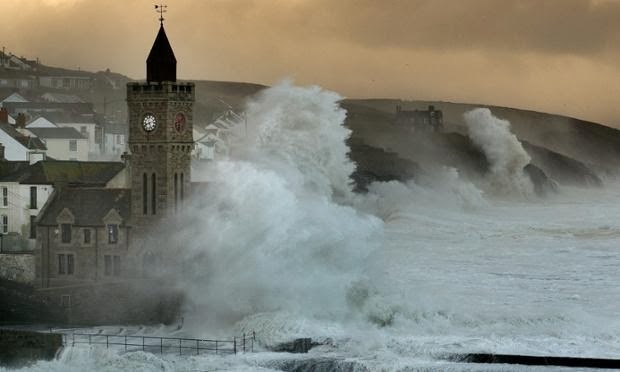
Well maybe we haven’t reached this stage yet but down here in the Westcountry, it’s all getting a little bit Biblical, and with a never-ending series of storms constantly battering out coastline from the Atlantic, it’s getting harder to believe that Spring should be just around the corner.

Porthleven, Cornwall (Source: The Guardian)
Dawlish seafront (Source: The Guardian)

We all woke up on Wednesday to heart-breaking scenes in Dawlish, the destruction of our iconic railway line, touted by many as the country’s most beautiful train ride.  Local travellers will tell you that “no two journeys are ever the same” along this stretch – the scenery changes by the minute, influenced by the position of the sun, the clouds, the weather, the seasons, the brooding moods of the Exe, the mist of the Teign, and the ever-menacing presence of the English Channel.  One day you’ll be waving to a family on a bucket-and-spade holiday, the next you’ll be jumping back as an angry wave smashes against the carriage window. 

Dawlish seafront (Source: The Guardian)
The railway at Dawlish (Source: The Daily Telegraph)

That rapid transformation perhaps best sums Devon up - taking a journey from Exeter to Newton Abbot on this line is like looking into the window of the county’s soul.  Sometimes calm, occasionally ferocious, ever beautiful, as gentle as innocent love, but with a cavalier streak that won’t hesitate to kill.  If you’re Devonian, the land – and the sea – will teach you to take the rough with the smooth, and thus we are a people brought up in tune with our surroundings – we respect it, we understand its power, we love it and we fear it, we wouldn’t change it for the world.

The most beautiful journey in England (Source: Dawlishwarren.info)

My thoughts and prayers go out to everyone affected by our terrible and destructive winter weather.  Good, hardworking people, whose homes are damaged, whose businesses have been swept away, whose livelihoods are now in jeopardy, from our county cousins on the Somerset Levels to our troubled friends in Cornwall, from Oddicombe beach to Exmouth seafront, up and down our coastline, in our estuaries and up our river valleys.  Winston Churchill once famously spoke over the wireless to a fallen France, and perhaps his words will resonate around our embattled county today, bringing with them some comfort for those affected, and some hope for the future:

“Good night then: sleep to gather strength for the morning.  For the morning will come.  Brightly will it shine on the brave and true, kindly upon all who suffer for the cause, glorious upon the tombs of heroes.  Thus will shine the dawn.”


Stay safe, Devon.  I'll see you in the morning.


Monday, 16 September 2013

Steam in the glasshouse, steam on the rails - It's 'otter along the Dart!

If you take a ten minute drive down the A38 from Teigngrace, you might just end up in a little town called Buckfastleigh.  At first glance, there isn’t much to keep the traveller in the little town for too long, but if you look again, you might just uncover a wonderful little world of intrigue, interest and conservation.

We roll up in my trusty little Toyota to what at first glance appears to be a fairground.  What is going on in this usually sleepy little corner of the county?  We find a space in the overflow carpark (courtesy of the traffic-controlling cadets) and make quietly for the otter sanctuary, a source of much delight for Lizzie and I in the past.  Inside, the spacious pens of Buckfastleigh’s well-loved otters lie in wonderfully natural conditions.  The otters, in one way or another, are all rescue creatures that, for various reasons, the sanctuary has been unable to release back into the wild.  One was a baby, swept away from its holt during the recent floods; another was unfortunately stuck in the waterwheel near Morrison’s supermarket in Totnes, and was injured.  Our arrival has coincided with the morning feed, so we are treated to a good talk from the expert keeper, who takes us from the Asian short-clawed to the North American, ending with our lovely native species.


Funnily enough, otters are not the only thing to be found at Buckfastleigh's Otter Sanctuary.  Inside the large glasshouse, cheerfully flapping in the heat and humidity, myriad perfectly formed butterflies flit from leaf to leaf, fruit to fruit.  Being careful not to step on any is quite a challenge, for they do seem to land anywhere and everywhere, including on your clothes, hair, and bag.  Through the middle of the glasshouse lies a pond, so we are also treated to enormous koi carp and sleepy terrapins, who cling to the edge of the water and bask in the heat, occasionally losing their grip and plopping straight in, with some comedy.  So hot is the glasshouse, my camera steams up almost as soon as we enter, hence the slightly hazy nature of the photos.


Back outside, and it turns out we have arrived – quite accidentally – in the middle of a vintage transport festival, enthusiasts out in full force to show off their perfectly-kept cars, or to photograph the shiny steam engines.  Following our visit to the otters, our destination is Totnes, which we intend to get to by the magical form of old steam train.  Our engine pulls into the intriguing little station – more a labour of love, of course, than anything that would function effectively nowadays (unless you’re from the Westcountry, then you may eye Buckfastleigh station with envy when compared to our unkempt and ramshackle modern mainline stops) – and we hop aboard, happily settling into our compartment, reminiscent of Agatha Christie’s murderous night on that famous Orient Express.  Talk about a timely service, within minutes we are chugging through River Dart country, rocking gently, enjoying the rural scenery pass us by at a more-than-acceptable relaxing speed.  I really like these old trains, their comfortable furnishing, their wood panels and doorframes, a glance around revealing not one hint of plastic in the entire carriage.


The ride to Totnes – which is the end of the line – takes not half an hour, and involves a stop at Staverton, from which many excited train spotters – all with massive cameras – can be seen.  When we alight at Totnes Littlehempston (yes, Totnes technically has two railway stations!), there is commotion aplenty, and you would be forgiven for thinking the 11.24 for London Paddington had just turned up.  It’s a heady mix of train spotters, locals and tourists on day trips, guards, luggage porters, even a man with an owl on his arm (a keeper from the nearby rare breeds farm) who has come to show the owl to the tourists, or perhaps the tourists to the owl, and to drum up some support for the farm, which lies just beyond the station.


And what a lovely little farm it is too!  We are given a free bag of animal feed on arrival, and Lizzie wastes no time letting the animals tuck in.  Around the site, we are treated to owls, goats, donkeys, alpacas, sheep, ducks, pigs, geese, hedgehogs, squirrels, guinea pigs, bantams, all manner of small and unusual creatures from the rarer gene pools of the world.  Even the most tiny of creatures had not been forgotten – indoors there are tiny harvest mice, whose nests stretch deep down inside glass-fronted cabinets, dotted with the occasional seed, and looking like the perfect winter retreat.


Rare breeds enjoyed, the food long gone, we stroll back to the station for the exciting return journey up the Dart valley.  Back at Buckfastleigh, there’s just enough time left to browse the railway museum, take in the classic cars, and spend a while watching my most favourite object of the moment, this beautiful carnival organ, which encapsulates a spirit of fun, humour and innocence that I thought was all-but-lost from this world.  It's an absolutely magical object to end an absolutely magical day, so why not play the video and enjoy the tunes yourself?


To see all the photos from our lovely day out along the Dart, click here

Sunday, 1 April 2012

Teigngrace Halt

Standing in the garden this week, I was struck by a sudden prolonged rumble cutting through the gentle birdsong. Stretching over the bank at the back of the house and peering through the bare trees, I saw the culprit; a freight train. The old railway line between Newton Abbot and Moretonhampstead had been closed for quite a few years, but the line up to Heathfield reopened for freight in 2011, bringing with it the occasional engine. Of course, it's all a far cry from the good old days, where passenger trains plied this route and the village of Teigngrace was connected to the great national rail network, but hearing the freight roll past certainly got my imagination going.

The station at Teigngrace came about under interesting circumstances. Initially it was decided that, due to the village's population, no station would be required. However, one of the conditions of the sale of the land to the Moretonhampstead and South Devon Railway was that the land owner, The Duke of Somerset, had the right to stop any train at the village when he wished to travel. it seemed sensible, therefore, to provide the village with a station, which opened in 1867.

Teigngrace Station had a 200-foot platform with a booking office and a lavatory, and remained in uninterrupted use until World War I, when it was closed as a cost-saving measure. It reopened after the war, but was demoted to a Halt in 1939, when a decision was taken to make it unstaffed. The halt was closed to passengers for good in 1959, and closed completely in 1962, a year before Doctor Beeching's report, The Reshaping of the British Railways, was published.

Below are some fascinating photographs of Teigngrace Station/Halt from its heyday, from the brilliant website Disused Stations (http://www.disused-stations.org.uk). I doubt I'm alone when I say I would love to see the halt operational again.

Teigngrace Halt in 1921

A steam train pulls into the Halt (unknown date)

Teigngrace Halt in 1965, after closure

The last special passenger train at Teigngrace in 1970

Teigngrace Halt in 2005, a shadow of its former self